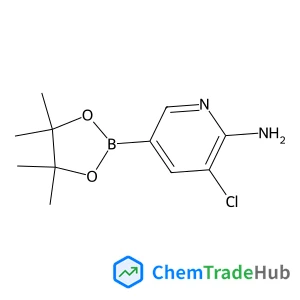
3-Chloro-5-(4,4,5,5-tetramethyl-1,3,2-dioxaborolan-2-yl)-2-pyridinamine
CAS Number:
1032758-99-8
Molecular Formula:
C11H16BClN2O2
Harry Ramanantoanina, Fanica Cimpoesu, Claude Daul
We discuss the applicability of the Angular Overlap Model (AOM) to evaluate the electronic structure of lanthanide compounds, which are currently the subject of incredible interest in the field of luminescent materials. The functioning of phosphors is well established by the f–d transitions, which requires the investigation of both the ground 4fn and excited 4fn−15d1 electron configurations of the lanthanides. The computational approach to the problem is based on the effective Hamiltonian adjusted from ligand field theory, but not restricted to it. The AOM parameterization implies the chemical bonding concept. Focusing our interest on this interaction, we take the advantages offered by modern computational tools to extract AOM parameters, which ensure the transparency of the theoretical determination and convey chemical intuitiveness of the non-empirical results. The given model contributes to the understanding of lanthanides in modern phosphors with high or low site symmetry and presents a non-empirical approach using a less sophisticated computational procedure for the rather complex problem of the ligand field of both 4f and 5d open shells.
Hong Chen
DOI: 10.1039/C7CP05557A
Qintang Li, Jiao Wang, Nana Lei, Minhao Yan, Xiao Chen
DOI: 10.1039/C8CP00001H
Wei-Wei Guo, Teng-Shuo Zhang, Wei-Hai Fang, Ganglong Cui
DOI: 10.1039/C7CP08696B
Carolyn E. Carr, Luis A. Marky
DOI: 10.1039/C7CP08329G
Yueying Chu, Xiuzhi Gao, Xin Zhang, Guangtong Xu
DOI: 10.1039/C8CP00946E
Sunghu Kim, Byung-Kuk Yoo, Yuri Choi, Oh-Hoon Kwon
DOI: 10.1039/C8CP01619D
S. Liu, D. Baugh, K. Motobayashi, X. Zhao, S. Gawinkowski, L. Grill, M. Persson, T. Kumagai
DOI: 10.1039/C8CP00178B
F. B. Haffner, N. Canilho, B. Medronho, C. Gardiennet, A. Gansmüller, A. Pasc
DOI: 10.1039/C8CP00073E
Alexander Schmid, Ghislain M. Rupp, Jürgen Fleig
DOI: 10.1039/C7CP07845E
This compound is mainly used as an intermediate in the synthesis of antipsychoti...
Waste containing 1-(D-Ribofuranosyl)-1,4-dihydro-3-pyridinecarboxamide (CAS: 191...
2-Methyl-2-propanyl 3-bromo-3-(hydroxymethyl)-1-azetidinecarboxylate (CAS: 20079...
N-(4-Chloro-2-pyridinyl)acetamide (CAS: 245056-66-0) is a chemical compound with...
5-Chloro-2-hydroxybenzoic acid, also known as 5-chlorosalicylic acid, is an arom...
When handling 1,1-Dichloro-1-fluoroethane (CAS: 1717-00-6), it is important to u...
Fmoc-(2S,3R)-3-phenylpyrrolidine-2-carboxylic acid is a white crystalline solid ...
4-Amino-5-bromo-2-pyridinecarboxylic acid is primarily used as a precursor in th...
Handling this compound should be done with personal protective equipment (PPE) i...
When handling 8-bromo-2,2-dimethyl-3,4-dihydro-2H-1,4-benzoxazin-3-one, use prop...

Physical Chemistry Chemical Physics (PCCP) is an international journal co-owned by 19 physical chemistry and physics societies from around the world. This journal publishes original, cutting-edge research in physical chemistry, chemical physics and biophysical chemistry. To be suitable for publication in PCCP, articles must include significant innovation and/or insight into physical chemistry; this is the most important criterion that reviewers and Editors will judge against when evaluating submissions. The journal has a broad scope and welcomes contributions spanning experiment, theory, computation and data science. Topical coverage includes spectroscopy, dynamics, kinetics, statistical mechanics, thermodynamics, electrochemistry, catalysis, surface science, quantum mechanics, quantum computing and machine learning. Interdisciplinary research areas such as polymers and soft matter, materials, nanoscience, energy, surfaces/interfaces, and biophysical chemistry are welcomed if they demonstrate significant innovation and/or insight into physical chemistry. Joined experimental/theoretical studies are particularly appreciated when complementary and based on up-to-date approaches.