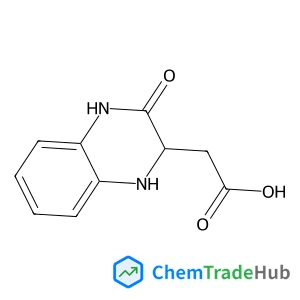
(3-Oxo-1,2,3,4-tetrahydro-2-quinoxalinyl)acetic acid
CAS Number:
136584-14-0
Molecular Formula:
C10H10N2O3
Sunghu Kim, Byung-Kuk Yoo, Yuri Choi, Oh-Hoon Kwon
Carbon dots (CDs) have potential applications in various fields such as energy, catalysis, and bioimaging due to their strong and tuneable photoluminescence (PL), low toxicity, and robust chemical inertness. Although several PL mechanisms have been proposed, the origin of PL in CDs is still in debate because of the ensembled nature of the heterogeneous luminophores present in the CDs. To unravel the origin of PL in CDs, we performed time-resolved spectroscopy on two types of CDs: nitrogen-doped (N-CD) and boron–nitrogen co-doped (BN-CD). The PL decays were fitted by stretched exponential functions to estimate the distribution of the decay kinetics in the CDs, which have different PL lifetime distributions. Both CDs displayed main, blue emission decaying in 15 ns, which originates from the dominant molecular state. The analysis of the non-exponential PL decay using stretched exponential fits revealed that the functional surface luminophores are of less variety but of more environmental heterogeneity and have much lower populations in BN-CD than in N-CD.
Gyan H. Aryal, Kenneth W. Hunter, Liming Huang
DOI: 10.1039/C8OB02180E
Jake C. Spiteri, Sergey A. Denisov, Gediminas Jonusauskas, Sylwia Klejna, Konrad Szaciłowski, Nathan D. McClenaghan, David C. Magri
DOI: 10.1039/C8OB00485D
Danil P. Zarezin, Olga I. Shmatova, Valentine G. Nenajdenko
DOI: 10.1039/C8OB01507D
Seong Nam, David C. Ware
DOI: 10.1039/C8OB00957K
Xinying Zhang, Xuesen Fan
DOI: 10.1039/C8OB01846D
Manthena Chaitanya, Pazhamalai Anbarasan
DOI: 10.1039/C8OB01770K
Mirela Matić, Bernard Denegri
DOI: 10.1039/C8OB00917A
Qinghe Gao, Yakun Wang, Qianqian Wang, Yanping Zhu, Zhaomin Liu, Jixia Zhang
DOI: 10.1039/C8OB02230E
Philip C. Bulman Page, Francesca S. Kinsey, Yohan Chan, Ian R. Strutt, Alexandra M. Z. Slawin, Garth A. Jones
DOI: 10.1039/C8OB01795F
Rei Saito, Naohiro Uemura, Hiroki Ishikawa, Akina Magara, Yoshio Kasashima
DOI: 10.1039/C8OB02066C
This compound is mainly used as an intermediate in the synthesis of antipsychoti...
Waste containing 1-(D-Ribofuranosyl)-1,4-dihydro-3-pyridinecarboxamide (CAS: 191...
2-Methyl-2-propanyl 3-bromo-3-(hydroxymethyl)-1-azetidinecarboxylate (CAS: 20079...
N-(4-Chloro-2-pyridinyl)acetamide (CAS: 245056-66-0) is a chemical compound with...
5-Chloro-2-hydroxybenzoic acid, also known as 5-chlorosalicylic acid, is an arom...
When handling 1,1-Dichloro-1-fluoroethane (CAS: 1717-00-6), it is important to u...
Fmoc-(2S,3R)-3-phenylpyrrolidine-2-carboxylic acid is a white crystalline solid ...
4-Amino-5-bromo-2-pyridinecarboxylic acid is primarily used as a precursor in th...
Handling this compound should be done with personal protective equipment (PPE) i...
When handling 8-bromo-2,2-dimethyl-3,4-dihydro-2H-1,4-benzoxazin-3-one, use prop...

Physical Chemistry Chemical Physics (PCCP) is an international journal co-owned by 19 physical chemistry and physics societies from around the world. This journal publishes original, cutting-edge research in physical chemistry, chemical physics and biophysical chemistry. To be suitable for publication in PCCP, articles must include significant innovation and/or insight into physical chemistry; this is the most important criterion that reviewers and Editors will judge against when evaluating submissions. The journal has a broad scope and welcomes contributions spanning experiment, theory, computation and data science. Topical coverage includes spectroscopy, dynamics, kinetics, statistical mechanics, thermodynamics, electrochemistry, catalysis, surface science, quantum mechanics, quantum computing and machine learning. Interdisciplinary research areas such as polymers and soft matter, materials, nanoscience, energy, surfaces/interfaces, and biophysical chemistry are welcomed if they demonstrate significant innovation and/or insight into physical chemistry. Joined experimental/theoretical studies are particularly appreciated when complementary and based on up-to-date approaches.
![Pyrazolo[1,5-a]pyridine-3-carbothioamide structure](https://static.chemtradehub.com/structs/885/885275-44-5-aae0.webp "Pyrazolo[1,5-a]pyridine-3-carbothioamide structure")