












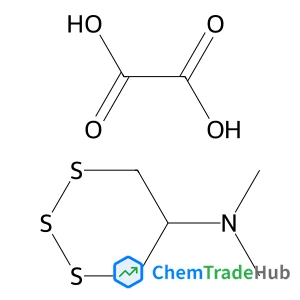
Oxalic acid compound with cyclohexylsulfamothioic O-acid (11)
CAS Number:
31895-22-4
Molecular Formula:
C7H13NO4S3
In this paper, horseradish peroxidase-mimicking DNAzyme (HRP-DNAzyme) and Prussian blue (PB)–gold (Au) nanocomposites were designed as versatile electrochemical sensing platforms for the amplified detection of DNA, Hg2+ and adenosine triphosphate (ATP). By the conjugation of the target probe with the capture probe, a conformational change resulted in the formation of HRP-DNAzyme on the PB–Au modified electrode. The redox of HRP-DNAzyme (red) was efficiently carried out in the presence of H2O2, in which PB acted as a mediator stimulating the biocatalytic functions of HRP-DNAzyme and actuated a catalytic cycle bringing an amplified signal. Specific recognition of the target DNA, Hg2+ and ATP allowed selective amperometric detection of the target molecule. The detection limits of DNA, Hg2+ and ATP were 50 nM, 30 pM and 3 nM, respectively. The highlight of this work is that the catalytic cycle between PB–Au nanocomposites and HRP-DNAzyme was adequately utilized in the amplification platform for versatile sensing. The novel electrocatalytic biosensor involving only one-step incubation exhibited a wide linear range, low detection limit, and satisfactory selectivity and operational stability. The proposed approach provided an ease-of-use and universal reporting system with a simple design and easy operations.
José M. Pedrosa, Marta Pérez, Inmaculada Prieto, María Teresa Martín-Romero, Dietmar Möbius, Luis Camacho
DOI: 10.1039/B108360K
Vincenza Crupi, A. Josè Dianoux, Domenico Majolino, Placido Migliardo, Valentina Venuti
DOI: 10.1039/B200115M
A. M. Tedeschi, G. D'Errico, E. Busi, R. Basosi, V. Barone
DOI: 10.1039/B106833D
DOI: 10.1039/B109911F
DOI: 10.1039/B110996K
R. K. Thomas
DOI: 10.1039/B108698G
Anthony Harriman, Annabelle Mayeux, Antoinette De Nicola, Raymond Ziessel
DOI: 10.1039/B109966N
Jana Chocholoušová, Jaroslav Vacek, Pavel Hobza
DOI: 10.1039/B110872G
M. J. Montenegro, M. Döbeli, T. Lippert, S. Müller, B. Schnyder, A. Weidenkaff, A. Wokaun
DOI: 10.1039/B200120A
A. Paladini, M. Satta, D. Catone, A. Filippi, S. Piccirillo, M. Speranza
DOI: 10.1039/B201347A
Waste containing (6-Bromo-2-naphthyl)oxy](dimethyl)(2-methyl-2-propanyl)silane (...
7-Fluoro-4-isoquinolinecarboxylic acid can be synthesized via a multi-step proce...
2,3,5,6-Tetrabromothieno[3,2-b]thiophene is a crystalline compound with a high m...
1-[4-(Benzylamino)-7,8-dihydro-5H-pyrano[4,3-d]pyrimidin-2-yl]-2-methyl-1H-indol...
The market for imidazo[5,1-d]-1,2,3,5-tetrazine-8-carboxylic acid, 3,4-dihydro-3...
3-(Triisopropylsilyl)propiolaldehyde is a synthetic organic compound with the CA...
6-Nitro-2H-1,4-benzoxazin-3(4H)-one (CAS: 81721-87-1) is subject to various regu...
Waste containing (3-Fluorophenyl)(4-{[(2-methyl-2-propanyl)oxy]carbonyl}-1-piper...
N,N'-4,4'-Biphenyldiyldiisonicotinamide is a white crystalline solid with a mole...
6-Bromo-8-fluoro-2-quinazolinol is primarily used in the pharmaceutical industry...

Analyst publishes analytical and bioanalytical research that reports premier fundamental discoveries and inventions, and the applications of those discoveries, unconfined by traditional discipline barriers.
![(2S)-2-({[(2-Methyl-2-propanyl)oxy]carbonyl}amino)-4-pentynoic acid structure](https://static.chemtradehub.com/structs/630/63039-48-5-b66d.webp "(2S)-2-({[(2-Methyl-2-propanyl)oxy]carbonyl}amino)-4-pentynoic acid structure")
![N-[(E)-Phenylmethylene]benzenesulfonamide structure](https://static.chemtradehub.com/structs/139/13909-34-7-8167.webp "N-[(E)-Phenylmethylene]benzenesulfonamide structure")





