













Electrochemical quantification of iodide ions in synthetic urine using silver nanoparticles: a proof-of-concept
Literature Information
Publication Date
2014-06-12
DOI
10.1039/C4AN00741G
Impact Factor
4.616
Authors
Her Shuang Toh, Kristina Tschulik, Christopher Batchelor-McAuley, Richard G. Compton
View Original
Abstract
Typical urinary iodide concentrations range from 0.3 μM to 6.0 μM. The conventional analytical method is based on the Sandell–Kolthoff reaction. It involves the toxic reagent, arsenic acid, and a waiting time of 30 minutes for the iodide ions to reduce the cerium(IV) ions. In the presented work, an alternative fast electrochemical method based on a silver nanoparticle modified electrode is proposed. Cyclic voltammetry was performed with a freshly modified electrode in presence of iodide ions and the voltammetric peaks corresponding to the oxidation of silver to silver iodide and the reverse reaction were recorded. The peak height of the reduction signal of silver iodide was used to plot a calibration line for the iodide ions. Two calibration plots for the iodide ions were obtained, one in 0.1 M sodium nitrate (a chloride-ion free environment to circumvent any interference from the other halides) and another in synthetic urine (which contains 0.2 M KCl). In both of the calibration plots, linear relationships were found between the reduction peak height and the iodide ion concentration of 0.3 μM to 6.0 μM. A slope of 1.46 × 10⁻² A M−1 and a R2 value of 0.999 were obtained for the iodide detection in sodium nitrate. For the synthetic urine experiments, a slope of 3.58 × 10⁻³ A M−1 and a R2 value of 0.942 were measured. A robust iodide sensor with the potential to be developed into a point-of-care system has been validated.
Related Literature
Spectral properties of a fluorescing molecule within a spherical metallic nanocavity
Jörg Enderlein
2002-05-07
Paper
DOI: 10.1039/B200502F
Black body radiation induced hydrogen formation in hydrated vanadium cations V+(H2O)n
Brigitte S. Fox, Iulia Balteanu, O. Petru Balaj, Haichuan Liu, Martin K. Beyer, Vladimir E. Bondybey
2002-05-01
Paper
DOI: 10.1039/B110849B
Mechanism of the reaction of OH radicals with acetone and acetaldehyde at 251 and 296 K
Geoffrey S. Tyndall, John J. Orlando, Timothy J. Wallington, Michael D. Hurley, Masashi Goto, Masahiro Kawasaki
2002-04-25
Paper
DOI: 10.1039/B111195G
Potential energy and free energy surfaces of the formic acid dimer: Correlated ab initio calculations and molecular dynamics simulations
Jana Chocholoušová, Jaroslav Vacek, Pavel Hobza
2002-04-22
Paper
DOI: 10.1039/B110872G
Phase behaviour of room temperature ionic liquid solutions: an unusually large co-solvent effect in (water + ethanol)
Vesna Najdanovic-Visak, José M. S. S. Esperança, Luís P. N. Rebelo, Manuel Nunes da Ponte, Henrique J. R. Guedes, Kenneth R. Seddon, Jerzy Szydlowski
2002-04-02
Communication
DOI: 10.1039/B201723G
Active sites on an oxidecatalyst for F/Cl-exchange reactions: X-ray spectroscopy of fluorinated γ-Al2O3
Wolfgang E. S. Unger, Erhard Kemnitz, Sven L. M. Schroeder
2002-05-09
Paper
DOI: 10.1039/B110792E
Laser spectroscopy of 1,2,3,4-tetrahydro-1-naphthol·ROH (R = H, CH3) clusters
A. Paladini, M. Satta, D. Catone, A. Filippi, S. Piccirillo, M. Speranza
2002-05-16
Paper
DOI: 10.1039/B201347A
Microspectroscopy at a moving reduction front in zirconia solid electrolyte
B. Luerßen, J. Janek, S. Günther, M. Kiskinova, R. Imbihl
2002-05-14
Paper
DOI: 10.1039/B109893D
Dynamical response of liquid water in confined geometry by laser and neutron spectroscopies
Vincenza Crupi, A. Josè Dianoux, Domenico Majolino, Placido Migliardo, Valentina Venuti
2002-05-14
Paper
DOI: 10.1039/B200115M
Kinetics of gas phase reactions of OH and Cl with aromatic aldehydes
2002-04-23
Paper
DOI: 10.1039/B200609J
You might also like
Compound Q&A
How should waste containing (6-Bromo-2-naphthyl)oxy](dimethyl)(2-methyl-2-propanyl)silane be handled?
Waste containing (6-Bromo-2-naphthyl)oxy](dimethyl)(2-methyl-2-propanyl)silane (...
100751-65-3[(6-Bromo-2-naphthyl...
Compound Q&A
How is 7-Fluoro-4-isoquinolinecarboxylic acid (CAS: 1841081-40-0) typically synthesized?
7-Fluoro-4-isoquinolinecarboxylic acid can be synthesized via a multi-step proce...
1841081-40-07-Fluoro-4-isoquinol...
Compound Q&A
What are the physical and chemical properties of 2,3,5,6-Tetrabromothieno[3,2-b]thiophene (CAS: 124638-53-5)?
2,3,5,6-Tetrabromothieno[3,2-b]thiophene is a crystalline compound with a high m...
124638-53-52,3,5,6-Tetrabromoth...
Compound Q&A
Is 1-[4-(Benzylamino)-7,8-dihydro-5H-pyrano[4,3-d]pyrimidin-2-yl]-2-methyl-1H-indole-4-carboxamide (CAS: 1542705-92-9) safe?
1-[4-(Benzylamino)-7,8-dihydro-5H-pyrano[4,3-d]pyrimidin-2-yl]-2-methyl-1H-indol...
1542705-92-91-[4-(Benzylamino)-7...
Compound Q&A
What is the market or research trend for imidazo[5,1-d]-1,2,3,5-tetrazine-8-carboxylic acid, 3,4-dihydro-3-methyl-4-oxo- (CAS: 113942-30-6)?
The market for imidazo[5,1-d]-1,2,3,5-tetrazine-8-carboxylic acid, 3,4-dihydro-3...
113942-30-6Imidazo[5,1-d]-1,2,3...
Compound Q&A
What is 3-(Triisopropylsilyl)propiolaldehyde (CAS: 163271-80-5)?
3-(Triisopropylsilyl)propiolaldehyde is a synthetic organic compound with the CA...
163271-80-53-(Triisopropylsilyl...
Compound Q&A
What regulatory guidelines apply to 6-Nitro-2H-1,4-benzoxazin-3(4H)-one (CAS: 81721-87-1)?
6-Nitro-2H-1,4-benzoxazin-3(4H)-one (CAS: 81721-87-1) is subject to various regu...
81721-87-16-Nitro-2H-1,4-benzo...
Compound Q&A
How should waste containing (3-Fluorophenyl)(4-{[(2-methyl-2-propanyl)oxy]carbonyl}-1-piperazinyl)acetic acid (CAS: 885272-91-3) be handled?
Waste containing (3-Fluorophenyl)(4-{[(2-methyl-2-propanyl)oxy]carbonyl}-1-piper...
885272-91-3(3-Fluorophenyl)(4-{...
Compound Q&A
What are the physical and chemical properties of N,N'-4,4'-Biphenyldiyldiisonicotinamide (CAS: 55119-40-9)?
N,N'-4,4'-Biphenyldiyldiisonicotinamide is a white crystalline solid with a mole...
55119-40-9N,N'-4,4'-Biphenyldi...
Compound Q&A
What industries use 6-Bromo-8-fluoro-2-quinazolinol (CAS: 1036756-15-6)?
6-Bromo-8-fluoro-2-quinazolinol is primarily used in the pharmaceutical industry...
1036756-15-66-Bromo-8-fluoro-2-q...
Source Journal
Analyst

CiteScore:
7.8
Self-citation Rate:
5.6%
Articles per Year:
653
Analyst publishes analytical and bioanalytical research that reports premier fundamental discoveries and inventions, and the applications of those discoveries, unconfined by traditional discipline barriers.
Recommended Compounds
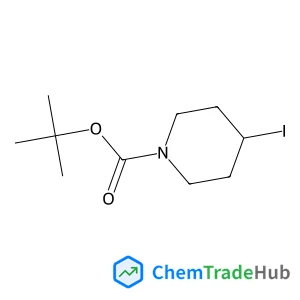
2-Methyl-2-propanyl 4-iodo-1-piperidinecarboxylate
CAS Number:
301673-14-3
Molecular Formula:
C10H18INO2
![5-Bromoimidazo[1,2-a]pyridine structure](https://static.chemtradehub.com/structs/692/69214-09-1-d8e2.webp "5-Bromoimidazo[1,2-a]pyridine structure")

Recommended Suppliers






Disclaimer
This page provides academic journal information for reference and research purposes only. We are not affiliated with any journal publishers and do not handle publication submissions. For publication-related inquiries, please contact the respective journal publishers directly.
If you notice any inaccuracies in the information displayed, please contact us at support@chemtradehub.com. We will promptly review and address your concerns.