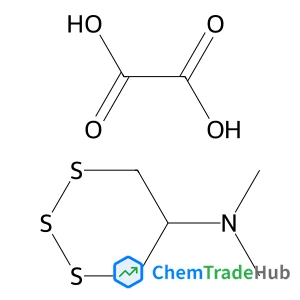
Oxalic acid compound with cyclohexylsulfamothioic O-acid (11)
CAS Number:
31895-22-4
Molecular Formula:
C7H13NO4S3
K. Melzer, A. M. Münzer, E. Jaworska, K. Maksymiuk, A. Michalska, G. Scarpa
In this work the ion-selective response of an electrolyte-gated carbon-nanotube field-effect transistor (CNT-FET) towards K+, Ca2+ and Cl− in the biologically relevant concentration range from 10−1 M to 10−6 M is demonstrated. The ion-selective response is achieved by modifying the gate-electrode of an electrolyte-gated CNT-FET with ion-selective membranes, which are selective towards the respective target analyte ions. The selectivity, assured by the ion-selective poly(vinyl chloride) based membrane, allows the successful application of the herein proposed K+-selective CNT-FET to detect changes in the K+ activity in the μM range even in solutions containing different ionic backgrounds. The sensing mechanism relies on a superposition of both an ion-sensitive response of the CNT-network as well as a change of the effective gate potential present at the semiconducting channel due to a selective and ion activity-dependent response of the membrane towards different types of ions. Moreover, the combination of a CNT-FET as a transducing element gated with an ion-selective coated-wire electrode offers the possibility to miniaturize the already well-established conventional ion-selective electrode setup. This approach represents a valuable strategy for the realization of portable, multi-purpose and low-cost biosensing devices.
Lavina C. Snoek, Romano T. Kroemer, John P. Simons
DOI: 10.1039/B200059H
A. Morresi, M. Ombelli, P. Sassi
DOI: 10.1039/B110225G
Vesna Najdanovic-Visak, José M. S. S. Esperança, Luís P. N. Rebelo, Manuel Nunes da Ponte, Henrique J. R. Guedes, Kenneth R. Seddon, Jerzy Szydlowski
DOI: 10.1039/B201723G
Karlheinz Hoyermann, Bettina Jürges
DOI: 10.1039/B111643F
F. A. Viva, E. M. Andrade, M. I. Florit, F. V. Molina
DOI: 10.1039/B110705D
Helena C. Junqueira, Divinomar Severino, Luis G. Dias, Marcos S. Gugliotti, Mauricio S. Baptista
DOI: 10.1039/B109753A
A. Paladini, M. Satta, D. Catone, A. Filippi, S. Piccirillo, M. Speranza
DOI: 10.1039/B201347A
M. Fernández-García, A. Martínez-Arias, A. B. Hungría, A. Iglesias-Juez, J. C. Conesa, J. Soria
DOI: 10.1039/B110811E
DOI: 10.1039/B111437A
Waste containing (6-Bromo-2-naphthyl)oxy](dimethyl)(2-methyl-2-propanyl)silane (...
7-Fluoro-4-isoquinolinecarboxylic acid can be synthesized via a multi-step proce...
2,3,5,6-Tetrabromothieno[3,2-b]thiophene is a crystalline compound with a high m...
1-[4-(Benzylamino)-7,8-dihydro-5H-pyrano[4,3-d]pyrimidin-2-yl]-2-methyl-1H-indol...
The market for imidazo[5,1-d]-1,2,3,5-tetrazine-8-carboxylic acid, 3,4-dihydro-3...
3-(Triisopropylsilyl)propiolaldehyde is a synthetic organic compound with the CA...
6-Nitro-2H-1,4-benzoxazin-3(4H)-one (CAS: 81721-87-1) is subject to various regu...
Waste containing (3-Fluorophenyl)(4-{[(2-methyl-2-propanyl)oxy]carbonyl}-1-piper...
N,N'-4,4'-Biphenyldiyldiisonicotinamide is a white crystalline solid with a mole...
6-Bromo-8-fluoro-2-quinazolinol is primarily used in the pharmaceutical industry...

Analyst publishes analytical and bioanalytical research that reports premier fundamental discoveries and inventions, and the applications of those discoveries, unconfined by traditional discipline barriers.
![5-Bromoimidazo[1,2-a]pyridine structure](https://static.chemtradehub.com/structs/692/69214-09-1-d8e2.webp "5-Bromoimidazo[1,2-a]pyridine structure")
![(2S)-2-({[(2-Methyl-2-propanyl)oxy]carbonyl}amino)-4-pentynoic acid structure](https://static.chemtradehub.com/structs/630/63039-48-5-b66d.webp "(2S)-2-({[(2-Methyl-2-propanyl)oxy]carbonyl}amino)-4-pentynoic acid structure")