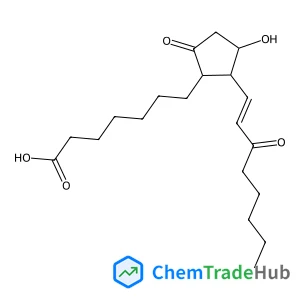
(11alpha,13E)-11-Hydroxy-9,15-dioxoprost-13-en-1-oic acid
CAS Number:
22973-19-9
Molecular Formula:
C20H32O5
Wei Teng Neo, Lee May Loo, Jing Song, Xiaobai Wang, Ching Mui Cho, Hardy Sze On Chan, Yun Zong
A series of donor–acceptor type electrochromic (EC) conjugated polymers P1–P4, poly(4,7-bis(3′,4′-ethylenedioxythiophen-2′-yl)-2-alkylbenzotriazole-5′,5′-diyl-alt-(3,4-dialkoxy-thiophen-2,5-diyl), was synthesized via a Stille coupling reaction. The polymers were characterized by gel permeation chromatography (GPC), nuclear magnetic resonance spectroscopy (NMR), thermogravimetric analysis (TGA) and differential scanning calorimetry (DSC). The electrochemical, spectroelectrochemical and EC properties of the polymers were studied. The polymers displayed improved solubility in common organic solvents. Upon oxidation, the polymers switched from a saturated blue to a transmissive light blue state. In particular, P4 exhibited exceptional optical contrasts of 46% and 72% in the visible and near-infrared regions, respectively. Furthermore, the effects of the side chains on the EC properties were examined and the results revealed that polymers with a long alkyl chain in the benzotriazole moiety had faster switching speed both in the visible and near infrared regions in the polymer film state. The absorption–transmission ECDs were fabricated, revealing that under ambient conditions and without any encapsulation of ECDs, the polymers exhibited good optical contrasts and coloration efficiencies with improved stability.
Justyna Kozłowska, Marta Chołuj, Robert Zaleśny, Wojciech Bartkowiak
DOI: 10.1039/C6CP07368A
DOI: 10.1039/C7CP03695G
Gilles Frapper
DOI: 10.1039/C6CP08708F
Wenting Zhang, Chaoyuan Zhu
DOI: 10.1039/C7CP04376G
DOI: 10.1039/C7CP05102F
Eric R. Kennehan, Christopher Grieco, Alyssa N. Brigeman, Adam Rimshaw, Kayla Bisgaier, Noel C. Giebink
DOI: 10.1039/C7CP04819J
DOI: 10.1039/C7CP01985H
Srashti Gupta, Sanjeev K. Srivastava, Sankarakumar Amrithapandian, Tripurari S. Tripathi, Surya K. Tripathi, Chung-Li Dong, Chi-Liang Chen, Devesh K. Avasthi, Kandasami Asokan
DOI: 10.1039/C7CP03527F
Rakesh Gupta, Nishi Kashyap, Beena Rai
DOI: 10.1039/C6CP08775B
6-(3-Fluorophenyl)picolinic acid is generally considered safe for laboratory use...
(3R)-3-Pyrrolidinol is used in the pharmaceutical industry as a precursor for dr...
When handling (4R,5R)-4,5-Diethoxycarbonyl-2,2-dimethyldioxolane (CAS: 59779-75-...
1-(6-Chloroimidazo[1,2-b]pyridazin-3-yl)ethanone is often synthesized via a mult...
The market for N-Ethyl-3,4-dimethylbenzylamine (CAS: 39180-83-1) remains steady,...
Tert-butyl 3-(pyrrolidin-1-yl)azetidine-1-carboxylate is a chemical compound wit...
1-Bromo-3-chloro-2,4-dimethoxybenzene (CAS: 1228956-93-1) falls under the classi...
The safety of 8-Bromo-2-methyl-3,4-dihydroisoquinolin-1(2H)-one (CAS: 1368622-07...
Benzyl [(3S)-2,6-dioxo-3-piperidinyl]carbamate is generally safe when handled wi...
1-{[4-(4,4,5,5-Tetramethyl-1,3,2-dioxaborolan-2-yl)phenyl]sulfonyl}pyrrolidine s...

Polymer Chemistry welcomes submissions in all areas of polymer science that have a strong focus on macromolecular chemistry. Manuscripts may cover a broad range of fields, yet no direct application focus is required.
![2-[({[(2-Methyl-2-propanyl)oxy]carbonyl}amino)methyl]isonicotinic acid structure](https://static.chemtradehub.com/structs/473/473924-63-9-973b.webp "2-[({[(2-Methyl-2-propanyl)oxy]carbonyl}amino)methyl]isonicotinic acid structure")