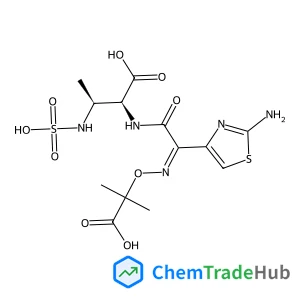
Aztreonam USP Related Compound A (Open-ring Aztreonam)
CAS Number:
87500-74-1
Molecular Formula:
C13H19N5O9S2
Srashti Gupta, Sanjeev K. Srivastava, Sankarakumar Amrithapandian, Tripurari S. Tripathi, Surya K. Tripathi, Chung-Li Dong, Chi-Liang Chen, Devesh K. Avasthi, Kandasami Asokan
Skutterudites are emerging as potential candidates that show high efficiency and thus provide an ideal platform for research. The properties of nanostructured films of skutterudites are different from those of the corresponding bulk. The present study reports the evolution of nanostructured single-phase CoSb3 fabricated by using low-energy ion irradiation of Co/Sb bilayer films and subsequent annealing at an optimized temperature and their Seebeck coefficients (S). The effects of ion beam parameters with annealing on the phase evolution and nanostructure modifications were studied. An increase in Xe+ ion fluence resulted in complete mixing of Co/Sb on postannealing forming flower-like nanostructures of single phase CoSb3. The temperature-dependent electrical resistivity (ρ) increases with the ion fluence because of defect creation which further increases on postannealing due to surface nanostructuring. The S of these films of CoSb3 is found to be higher and this is attributed to the formation of a uniform layer of nanostructured CoSb3 alloy thin film. The S and Hall coefficients of all these films are negative implying that they are n-type semiconductors.
Tanay Kesharwani, Justin S. Valenstein, Brian G. Trewyn, Fengkui Li, Victor S.-Y. Lin, Richard C. Larock
DOI: 10.1039/C0PY00145G
Mathias Glassner, Jana Falkenhagen, Christopher Barner-Kowollik
DOI: 10.1039/B9PY00273A
Sharon K. Hamilton, Artez L. Sims, Jenna Donavan, Eva Harth
DOI: 10.1039/C0PY00342E
Nicola Vinson, Yanzi Gou, C. Remzi Becer, David M. Haddleton, Matthew I. Gibson
DOI: 10.1039/C0PY00260G
Xuewu Ge, Mozhen Wang, Jianjun Yang, Qingyun Wu, Mingyuan Wu, Dandan Xu
DOI: 10.1039/C0PY00320D
Charlotte Juel Fristrup, Katja Jankova, Søren Hvilsted
DOI: 10.1039/C0PY00142B
Jennifer R. Lowe, Mark T. Martello, William B. Tolman, Marc A. Hillmyer
DOI: 10.1039/C0PY00283F
Martin E. Levere, Ian Willoughby, Stephen O'Donohue, Anne de Cuendias, Anthony J. Grice, Christopher Fidge, C. Remzi Becer, David M. Haddleton
DOI: 10.1039/C0PY00113A
Miaojun Ding
DOI: 10.1039/C0PY00194E
6-(3-Fluorophenyl)picolinic acid is generally considered safe for laboratory use...
(3R)-3-Pyrrolidinol is used in the pharmaceutical industry as a precursor for dr...
When handling (4R,5R)-4,5-Diethoxycarbonyl-2,2-dimethyldioxolane (CAS: 59779-75-...
1-(6-Chloroimidazo[1,2-b]pyridazin-3-yl)ethanone is often synthesized via a mult...
The market for N-Ethyl-3,4-dimethylbenzylamine (CAS: 39180-83-1) remains steady,...
Tert-butyl 3-(pyrrolidin-1-yl)azetidine-1-carboxylate is a chemical compound wit...
1-Bromo-3-chloro-2,4-dimethoxybenzene (CAS: 1228956-93-1) falls under the classi...
The safety of 8-Bromo-2-methyl-3,4-dihydroisoquinolin-1(2H)-one (CAS: 1368622-07...
Benzyl [(3S)-2,6-dioxo-3-piperidinyl]carbamate is generally safe when handled wi...
1-{[4-(4,4,5,5-Tetramethyl-1,3,2-dioxaborolan-2-yl)phenyl]sulfonyl}pyrrolidine s...

Physical Chemistry Chemical Physics (PCCP) is an international journal co-owned by 19 physical chemistry and physics societies from around the world. This journal publishes original, cutting-edge research in physical chemistry, chemical physics and biophysical chemistry. To be suitable for publication in PCCP, articles must include significant innovation and/or insight into physical chemistry; this is the most important criterion that reviewers and Editors will judge against when evaluating submissions. The journal has a broad scope and welcomes contributions spanning experiment, theory, computation and data science. Topical coverage includes spectroscopy, dynamics, kinetics, statistical mechanics, thermodynamics, electrochemistry, catalysis, surface science, quantum mechanics, quantum computing and machine learning. Interdisciplinary research areas such as polymers and soft matter, materials, nanoscience, energy, surfaces/interfaces, and biophysical chemistry are welcomed if they demonstrate significant innovation and/or insight into physical chemistry. Joined experimental/theoretical studies are particularly appreciated when complementary and based on up-to-date approaches.
![Benzyl spiro[indole-3,4'-piperidine]-1(2H)-carboxylate hydrochloride (1:1) structure](https://static.chemtradehub.com/structs/159/159635-46-8-8de0.webp "Benzyl spiro[indole-3,4'-piperidine]-1(2H)-carboxylate hydrochloride (1:1) structure")