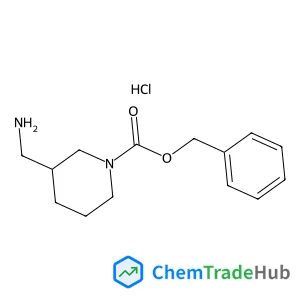
Benzyl 3-(aminomethyl)piperidine-1-carboxylate hydrochloride
CAS Number:
1186663-23-9
Molecular Formula:
C14H21ClN2O2
Xiuyu Jiang, Guolin Lu, Chun Feng, Yongjun Li, Xiaoyu Huang
Stimuli-responsive polymers have undoubtedly been of great interest in the past few decades due to a variety of potential applications in biomedical territory. Herein, we report a novel dual-stimuli responsive double hydrophilic graft copolymer system, poly(acrylic acid)-g-poly(N-vinylcaprolactam) (PAA-g-PNVCL), which could respond to changes in pH and temperature simultaneously. In our design, poly(acrylic acid) (PAA) was selected as a pH-sensitive moiety, whereas poly(N-vinylcaprolactam) (PNVCL) could be regarded as a thermo-sensitive one. The responsiveness of PAA-g-PNVCL to pH and temperature by itself was demonstrated in detail primarily: dynamic light scattering (DLS), fluorescence spectroscopy, and transmission electron microscopy (TEM) were employed to examine its pH-induced micellization behavior; 1H NMR, DLS, and TEM were employed to examine its thermo-induced micellization behavior. Finally, its responsiveness to the combination of both stimuli was studied by UV-vis test.
Binita Pathak, Goutam Prasanna Kar, Suryasarathi Bose, Saptarshi Basu
DOI: 10.1039/C7CP03621C
Nathalie Minko Ito, Waldemir Moura Carvalho, Jr, Dereck Nills Ferreira Muche, Ricardo Hauch Ribeiro Castro, Gustavo Martini Dalpian
DOI: 10.1039/C7CP04827K
DOI: 10.1039/C7CP05102F
Christopher Copeland, Omkaran Menon, D. Majumdar, Szczepan Roszak, Jerzy Leszczynski
DOI: 10.1039/C7CP04224H
Sen Wang, Peng Sun, Rongrong Zhang, Ang Lu, Maili Liu, Lina Zhang
DOI: 10.1039/C6CP08744B
Jan Řezáč, Dana Natchigallová, Pavel Hobza
DOI: 10.1039/C7CP03763E
Lauri Hautala, Kari Jänkälä, Mikko-Heikki Mikkelä, Paavo Turunen, Nønne L. Prisle, Minna Patanen, Maxim Tchaplyguine, Marko Huttula
DOI: 10.1039/C7CP04398H
Jorge L. Cholula-Díaz, José Barzola-Quiquia, Marcelo Videa, Chunhai Yin, Pablo Esquinazi
DOI: 10.1039/C7CP04052K
Masaaki Fujii
DOI: 10.1039/C7CP03480F
6-(3-Fluorophenyl)picolinic acid is generally considered safe for laboratory use...
(3R)-3-Pyrrolidinol is used in the pharmaceutical industry as a precursor for dr...
When handling (4R,5R)-4,5-Diethoxycarbonyl-2,2-dimethyldioxolane (CAS: 59779-75-...
1-(6-Chloroimidazo[1,2-b]pyridazin-3-yl)ethanone is often synthesized via a mult...
The market for N-Ethyl-3,4-dimethylbenzylamine (CAS: 39180-83-1) remains steady,...
Tert-butyl 3-(pyrrolidin-1-yl)azetidine-1-carboxylate is a chemical compound wit...
1-Bromo-3-chloro-2,4-dimethoxybenzene (CAS: 1228956-93-1) falls under the classi...
The safety of 8-Bromo-2-methyl-3,4-dihydroisoquinolin-1(2H)-one (CAS: 1368622-07...
Benzyl [(3S)-2,6-dioxo-3-piperidinyl]carbamate is generally safe when handled wi...
1-{[4-(4,4,5,5-Tetramethyl-1,3,2-dioxaborolan-2-yl)phenyl]sulfonyl}pyrrolidine s...

Polymer Chemistry welcomes submissions in all areas of polymer science that have a strong focus on macromolecular chemistry. Manuscripts may cover a broad range of fields, yet no direct application focus is required.