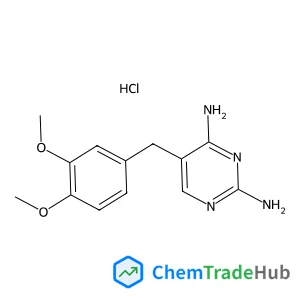
5-(3,4-Dimethoxybenzyl)-2,4-pyrimidinediamine hydrochloride (1:1)
CAS Number:
2507-23-5
Molecular Formula:
C13H17ClN4O2
Stergios Pispas
Amphiphilic diblock copolymers from ethylene oxide and 1,2-butene oxide or 1,2-hexene oxide monomers were synthesized by anionic ring-opening polymerization via the monomer activation methodology. Well defined block copolymers with predictable molecular weights and low polydispersities have been produced by starting the block copolymerization either from the hydrophilic or the hydrophobic monomer. The self-assembly behaviour of poly(ethylene oxide-b-hexene oxide) diblocks, containing segments with the more hydrophobic butyl side groups, was examined in aqueous solutions as a function of the block copolymer composition. Light scattering, atomic force microscopy and fluorescence spectroscopy measurements revealed the presence of self-organized nanostructures. The structure and properties of the nanoassemblies depend on the diblock copolymer composition and the solution preparation protocol.
Feiyan Zhu, Yongri Liang, Fuxin Liang, Qian Wang, Jiaoli Li, Zhibo Li, Zhenzhong Yang
DOI: 10.1039/C4PY00686K
Vincent Ladmiral, Thierry Lannuzel, Fabrice Domingues Dos Santos, Bruno Améduri
DOI: 10.1039/C6PY01874B
Marco Albuszis, Peter J. Roth, Werner Pauer, Hans-Ulrich Moritz
DOI: 10.1039/C4PY00709C
Hongyan Yao, Na Zhang, Ningning Song, Kunzhi Shen, Pengfei Huo, Shiyang Zhu, Yunhe Zhang, Shaowei Guan
DOI: 10.1039/C6PY01814A
Yaqing Qu, Fei Huo, Quanlong Li, Xin He, Shentong Li, Wangqing Zhang
DOI: 10.1039/C4PY00510D
Toyokazu Tsutsuba
DOI: 10.1039/C7PY00100B
Hui Zhou, Chuanguang Wu, Qiaolin Wu, Bixuan Guo, Wanting Liu, Guanghua Li, Ying Mu
DOI: 10.1039/C6PY01784C
Kai Zhang, Jiyu Fan, Michael J. Monteiro, Zhongfan Jia
DOI: 10.1039/C7PY00151G
Nicholas Ballard, Miren Aguirre, Alexandre Simula, Jose R. Leiza, José M. Asua
DOI: 10.1039/C7PY00067G
Ran Yu, Klaus Tauer
DOI: 10.1039/C4PY00458B
When considering alternatives to 1-(4-Chlorophenyl)-N-hydroxymethanimine (CAS: 3...
This compound should be stored in a cool, dry place away from direct sunlight. I...
3-(4-Bromophenyl)-5-(2-fluorophenyl)-1,2,4-oxadiazole is synthesized through a m...
5-Chloro-2-(4-chlorophenyl)-4-methyl-6-[3-(1-piperidinyl)propoxy]pyrimidine (CAS...
2-Chloro-4-(difluoromethoxy)pyridine is used in the pharmaceutical industry for ...
3-Chloro-6-methylpyridazine (CAS: 1121-79-5) is classified under the Globally Ha...
Several alternatives can be used in the synthesis of Methyl 4,5-dimethyl-2-nitro...
Alternatives to (2E,2'E)-3,3'-(1,4-Phenylene)bisacrylaldehyde include other acry...
3-Amino-5-chloropyridin-2-ol hydrochloride is an organic compound with the CAS n...
When handling 6,7-Difluoro-2,3-dihydro-4H-chromen-4-one, it is essential to wear...

Polymer Chemistry welcomes submissions in all areas of polymer science that have a strong focus on macromolecular chemistry. Manuscripts may cover a broad range of fields, yet no direct application focus is required.
![2-{[(1R,2S)-2-Aminocyclohexyl]amino}-4-{[3-(2H-1,2,3-triazol-2-yl)phenyl]amino}-5-pyrimidinecarboxamide structure](https://static.chemtradehub.com/structs/137/1370261-96-3-40df.webp "2-{[(1R,2S)-2-Aminocyclohexyl]amino}-4-{[3-(2H-1,2,3-triazol-2-yl)phenyl]amino}-5-pyrimidinecarboxamide structure")