













Fibril-shaped aggregates of doxorubicin with poly-l-lysine and its derivative
Literature Information
Publication Date
2014-06-10
DOI
10.1039/C4PY00686K
Impact Factor
5.582
Authors
Feiyan Zhu, Yongri Liang, Fuxin Liang, Qian Wang, Jiaoli Li, Zhibo Li, Zhenzhong Yang
View Original
Abstract
Complex formation between polymers and organic molecules is an interesting topic in polymer physics. Compared to the influence of small molecules on polymer assembly, there are fewer examples demonstrating the effect of polymers on the supramolecular structures formed by organic molecules. In this paper, we first prove that doxorubicin (DOX), a common anti-tumour drug, assembles into fibril-like aggregates in phosphate buffer (pH 7.4) and then show that the assembly of DOX was influenced by the complexation with an amphiphilic poly (amino acid) derivative, i.e. cholate-grafted poly-L-lysine (PLL-CA). With PLL-CA, the DOX fibrils converted to helix structured nano-spindles, whilst the presence of PLL led to minor change on the morphology of PLL/DOX complex compared to the DOX aggregates, which is attributed to the amplitude of intermolecular interactions. As a DNA intercalating agent, the aggregation of DOX on its biofunctionality was also investigated, showing that the formation of fibril assemblies was unfavourable for the cellular internalization of DOX and caused lower cytotoxicity to DOX resistance MCF-7 cells, whereas the polymer/DOX complexes gained an improved cell uptake on the MCF-7/ADR cell line due to an enhanced electrostatic interaction between the complexes and the cell membrane.
Recommended Journals
Related Literature
Unveiling the efficiency of microwave-assisted hydrothermal treatment for the preparation of SrTiO3 mesocrystals
Luís F. da Silva, Ariadne C. Catto, Waldir Avansi, Jr, Alexandre Mesquita, Lauro J. Q. Maia, Osmando F. Lopes, Máximo Siu Li, Mário L. Moreira, Elson Longo, Juan Andrés, Valmor R. Mastelaro
2019-09-16
Paper
DOI: 10.1039/C9CP02893E
Revealing the thermodynamics of individual catalytic steps based on temperature-dependent single-particle nanocatalysis
Tao Chen
2019-09-24
Paper
DOI: 10.1039/C9CP04538D
Cu/SAPO-34 prepared by a facile ball milling method for enhanced catalytic performance in the selective catalytic reduction of NOx with NH3
Huazhen Chang, Xuan Qin, Lei Ma, Tao Zhang, Junhua Li
2019-09-24
Paper
DOI: 10.1039/C9CP04519H
Effect of mild nanoscopic confinement on the dynamics of ionic liquids
Daria Noferini, Olaf Holderer, Henrich Frielinghaus
2020-04-09
Paper
DOI: 10.1039/C9CP05200C
Tailoring the structural and electronic properties of an SnSe2/MoS2 van der Waals heterostructure with an electric field and the insertion of a graphene sheet
Nguyen V. Hieu, Le T. P. Thao, Nguyen N. Hieu, Huynh V. Phuc, H. D. Bui, M. Idrees, B. Amin, Le M. Duc, Chuong V. Nguyen
2019-09-24
Paper
DOI: 10.1039/C9CP04689E
Mechanochemical reaction of Al and melamine: a potential approach towards the in situ synthesis of aluminum nitride–carbon nanotube nanocomposites
Seyyed Amin Rounaghi, Hossein Eshghi, Sergio Scudino, Elaheh Esmaeili, Ali-Reza Kiani-Rashid
2019-09-24
Paper
DOI: 10.1039/C9CP04577E
Recent progress in Pt and Pd-based hybrid nanocatalysts for methanol electrooxidation
2019-09-02
Perspective
DOI: 10.1039/C9CP03600H
Molecular mechanisms for thermal degradation of CO2-loaded aqueous monoethanolamine solution: a first-principles study
Bohak Yoon, Haley M. Stowe
2019-09-25
Paper
DOI: 10.1039/C9CP04518J
Dissociative chemisorption of O2 on Agn and Agn−1Ir (n = 3–26) clusters: a first-principle study
Chuangchuang Wang, Yongpeng Yang, Xiaojing Liu, Yuanjie Li, Dandan Song, Yun Tian, Zhaojun Zhang
2020-04-06
Paper
DOI: 10.1039/D0CP01005G
New insights into HER catalysis: the effect of nano-silica support on catalysis by silver nanoparticles
Gifty Sara Rolly, Guy Yardeni, Ronen Bar-Ziv, Tomer Zidki
2020-03-02
Paper
DOI: 10.1039/C9CP06820A
You might also like
Compound Q&A
What are the main uses of 4-Nitrophenyl phosphate disodium salt hexahydrate (CAS: 333338-18-4)?
4-Nitrophenyl phosphate disodium salt hexahydrate is primarily used as a substra...
333338-18-44-Nitrophenyl phosph...
Compound Q&A
What are the main uses of 2-(Trifluoromethyl)-1,3-oxazole-4-carboxylic Acid (CAS: 1060816-01-4)?
2-(Trifluoromethyl)-1,3-oxazole-4-carboxylic Acid (CAS: 1060816-01-4) is widely ...
1060816-01-42-(Trifluoromethyl)-...
Compound Q&A
How should 2-Fluoro-4-biphenylcarboxylic acid (CAS: 137045-30-8) be stored?
2-Fluoro-4-biphenylcarboxylic acid should be stored in a cool, dry place at room...
137045-30-82-Fluoro-4-biphenylc...
Compound Q&A
What industries use Prednisolone-21-Carboxylic Acid (CAS: 61549-70-0)?
Prednisolone-21-Carboxylic Acid is primarily used in the pharmaceutical industry...
61549-70-0Prednisolone-21-Carb...
Compound Q&A
How should 4-(Hydrazinomethyl)-1,2,3-benzenetriol (CAS: 3614-72-0) be stored?
4-(Hydrazinomethyl)-1,2,3-benzenetriol (CAS: 3614-72-0) should be stored in a co...
3614-72-04-(Hydrazinomethyl)-...
Compound Q&A
What industries use 4-Amino-1-methyl-1H-pyrazole-5-carboxylic acid hydrochloride (CAS: 92534-70-8)?
4-Amino-1-methyl-1H-pyrazole-5-carboxylic acid hydrochloride (CAS: 92534-70-8) i...
92534-70-84-Amino-1-methyl-1H-...
Compound Q&A
What regulatory guidelines apply to dehydropachymic acid (CAS: 77012-31-8)?
Dehydropachymic acid (CAS: 77012-31-8) is regulated by various agencies. It fall...
77012-31-8Dehydropachymic acid
Compound Q&A
What is the market or research trend for 6-[(2,2-Dimethylpropanoyl)amino]nicotinic acid (CAS: 898561-66-5)?
The market and research trends for 6-[(2,2-Dimethylpropanoyl)amino]nicotinic aci...
898561-66-56-[(2,2-Dimethylprop...
Compound Q&A
How should 1,10-Phenanthroline-2,9-dicarbaldehyde (CAS: 57709-62-3) be stored?
1,10-Phenanthroline-2,9-dicarbaldehyde should be stored in a cool, dry place awa...
57709-62-31,10-Phenanthroline-...
Compound Q&A
How is 5-Carbamoyl-11-oxo-10,11-dihydro-5H-dibenzo[b,f]azepin-10-yl acetate (CAS: 113952-21-9) typically synthesized?
5-Carbamoyl-11-oxo-10,11-dihydro-5H-dibenzo[b,f]azepin-10-yl acetate can be synt...
113952-21-95-Carbamoyl-11-oxo-1...
Source Journal
Polymer Chemistry

CiteScore:
8.6
Self-citation Rate:
7.3%
Articles per Year:
457
Polymer Chemistry welcomes submissions in all areas of polymer science that have a strong focus on macromolecular chemistry. Manuscripts may cover a broad range of fields, yet no direct application focus is required.
Recommended Compounds
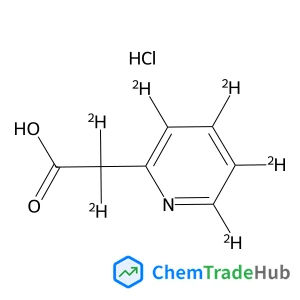
2,2-dideuterio-2-(3,4,5,6-tetradeuterio-2-pyridyl)acetic acid;hydrochloride
CAS Number:
1329799-67-8
Molecular Formula:
C7H2ClD6NO2
Recommended Suppliers





Disclaimer
This page provides academic journal information for reference and research purposes only. We are not affiliated with any journal publishers and do not handle publication submissions. For publication-related inquiries, please contact the respective journal publishers directly.
If you notice any inaccuracies in the information displayed, please contact us at support@chemtradehub.com. We will promptly review and address your concerns.