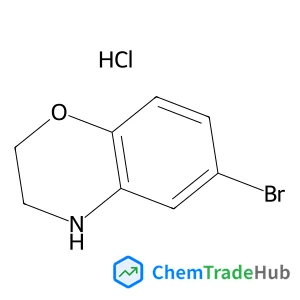
6-Bromo-3,4-dihydro-2H-1,4-benzoxazine hydrochloride (1:1)
CAS Number:
1260803-10-8
Molecular Formula:
C8H9BrClNO
Yaqing Qu, Fei Huo, Quanlong Li, Xin He, Shentong Li, Wangqing Zhang
RAFT polymerization of N-isopropylacrylamide under heterogeneous conditions in the presence of diblock copolymer nano-objects of polystyrene-block-poly(N,N-dimethylacrylamide) trithiocarbonate (PS-b-PDMA-TTC) with the Z-group RAFT terminal on the outer side of the solvophilic poly(N,N-dimethylacrylamide) (PDMA) block is performed. This heterogeneous RAFT polymerization, which is named seeded RAFT polymerization, affords the in situ synthesis of the polystyrene-block-poly(N,N-dimethylacrylamide)-block-poly(N-isopropylacrylamide) (PS-b-PDMA-b-PNIPAM) triblock terpolymer nano-objects. The molecular weight of the triblock terpolymer linearly increases with the monomer conversion during the seeded RAFT polymerization. The morphology of the PS-b-PDMA-b-PNIPAM triblock terpolymer nano-objects is merely duplicated from the seed of the PS-b-PDMA-TTC diblock copolymer, which is the binary mixture of nanospheres and nanorods, when the polymerization degree (DP) of the poly(N-isopropylacrylamide) (PNIPAM) block is low or moderately large. When the DP of the PNIPAM block is relatively large, the triblock terpolymer nanospheres are formed. The size of the PS-b-PDMA-b-PNIPAM triblock terpolymer nano-objects slightly increases initially and subsequently decreases with the monomer conversion during the seeded RAFT polymerization. In water at temperature above the phase-transition temperature (PTT) of the PNIPAM block, the PNIPAM chains deposit onto the polystyrene (PS) core to form the triblock terpolymer multicompartment nano-objects containing a microphase separated solvophobic core of PS/PNIPAM and a solvophilic PDMA corona. Our findings are anticipated to be useful in preparation of concentrated ABC triblock terpolymer nano-objects.
Naixia Lv, Linghao Sun, Linlin Chen, Yujun Li, Jinrui Zhang, Peiwen Wu, Hongping Li, Wenshuai Zhu, Huaming Li
DOI: 10.1039/C9CP03758F
Mohammad Hasani, Lars Nordstierna, Anna Martinelli
DOI: 10.1039/C9CP03563J
Baihui Lin, Hongxing Zhang
DOI: 10.1039/D0CP00763C
DOI: 10.1039/C9CP03953H
Ayana Tagawa, Toshiyuki Shikata
DOI: 10.1039/C9CP02500F
Alexandra Parmentier, Marco Maccarini, Alessio De Francesco, Luisa Scaccia, Giovanna Rogati, Orsolya Czakkel, Francesco De Luca
DOI: 10.1039/C9CP04248B
Xukun Feng, Jian Liu, Xikui Ma, Mingwen Zhao
DOI: 10.1039/C9CP06966F
Jo Hsueh Lee, Cheng-Hung Cheng, Bo-Rong Liao, Shi-Hsin Lin
DOI: 10.1039/C9CP06469A
Shuheng Huang
DOI: 10.1039/D0CP00382D
4-Nitrophenyl phosphate disodium salt hexahydrate is primarily used as a substra...
2-(Trifluoromethyl)-1,3-oxazole-4-carboxylic Acid (CAS: 1060816-01-4) is widely ...
2-Fluoro-4-biphenylcarboxylic acid should be stored in a cool, dry place at room...
Prednisolone-21-Carboxylic Acid is primarily used in the pharmaceutical industry...
4-(Hydrazinomethyl)-1,2,3-benzenetriol (CAS: 3614-72-0) should be stored in a co...
4-Amino-1-methyl-1H-pyrazole-5-carboxylic acid hydrochloride (CAS: 92534-70-8) i...
Dehydropachymic acid (CAS: 77012-31-8) is regulated by various agencies. It fall...
The market and research trends for 6-[(2,2-Dimethylpropanoyl)amino]nicotinic aci...
1,10-Phenanthroline-2,9-dicarbaldehyde should be stored in a cool, dry place awa...
5-Carbamoyl-11-oxo-10,11-dihydro-5H-dibenzo[b,f]azepin-10-yl acetate can be synt...

Polymer Chemistry welcomes submissions in all areas of polymer science that have a strong focus on macromolecular chemistry. Manuscripts may cover a broad range of fields, yet no direct application focus is required.
![(2E)-3-(3-Chlorophenyl)-N-{2-[4-(methylsulfonyl)-1-piperazinyl]-2-oxoethyl}acrylamide structure](https://static.chemtradehub.com/structs/250/2505001-54-5-c1e9.webp "(2E)-3-(3-Chlorophenyl)-N-{2-[4-(methylsulfonyl)-1-piperazinyl]-2-oxoethyl}acrylamide structure")
![[(1S,2S,3R,4S,7R,9S,10S,12R,15S)-4,12-Diacetyloxy-15-[(2R,3S)-3-benzamido-3-phenyl-2-(2,2,2-trichloroethoxycarbonyloxy)propanoyl]oxy-1,9-dihydroxy-10,14,17,17-tetramethyl-11-oxo-6-oxatetracyclo[11.3.1.03,10.04,7]heptadec-13-en-2-yl] benzoate structure](https://static.chemtradehub.com/structs/100/100431-55-8-7104.webp "[(1S,2S,3R,4S,7R,9S,10S,12R,15S)-4,12-Diacetyloxy-15-[(2R,3S)-3-benzamido-3-phenyl-2-(2,2,2-trichloroethoxycarbonyloxy)propanoyl]oxy-1,9-dihydroxy-10,14,17,17-tetramethyl-11-oxo-6-oxatetracyclo[11.3.1.03,10.04,7]heptadec-13-en-2-yl] benzoate structure")