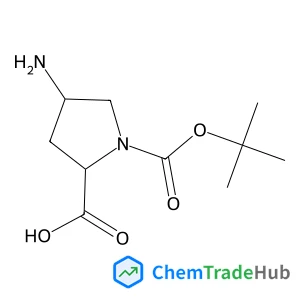
(2R,4R)-1-Boc-4-Aminopyrrolidine-2-carboxylic acid
CAS Number:
132622-98-1
Molecular Formula:
C10H18N2O4
Derek L. Patton, Kirt A. Page, Emily A. Hoff, Michael J. Fasolka, Kathryn L. Beers
This article describes a robust approach to measure monomer reactivity ratios from surface-initiated copolymerization, by measuring composition of statistical copolymer brush surfaces using X-ray photoelectron spectroscopy. Statistical copolymer brushes were prepared from various monomer feeds by surface-initiated radical copolymerization at room temperature under ultraviolet (UV) irradiation. The copolymer brush composition data were fit to the terminal copolymerization kinetic model resulting in point estimates for the monomer reactivity ratios that are in good agreement with values measured under bulk reaction conditions. Additionally, a high-throughput approach was demonstrated to measure reactivity ratios using a single substrate exhibiting a gradient in copolymer brush composition. This high-throughput approach significantly reduces the time and effort required to generate reliable and reproducible point estimates of reactivity ratios, and these values are in good agreement with values obtained from both the discrete sample surface measurements and classical bulk analytical methods.
Marco Albuszis, Peter J. Roth, Werner Pauer, Hans-Ulrich Moritz
DOI: 10.1039/C4PY00709C
Guo Wei, Yuliang Jiang, Fei Li, Yiwu Quan, Yixiang Cheng, Chengjian Zhu
DOI: 10.1039/C4PY00755G
Jaipal Gupta, Daniel J. Keddie, Chaoying Wan, David M. Haddleton, Tony McNally
DOI: 10.1039/C6PY00522E
Beiyue Shao, Xinju Zhu, Kyle N. Plunkett, David A. Vanden Bout
DOI: 10.1039/C6PY01871H
Graeme Moad, San H. Thang
DOI: 10.1039/C4PY00496E
Lucie Malosse, Etienne Duguet, Muriel Lansalot, Elodie Bourgeat-Lami, Serge Ravaine
DOI: 10.1039/C4PY00370E
Ana Cenacchi Perreira, Samuel Pearson, Franck D'Agosto, Muriel Lansalot, Elodie Bourgeat-Lami
DOI: 10.1039/C6PY01742H
Shinji Yamada, Akinori Takasu, Sadatsugu Takayama, Kazuhiko Kawamura
DOI: 10.1039/C4PY00639A
Nana Sun, Dongdong Qi, Jianzhuang Jiang
DOI: 10.1039/C4PY00512K
T. Suzuki, T. Moriya, R. Endo, N. Iwasaki
DOI: 10.1039/C6PY02036D
When considering alternatives to 1-(4-Chlorophenyl)-N-hydroxymethanimine (CAS: 3...
This compound should be stored in a cool, dry place away from direct sunlight. I...
3-(4-Bromophenyl)-5-(2-fluorophenyl)-1,2,4-oxadiazole is synthesized through a m...
5-Chloro-2-(4-chlorophenyl)-4-methyl-6-[3-(1-piperidinyl)propoxy]pyrimidine (CAS...
2-Chloro-4-(difluoromethoxy)pyridine is used in the pharmaceutical industry for ...
3-Chloro-6-methylpyridazine (CAS: 1121-79-5) is classified under the Globally Ha...
Several alternatives can be used in the synthesis of Methyl 4,5-dimethyl-2-nitro...
Alternatives to (2E,2'E)-3,3'-(1,4-Phenylene)bisacrylaldehyde include other acry...
3-Amino-5-chloropyridin-2-ol hydrochloride is an organic compound with the CAS n...
When handling 6,7-Difluoro-2,3-dihydro-4H-chromen-4-one, it is essential to wear...

Polymer Chemistry welcomes submissions in all areas of polymer science that have a strong focus on macromolecular chemistry. Manuscripts may cover a broad range of fields, yet no direct application focus is required.
![2-{[(1R,2S)-2-Aminocyclohexyl]amino}-4-{[3-(2H-1,2,3-triazol-2-yl)phenyl]amino}-5-pyrimidinecarboxamide structure](https://static.chemtradehub.com/structs/137/1370261-96-3-40df.webp "2-{[(1R,2S)-2-Aminocyclohexyl]amino}-4-{[3-(2H-1,2,3-triazol-2-yl)phenyl]amino}-5-pyrimidinecarboxamide structure")