


Synthesis of nanoscaled poly(styrene-co-n-butyl acrylate)/silica particles with dumbbell- and snowman-like morphologies by emulsion polymerization
Literature Information
Publication Date
2014-06-05
DOI
10.1039/C4PY00370E
Impact Factor
5.582
Authors
Lucie Malosse, Etienne Duguet, Muriel Lansalot, Elodie Bourgeat-Lami, Serge Ravaine
View Original
Abstract
Poly(styrene-co-n-butyl acrylate) (P(Sty-co-BuA)) nanoparticles having diameters in the range of 25–60 nm have been successfully synthesized via emulsion polymerization. Sodium styrene sulfonate (SSNa) was used as an ionic comonomer, sodium dodecyl sulfate as a surfactant and divinyl benzene (DVB) as a crosslinking agent. The average polymer particle diameter increased with decreasing the SSNa content in the feed, while increasing DVB concentrations increased the size polydispersity. Dumbbell- and snowman-like P(Sty-co-BuA)/silica biphasic nanoparticles with silica and polymer nodules smaller than typically 60 nm in diameter were obtained by introducing appropriate amounts of 3-(methacryloxy)propyl trimethoxysilane-functionalized silica nanoparticles as seeds in the emulsion polymerization reaction. Neither the quantity of the surfactant nor that of the coupling agent had a strong influence on the obtained morphologies. The control of the number of polymer nodules attached to the silica seed through the modulation of the quantity of silica was also limited, likely because of the low available surface area on each seed in the targeted size range. Consequently, silica–polymer biphasic particles with on average one, two or three polymer nodules at the most were obtained depending on the experimental conditions.
Recommended Journals

New Journal of Chemistry

Current Opinion in Colloid & Interface Science

Journal of Saudi Chemical Society

Saudi Pharmaceutical Journal

Journal of Natural Medicines

Chemical Communications

Russian Journal of Organic Chemistry

Russian Journal of General Chemistry

Russian Journal of Coordination Chemistry

Russian Journal of Applied Chemistry
Related Literature
The total dose effect of γ-ray induced domain evolution on α-In2Se3 nanoflakes
Jinbin Wang, Xiangli Zhong, Xiaoping Ouyang
2020-03-30
Communication
DOI: 10.1039/D0CP00512F
Automated exploration of the low-energy chemical space with fast quantum chemical methods
Philipp Pracht, Fabian Bohle, Stefan Grimme
2020-02-12
Paper
DOI: 10.1039/C9CP06869D
BAR-based multi-dimensional nonequilibrium pulling for indirect construction of QM/MM free energy landscapes: from semi-empirical to ab initio
2019-09-25
Paper
DOI: 10.1039/C9CP04113C
On the wetting translucency of hexagonal boron nitride
Enrique Wagemann, Yanbin Wang, Siddhartha Das, Sushanta K. Mitra
2020-02-27
Paper
DOI: 10.1039/D0CP00200C
Efficient thermal- and photocatalysts made of Au nanoparticles on MgAl-layered double hydroxides for energy and environmental applications
2019-09-16
Paper
DOI: 10.1039/C9CP04445K
Detailed mechanism and kinetics of the reaction of Criegee intermediate CH2OO with HCOOH investigated via infrared identification of conformers of hydroperoxymethyl formate and formic acid anhydride
Chen-An Chung, Jou Wei Su
2019-09-09
Paper
DOI: 10.1039/C9CP04168K
Ferroelectricity and multiferroicity in two-dimensional Sc2P2Se6 and ScCrP2Se6 monolayers
Xukun Feng, Jian Liu, Xikui Ma, Mingwen Zhao
2020-03-06
Paper
DOI: 10.1039/C9CP06966F
Neutron spin echo monitoring of segmental-like diffusion of water confined in the cores of carbon nanotubes
Alexandra Parmentier, Marco Maccarini, Alessio De Francesco, Luisa Scaccia, Giovanna Rogati, Orsolya Czakkel, Francesco De Luca
2019-09-11
Paper
DOI: 10.1039/C9CP04248B
Carbon sp chains in diamond nanocavities
Francesco Delodovici, Daniel S. Choi, Mohamed Al Fahim, Larry A. Burchfield, Nicola Manini
2019-09-18
Paper
DOI: 10.1039/C9CP03978C
Hydration structure and water exchange kinetics at xenotime–water interfaces: implications for rare earth minerals separation‡
Santanu Roy, Lili Wu, Sriram Goverapet Srinivasan, Andrew G. Stack, Alexandra Navrotsky, Vyacheslav S. Bryantsev
2020-02-26
Paper
DOI: 10.1039/D0CP00087F
You might also like
Compound Q&A
What are the main uses of 4-Nitrophenyl phosphate disodium salt hexahydrate (CAS: 333338-18-4)?
4-Nitrophenyl phosphate disodium salt hexahydrate is primarily used as a substra...
333338-18-44-Nitrophenyl phosph...
Compound Q&A
What are the main uses of 2-(Trifluoromethyl)-1,3-oxazole-4-carboxylic Acid (CAS: 1060816-01-4)?
2-(Trifluoromethyl)-1,3-oxazole-4-carboxylic Acid (CAS: 1060816-01-4) is widely ...
1060816-01-42-(Trifluoromethyl)-...
Compound Q&A
How should 2-Fluoro-4-biphenylcarboxylic acid (CAS: 137045-30-8) be stored?
2-Fluoro-4-biphenylcarboxylic acid should be stored in a cool, dry place at room...
137045-30-82-Fluoro-4-biphenylc...
Compound Q&A
What industries use Prednisolone-21-Carboxylic Acid (CAS: 61549-70-0)?
Prednisolone-21-Carboxylic Acid is primarily used in the pharmaceutical industry...
61549-70-0Prednisolone-21-Carb...
Compound Q&A
How should 4-(Hydrazinomethyl)-1,2,3-benzenetriol (CAS: 3614-72-0) be stored?
4-(Hydrazinomethyl)-1,2,3-benzenetriol (CAS: 3614-72-0) should be stored in a co...
3614-72-04-(Hydrazinomethyl)-...
Compound Q&A
What industries use 4-Amino-1-methyl-1H-pyrazole-5-carboxylic acid hydrochloride (CAS: 92534-70-8)?
4-Amino-1-methyl-1H-pyrazole-5-carboxylic acid hydrochloride (CAS: 92534-70-8) i...
92534-70-84-Amino-1-methyl-1H-...
Compound Q&A
What regulatory guidelines apply to dehydropachymic acid (CAS: 77012-31-8)?
Dehydropachymic acid (CAS: 77012-31-8) is regulated by various agencies. It fall...
77012-31-8Dehydropachymic acid
Compound Q&A
What is the market or research trend for 6-[(2,2-Dimethylpropanoyl)amino]nicotinic acid (CAS: 898561-66-5)?
The market and research trends for 6-[(2,2-Dimethylpropanoyl)amino]nicotinic aci...
898561-66-56-[(2,2-Dimethylprop...
Compound Q&A
How should 1,10-Phenanthroline-2,9-dicarbaldehyde (CAS: 57709-62-3) be stored?
1,10-Phenanthroline-2,9-dicarbaldehyde should be stored in a cool, dry place awa...
57709-62-31,10-Phenanthroline-...
Compound Q&A
How is 5-Carbamoyl-11-oxo-10,11-dihydro-5H-dibenzo[b,f]azepin-10-yl acetate (CAS: 113952-21-9) typically synthesized?
5-Carbamoyl-11-oxo-10,11-dihydro-5H-dibenzo[b,f]azepin-10-yl acetate can be synt...
113952-21-95-Carbamoyl-11-oxo-1...
Source Journal
Polymer Chemistry

CiteScore:
8.6
Self-citation Rate:
7.3%
Articles per Year:
457
Polymer Chemistry welcomes submissions in all areas of polymer science that have a strong focus on macromolecular chemistry. Manuscripts may cover a broad range of fields, yet no direct application focus is required.
Recommended Compounds
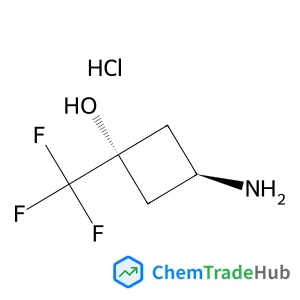
cis-3-Amino-1-(trifluoromethyl)cyclobutanol hydrochloride (1:1)
CAS Number:
1408075-16-0
Molecular Formula:
C5H9ClF3NO
![S-[2,3-Bis(palmitoyloxy)propyl]-N-[(9H-fluoren-9-ylmethoxy)(hydroxy)methylene]cysteine structure](https://static.chemtradehub.com/structs/210/210532-98-2-f6a7.webp "S-[2,3-Bis(palmitoyloxy)propyl]-N-[(9H-fluoren-9-ylmethoxy)(hydroxy)methylene]cysteine structure")
S-[2,3-Bis(palmitoyloxy)propyl]-N-[(9H-fluoren-9-ylmethoxy)(hydroxy)methylene]cysteine
CAS Number:
210532-98-2
Molecular Formula:
C53H83NO8S
![(2E)-3-(3-Chlorophenyl)-N-{2-[4-(methylsulfonyl)-1-piperazinyl]-2-oxoethyl}acrylamide structure](https://static.chemtradehub.com/structs/250/2505001-54-5-c1e9.webp "(2E)-3-(3-Chlorophenyl)-N-{2-[4-(methylsulfonyl)-1-piperazinyl]-2-oxoethyl}acrylamide structure")
(2E)-3-(3-Chlorophenyl)-N-{2-[4-(methylsulfonyl)-1-piperazinyl]-2-oxoethyl}acrylamide
CAS Number:
2505001-54-5
Molecular Formula:
C16H20ClN3O4S

6-Bromo-3,4-dihydro-2H-1,4-benzoxazine hydrochloride (1:1)
CAS Number:
1260803-10-8
Molecular Formula:
C8H9BrClNO
Recommended Suppliers




Disclaimer
This page provides academic journal information for reference and research purposes only. We are not affiliated with any journal publishers and do not handle publication submissions. For publication-related inquiries, please contact the respective journal publishers directly.
If you notice any inaccuracies in the information displayed, please contact us at support@chemtradehub.com. We will promptly review and address your concerns.