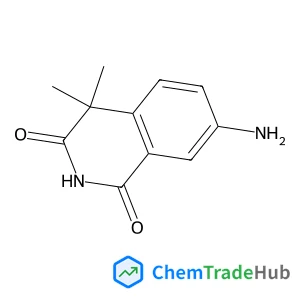
1,3(2H,4H)-Isoquinolinedione, 7-amino-4,4-dimethyl-
CAS Number:
14576-22-8
Molecular Formula:
C11H12N2O2
Shinji Yamada, Akinori Takasu, Sadatsugu Takayama, Kazuhiko Kawamura
We examined the solution polycondensation of L-lactic acid (L-LA) in xylene catalyzed by scandium trifluoromethanesulfonate using a Dean–Stark apparatus under various microwave power conditions (100–400 W). At the optimum irradiation power (300 W) and 3 M L-LA, we obtained poly(L-lactic acid) (PLLA) with a weight-average molecular weight (Mw) of 11.6 × 10³. Using 1.0 mol% SnCl2 as the catalyst and multi-mode irradiation, the largest PLLA (Mw = 46.7 × 10³) was obtained, which is a Mw greater than that obtained by conventional heating at the same temperature. We also performed microwave-assisted polycondensation of L-LA using a single-mode microwave cavity that separated microwave electric and magnetic fields. The PLLA Mw values decreased as the irradiation power of the magnetic field increased. Conversely, PLLA with a Mw > 10 000 was obtained by increasing the electric field power despite using the same conditions. The results indicate the existence of a non-thermal microwave effect induced by an electric field.

Current Opinion in Colloid & Interface Science

Organic Process Research & Development

Saudi Pharmaceutical Journal

Crystallography Reports

Current Opinion in Solid State & Materials Science

Russian Journal of Organic Chemistry

Nature Medicine

Acta Materialia

Chemistry Education Research and Practice

Russian Journal of Bioorganic Chemistry
Xiaofei Wang, Yuanzuo Li, Peng Song, Fengcai Ma, Yanhui Yang
DOI: 10.1039/C9CP06543A
Chuangchuang Wang, Yongpeng Yang, Xiaojing Liu, Yuanjie Li, Dandan Song, Yun Tian, Zhaojun Zhang
DOI: 10.1039/D0CP01005G
Jinbin Wang, Xiangli Zhong, Xiaoping Ouyang
DOI: 10.1039/D0CP00512F
Shai Mangel, Katharina Polyudov, Christian Dette, Tobias Wollandt, Paul Punke, Dongzhe Li, Roberto Urcuyo, Soon Jung Jung
DOI: 10.1039/C9CP06868F
Dipayan Chakraborty, Aranya Giri, Dhananjay Nandi
DOI: 10.1039/C9CP03973B
Lin-Yan Feng, Chuan Dong, Hua-Jin Zhai
DOI: 10.1039/C9CP04437J
Xiaodong Lv, Fengyu Li, Jian Gong, Jinxing Gu, Shiru Lin, Zhongfang Chen
DOI: 10.1039/D0CP00967A
Om Prakash, Ranjan K. Singh
DOI: 10.1039/C9CP03124C
Shivani Gupta
DOI: 10.1039/C9CP04162A
4-Nitrophenyl phosphate disodium salt hexahydrate is primarily used as a substra...
2-(Trifluoromethyl)-1,3-oxazole-4-carboxylic Acid (CAS: 1060816-01-4) is widely ...
2-Fluoro-4-biphenylcarboxylic acid should be stored in a cool, dry place at room...
Prednisolone-21-Carboxylic Acid is primarily used in the pharmaceutical industry...
4-(Hydrazinomethyl)-1,2,3-benzenetriol (CAS: 3614-72-0) should be stored in a co...
4-Amino-1-methyl-1H-pyrazole-5-carboxylic acid hydrochloride (CAS: 92534-70-8) i...
Dehydropachymic acid (CAS: 77012-31-8) is regulated by various agencies. It fall...
The market and research trends for 6-[(2,2-Dimethylpropanoyl)amino]nicotinic aci...
1,10-Phenanthroline-2,9-dicarbaldehyde should be stored in a cool, dry place awa...
5-Carbamoyl-11-oxo-10,11-dihydro-5H-dibenzo[b,f]azepin-10-yl acetate can be synt...

Polymer Chemistry welcomes submissions in all areas of polymer science that have a strong focus on macromolecular chemistry. Manuscripts may cover a broad range of fields, yet no direct application focus is required.
![N-[2-(4-Hydroxyphenoxy)-4-nitrophenyl]methanesulfonamide structure](https://static.chemtradehub.com/structs/109/109032-22-6-7c88.webp "N-[2-(4-Hydroxyphenoxy)-4-nitrophenyl]methanesulfonamide structure")