













A photo-responsive polymeric azopyridine ligand with metal-complexation sensitivity: application to coordination equilibrium studies on the polymer complexes of a cobalt(ii) Schiff base
Literature Information
Publication Date
2016-12-16
DOI
10.1039/C6PY02036D
Impact Factor
5.582
Authors
T. Suzuki, T. Moriya, R. Endo, N. Iwasaki
View Original
Abstract
In a solution of the copolymer, P(EHMA-APMA), consisting of ethylhexyl methacrylate (EHMA) and the photo-responsive azopyridine methacrylate (APMA), the E form of APMA showed photo-reversible isomerization to the Z form upon UV irradiation. After addition of the cobalt(II) Schiff base (CoS), the copolymer complex, P(EHMA-(E)-APMA)-CoS, was produced, and the (E)-APMA moieties coordinated to CoS no longer underwent photo-induced isomerization. The complexation-sensitive isomerization of (E)-APMA had a large extinction coefficient and the apparent equilibrium constant (Kapp) for the coordination reaction of (E)-APMA with CoS in a dilute solution was calculated to be 4.4 × 10⁴ M−1 ([APMA moiety] = 0.05 mM) and 1.0 × 10⁵ M−1 ([APMA moiety] = 0.003 mM) at 25 °C. The resulting concentration-dependent large Kapp values were due mainly to a micro-heterogeneous solution environment, consisting of a micro-suspension with a large solvent phase and a small polymer-domain phase caused by the extreme dilution, in addition to the thermodynamic stabilization of the five-coordinate CoS via the local concentration effect of the coordinating polymeric APMA ligands located only in the polymer domain.
Related Literature
Recyclable and efficient polyurethane-Ir catalysts for direct borylation of aromatic compounds
Akihiro Kimura, Haruka Hayama, Hassan Nageh, Yue Wang, Naofumi Naga
2017-11-09
Paper
DOI: 10.1039/C7PY01509G
A novel self-healing electrochromic film based on a triphenylamine cross-linked polymer
Rongzong Zheng, Jiaqiang Zhang, Chunyang Jia, Zhongquan Wan, Yaru Fan, Xiaolong Weng, Jianliang Xie, Longjiang Deng
2017-10-18
Paper
DOI: 10.1039/C7PY01434A
Thermoresponse and self-assembly of an ABC star quarterpolymer with O2 and redox dual-responsive Y junctions
Xiaoqi Zhao, Wentao Wu, Jian Zhang, Wenxue Dai, Youliang Zhao
2018-02-13
Paper
DOI: 10.1039/C8PY00085A
Aromatic polyesters from biosuccinic acid
Gabriel N. Short, Ha T. H. Nguyen, Patricia I. Scheurle, Stephen A. Miller
2018-07-20
Communication
DOI: 10.1039/C8PY00862K
Synthesis of PEVE-b-P(CTFE-alt-EVE) block copolymers by sequential cationic and radical RAFT polymerization
Marc Guerre, Mineto Uchiyama, Gérald Lopez, Bruno Améduri, Masami Kamigaito, Vincent Ladmiral
2017-12-08
Paper
DOI: 10.1039/C7PY01924F
Inhibition of lysozyme's polymerization activity using a polymer structural mimic
D. L. Morris, T. C. Leeper, C. J. Ziegler
2018-05-29
Communication
DOI: 10.1039/C8PY00545A
Ferromagnetic iron oxide–cellulose nanocomposites prepared by ultrasonication
Razvan Rotaru, Marcela Savin, Nita Tudorachi, Cristian Peptu, Petrisor Samoila, Liviu Sacarescu, Valeria Harabagiu
2017-10-27
Paper
DOI: 10.1039/C7PY01587A
You might also like
Compound Q&A
What are the main uses of 4-Nitrophenyl phosphate disodium salt hexahydrate (CAS: 333338-18-4)?
4-Nitrophenyl phosphate disodium salt hexahydrate is primarily used as a substra...
333338-18-44-Nitrophenyl phosph...
Compound Q&A
What are the main uses of 2-(Trifluoromethyl)-1,3-oxazole-4-carboxylic Acid (CAS: 1060816-01-4)?
2-(Trifluoromethyl)-1,3-oxazole-4-carboxylic Acid (CAS: 1060816-01-4) is widely ...
1060816-01-42-(Trifluoromethyl)-...
Compound Q&A
How should 2-Fluoro-4-biphenylcarboxylic acid (CAS: 137045-30-8) be stored?
2-Fluoro-4-biphenylcarboxylic acid should be stored in a cool, dry place at room...
137045-30-82-Fluoro-4-biphenylc...
Compound Q&A
What industries use Prednisolone-21-Carboxylic Acid (CAS: 61549-70-0)?
Prednisolone-21-Carboxylic Acid is primarily used in the pharmaceutical industry...
61549-70-0Prednisolone-21-Carb...
Compound Q&A
How should 4-(Hydrazinomethyl)-1,2,3-benzenetriol (CAS: 3614-72-0) be stored?
4-(Hydrazinomethyl)-1,2,3-benzenetriol (CAS: 3614-72-0) should be stored in a co...
3614-72-04-(Hydrazinomethyl)-...
Compound Q&A
What industries use 4-Amino-1-methyl-1H-pyrazole-5-carboxylic acid hydrochloride (CAS: 92534-70-8)?
4-Amino-1-methyl-1H-pyrazole-5-carboxylic acid hydrochloride (CAS: 92534-70-8) i...
92534-70-84-Amino-1-methyl-1H-...
Compound Q&A
What regulatory guidelines apply to dehydropachymic acid (CAS: 77012-31-8)?
Dehydropachymic acid (CAS: 77012-31-8) is regulated by various agencies. It fall...
77012-31-8Dehydropachymic acid
Compound Q&A
What is the market or research trend for 6-[(2,2-Dimethylpropanoyl)amino]nicotinic acid (CAS: 898561-66-5)?
The market and research trends for 6-[(2,2-Dimethylpropanoyl)amino]nicotinic aci...
898561-66-56-[(2,2-Dimethylprop...
Compound Q&A
How should 1,10-Phenanthroline-2,9-dicarbaldehyde (CAS: 57709-62-3) be stored?
1,10-Phenanthroline-2,9-dicarbaldehyde should be stored in a cool, dry place awa...
57709-62-31,10-Phenanthroline-...
Compound Q&A
How is 5-Carbamoyl-11-oxo-10,11-dihydro-5H-dibenzo[b,f]azepin-10-yl acetate (CAS: 113952-21-9) typically synthesized?
5-Carbamoyl-11-oxo-10,11-dihydro-5H-dibenzo[b,f]azepin-10-yl acetate can be synt...
113952-21-95-Carbamoyl-11-oxo-1...
Source Journal
Polymer Chemistry

CiteScore:
8.6
Self-citation Rate:
7.3%
Articles per Year:
457
Polymer Chemistry welcomes submissions in all areas of polymer science that have a strong focus on macromolecular chemistry. Manuscripts may cover a broad range of fields, yet no direct application focus is required.
Recommended Compounds
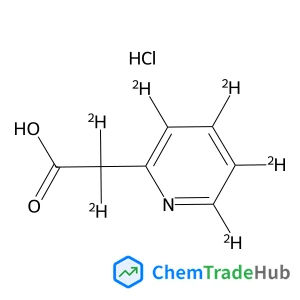
2,2-dideuterio-2-(3,4,5,6-tetradeuterio-2-pyridyl)acetic acid;hydrochloride
CAS Number:
1329799-67-8
Molecular Formula:
C7H2ClD6NO2
![[(1S,2S,3R,4S,7R,9S,10S,12R,15S)-4,12-Diacetyloxy-15-[(2R,3S)-3-benzamido-3-phenyl-2-(2,2,2-trichloroethoxycarbonyloxy)propanoyl]oxy-1,9-dihydroxy-10,14,17,17-tetramethyl-11-oxo-6-oxatetracyclo[11.3.1.03,10.04,7]heptadec-13-en-2-yl] benzoate structure](https://static.chemtradehub.com/structs/100/100431-55-8-7104.webp "[(1S,2S,3R,4S,7R,9S,10S,12R,15S)-4,12-Diacetyloxy-15-[(2R,3S)-3-benzamido-3-phenyl-2-(2,2,2-trichloroethoxycarbonyloxy)propanoyl]oxy-1,9-dihydroxy-10,14,17,17-tetramethyl-11-oxo-6-oxatetracyclo[11.3.1.03,10.04,7]heptadec-13-en-2-yl] benzoate structure")
Recommended Suppliers





Disclaimer
This page provides academic journal information for reference and research purposes only. We are not affiliated with any journal publishers and do not handle publication submissions. For publication-related inquiries, please contact the respective journal publishers directly.
If you notice any inaccuracies in the information displayed, please contact us at support@chemtradehub.com. We will promptly review and address your concerns.