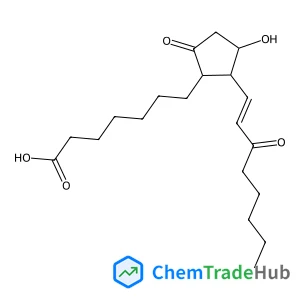
(11alpha,13E)-11-Hydroxy-9,15-dioxoprost-13-en-1-oic acid
CAS Number:
22973-19-9
Molecular Formula:
C20H32O5
Aninda Chatterjee, Banibrata Maity, Debabrata Seth
In this manuscript we have studied the photophysics of 7-(N,N′-diethylamino)coumarin-3-carboxylic acid (7-DCCA) in water/AOT/isooctane reverse micelles. For this purpose we have used steady state absorption and fluorescence emission spectroscopy and time resolved fluorescence spectroscopy. We have studied the spectral behaviour of 7-DCCA inside the water/AOT/isooctane reverse micelles with variation of excitation wavelength. We have studied the dynamics of solvent and rotational relaxation by using two different excitation wavelengths (λexi = 375 nm and λexi = 405 nm). We have observed the excitation wavelength dependent dynamics of 7-DCCA in the reverse micelles. The fluorescence quantum yield, decay time, solvent relaxation time and rotational relaxation time of 7-DCCA in reverse micelles vary with the excitation wavelength. A two step and wobbling-in-cone model was used to interpret the rotational relaxation dynamics of 7-DCCA in reverse micelles.
Aashish Sharma, Aasheesh Srivastava
DOI: 10.1039/C3PY00741C
Yeli Fan, Baoping Lin, Ying Sun, Xiaohui Gong, Hong Yang, Xueqin Zhang
DOI: 10.1039/C3PY00454F
Aroa Duro-Castano, María J. Vicent
DOI: 10.1039/C3PY00189J
Wim Van Camp, Filip Du Prez, Laurent Rubatat, Laurent Billon, Maud Save
DOI: 10.1039/C3PY00643C
Mingming Zhang, Qingqing Xiong, Jinqian Chen, Yinsong Wang
DOI: 10.1039/C3PY00656E
Yulia Rogan, Ludmila Starannikova, Victoria Ryzhikh, Yuri Yampolskii, Paola Bernardo, Fabio Bazzarelli, Johannes Carolus Jansen, Neil B. McKeown
DOI: 10.1039/C3PY00451A
Wei Shao, Ke Miao, Huanhuan Liu, Chunnuan Ye, Jianzhong Du, Youliang Zhao
DOI: 10.1039/C3PY00252G
Xiaodong Chi, Donghua Xu, Xuzhou Yan, Jianzhuang Chen, Mingming Zhang, Bingjie Hu, Yihua Yu, Feihe Huang
DOI: 10.1039/C3PY00201B
Lijun Huo, Zhaojun Li, Xia Guo, Yue Wu, Maojie Zhang, Long Ye, Shaoqing Zhang, Jianhui Hou
DOI: 10.1039/C3PY00074E
Carlos Guerrero-Sanchez, Graeme Moad
DOI: 10.1039/C3PY00487B
6-(3-Fluorophenyl)picolinic acid is generally considered safe for laboratory use...
(3R)-3-Pyrrolidinol is used in the pharmaceutical industry as a precursor for dr...
When handling (4R,5R)-4,5-Diethoxycarbonyl-2,2-dimethyldioxolane (CAS: 59779-75-...
1-(6-Chloroimidazo[1,2-b]pyridazin-3-yl)ethanone is often synthesized via a mult...
The market for N-Ethyl-3,4-dimethylbenzylamine (CAS: 39180-83-1) remains steady,...
Tert-butyl 3-(pyrrolidin-1-yl)azetidine-1-carboxylate is a chemical compound wit...
1-Bromo-3-chloro-2,4-dimethoxybenzene (CAS: 1228956-93-1) falls under the classi...
The safety of 8-Bromo-2-methyl-3,4-dihydroisoquinolin-1(2H)-one (CAS: 1368622-07...
Benzyl [(3S)-2,6-dioxo-3-piperidinyl]carbamate is generally safe when handled wi...
1-{[4-(4,4,5,5-Tetramethyl-1,3,2-dioxaborolan-2-yl)phenyl]sulfonyl}pyrrolidine s...

Physical Chemistry Chemical Physics (PCCP) is an international journal co-owned by 19 physical chemistry and physics societies from around the world. This journal publishes original, cutting-edge research in physical chemistry, chemical physics and biophysical chemistry. To be suitable for publication in PCCP, articles must include significant innovation and/or insight into physical chemistry; this is the most important criterion that reviewers and Editors will judge against when evaluating submissions. The journal has a broad scope and welcomes contributions spanning experiment, theory, computation and data science. Topical coverage includes spectroscopy, dynamics, kinetics, statistical mechanics, thermodynamics, electrochemistry, catalysis, surface science, quantum mechanics, quantum computing and machine learning. Interdisciplinary research areas such as polymers and soft matter, materials, nanoscience, energy, surfaces/interfaces, and biophysical chemistry are welcomed if they demonstrate significant innovation and/or insight into physical chemistry. Joined experimental/theoretical studies are particularly appreciated when complementary and based on up-to-date approaches.

![[4-Chloro-3-(diethylcarbamoyl)phenyl]boronic acid structure](https://static.chemtradehub.com/structs/871/871332-68-2-0e3b.webp "[4-Chloro-3-(diethylcarbamoyl)phenyl]boronic acid structure")