












Pronounced influence of pH, metal-ion and solvent isotope on the thermoresponse of synthetic amphiphilic polypeptides
Literature Information
Publication Date
2013-06-28
DOI
10.1039/C3PY00741C
Impact Factor
5.582
Authors
Aashish Sharma, Aasheesh Srivastava
View Original
Abstract
This contribution reports a series of novel amphiphilic random copolymers based on biodegradable polyaspartamides that respond to three independent stimuli viz. temperature, pH and metal-ions. Architecturally, the attachment of 1-propylimidazole pendants (hydrophobic at physiological pH) and dimethylpropylammonium pendants (hydrophilic at physiological pH) to the hydrophilic polyamide backbone introduced well-defined, reversible thermosensitivity at and around physiological conditions (temp. = 37 °C and pH = 7.4) in phosphate buffer (PB). The cloud points could easily be tuned by varying the ratios of the two pendants. The anions of the Hofmeister series were found to affect the thermosensitivity. Aggregation behaviour of the copolymers as a function of pendant ratios, as well as their temperature-induced aggregation, was investigated by 1H NMR spectroscopy and dynamic light scattering (DLS). Importantly under salt-free conditions, thermosensitivity was observed only in heavy water and not in normal water due to the solvent isotope effect. Profound modulation of thermosensitivity was achieved through the variation of pH of polymer-solution and by the presence of metal ions in it. The morphology of metal ion-stabilized polymer globules was probed by atomic force microscopy (AFM).
Recommended Journals
Related Literature
Probing the charge distribution at the electrochemical interface
Yvonne Gründer, Christopher A. Lucas
2017-02-27
Paper
DOI: 10.1039/C7CP00244K
Surface fouling as a mechanism for chemotaxis in isotropic catalytic swimmers
2017-09-05
Paper
DOI: 10.1039/C7CP05102F
Photoinduced dimerization of a photosensory DNA-binding protein EL222 and its LOV domain
Akira Takakado, Yusuke Nakasone, Masahide Terazima
2017-08-18
Paper
DOI: 10.1039/C7CP03686H
Near-infrared photochemistry at interfaces based on upconverting nanoparticles
Si Wu, Hans-Jürgen Butt
2017-05-03
Perspective
DOI: 10.1039/C7CP01838J
Chiral segregation driven by a dynamical response of the adsorption footprint to the local adsorption environment: bitartrate on Cu(110)
G. R. Darling, M. Forster, C. Lin, N. Liu, R. Raval, A. Hodgson
2017-02-22
Paper
DOI: 10.1039/C7CP00622E
Defects in crystalline PVDF: a density functional theory-density functional tight binding study
Saeid Arabnejad, Koichi Yamashita, Sergei Manzhos
2017-02-17
Paper
DOI: 10.1039/C7CP00510E
Membrane interactions and antimicrobial effects of layered double hydroxide nanoparticles
L. Nyström, R. Nordström, Z. P. Xu, M. Davoudi
2017-07-06
Paper
DOI: 10.1039/C7CP02701J
Pd-P nanoparticles supported on PxOy-incorporated carbon nanotubes for enhanced methanol oxidation in an alkaline medium
Yanan Xie, Weizhen Yu, Juan Wang, Yifei Wu, Shuo Niu, Wenyao Guo, Tsungwu Lin, Lidong Shao
2017-08-18
Paper
DOI: 10.1039/C7CP04540A
Theoretical study of the substituent effect controlling the radiative and non-radiative decay processes of platinum(ii) complexes
Wenting Zhang, Chaoyuan Zhu
2017-08-10
Paper
DOI: 10.1039/C7CP04376G
You might also like
Compound Q&A
Is 6-(3-Fluorophenyl)picolinic acid (CAS: 887982-40-3) safe?
6-(3-Fluorophenyl)picolinic acid is generally considered safe for laboratory use...
887982-40-36-(3-Fluorophenyl)pi...
Compound Q&A
What industries use (3R)-3-Pyrrolidinol (CAS: 2799-21-5)?
(3R)-3-Pyrrolidinol is used in the pharmaceutical industry as a precursor for dr...
2799-21-5(3R)-3-Pyrrolidinol
Compound Q&A
What precautions should be taken when handling (4R,5R)-4,5-Diethoxycarbonyl-2,2-dimethyldioxolane (CAS: 59779-75-8)?
When handling (4R,5R)-4,5-Diethoxycarbonyl-2,2-dimethyldioxolane (CAS: 59779-75-...
59779-75-8(4R,5R)-4,5-Diethoxy...
Compound Q&A
How is 1-(6-Chloroimidazo[1,2-b]pyridazin-3-yl)ethanone (CAS: 90734-71-7) typically synthesized?
1-(6-Chloroimidazo[1,2-b]pyridazin-3-yl)ethanone is often synthesized via a mult...
90734-71-71-(6-Chloroimidazo[1...
Compound Q&A
What is the market or research trend for N-Ethyl-3,4-dimethylbenzylamine (CAS: 39180-83-1)?
The market for N-Ethyl-3,4-dimethylbenzylamine (CAS: 39180-83-1) remains steady,...
39180-83-1N-Ethyl-3,4-dimethyl...
Compound Q&A
What is Tert-butyl 3-(pyrrolidin-1-yl)azetidine-1-carboxylate (CAS: 1019008-21-9)?
Tert-butyl 3-(pyrrolidin-1-yl)azetidine-1-carboxylate is a chemical compound wit...
1019008-21-9Tert-butyl 3-(pyrrol...
Compound Q&A
What regulatory guidelines apply to 1-Bromo-3-chloro-2,4-dimethoxybenzene (CAS: 1228956-93-1)?
1-Bromo-3-chloro-2,4-dimethoxybenzene (CAS: 1228956-93-1) falls under the classi...
1228956-93-11-Bromo-3-chloro-2,4...
Compound Q&A
Is 8-Bromo-2-methyl-3,4-dihydroisoquinolin-1(2H)-one (CAS: 1368622-07-4) safe?
The safety of 8-Bromo-2-methyl-3,4-dihydroisoquinolin-1(2H)-one (CAS: 1368622-07...
1368622-07-48-Bromo-2-methyl-3,4...
Compound Q&A
Is Benzyl [(3S)-2,6-dioxo-3-piperidinyl]carbamate (CAS: 22785-43-9) safe?
Benzyl [(3S)-2,6-dioxo-3-piperidinyl]carbamate is generally safe when handled wi...
22785-43-9Benzyl [(3S)-2,6-dio...
Compound Q&A
How should 1-{[4-(4,4,5,5-Tetramethyl-1,3,2-dioxaborolan-2-yl)phenyl]sulfonyl}pyrrolidine (CAS: 928657-21-0) be stored?
1-{[4-(4,4,5,5-Tetramethyl-1,3,2-dioxaborolan-2-yl)phenyl]sulfonyl}pyrrolidine s...
928657-21-01-{[4-(4,4,5,5-Tetra...
Source Journal
Polymer Chemistry

CiteScore:
8.6
Self-citation Rate:
7.3%
Articles per Year:
457
Polymer Chemistry welcomes submissions in all areas of polymer science that have a strong focus on macromolecular chemistry. Manuscripts may cover a broad range of fields, yet no direct application focus is required.
Recommended Compounds
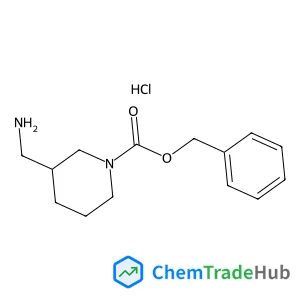
Benzyl 3-(aminomethyl)piperidine-1-carboxylate hydrochloride
CAS Number:
1186663-23-9
Molecular Formula:
C14H21ClN2O2
Recommended Suppliers





Disclaimer
This page provides academic journal information for reference and research purposes only. We are not affiliated with any journal publishers and do not handle publication submissions. For publication-related inquiries, please contact the respective journal publishers directly.
If you notice any inaccuracies in the information displayed, please contact us at support@chemtradehub.com. We will promptly review and address your concerns.