












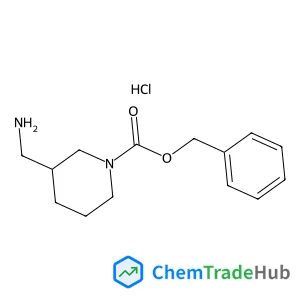
Benzyl 3-(aminomethyl)piperidine-1-carboxylate hydrochloride
CAS Number:
1186663-23-9
Molecular Formula:
C14H21ClN2O2
Wei Shao, Ke Miao, Huanhuan Liu, Chunnuan Ye, Jianzhong Du, Youliang Zhao
Disulfide- and acetal-functionalized comb-like copolymers (SACP) with poly(ε-caprolactone) (PCL) and poly(ethylene glycol) (PEG) side chains and a polymethacrylate backbone were synthesized and self-assembled for in vitro encapsulation and release of an anticancer drug, doxorubicin (DOX). Three step reactions including RAFT copolymerization of 2-hydroxyethyl methacrylate and poly(ethylene glycol) methyl ether methacrylate mediated by a disulfide-functionalized RAFT agent, hydroxyl-vinyloxy addition reaction to introduce acid cleavable PEG segments, and CL polymerization to grow PCL chains were used to generate the target dual-sensitive comb-like copolymers. Meanwhile, well-defined normal comb-like polymers (CP), acid-cleavable comb-like polymers (ACP) and disulfide-linked comb-like polymers (SCP) with PEG and PCL pendent chains were also prepared and acted as analogues of SACP. All the resultant comb-like copolymers had the desired chemical structures, well-controlled molecular weight and relatively low polydispersity (PDI = 1.09–1.16), evident from 1H NMR and GPC-MALLS analyses. DLS and TEM measurements revealed that these copolymers were liable to self-assemble into micelles or large compound micelles in aqueous solution, and SACP aggregates could be dissociated and reaggregated in the presence of acidic PBS solution (pH 5.0) or 10 mM DL-dithiothreitol (DTT). Compared with CP aggregates with a lack of cleavable linkage, ACP, SCP and SACP aggregates upon acid and reduction stimuli could quickly release the encapsulated DOX, and the cumulative release from SACP aggregates could be roughly adjusted by addition of a single stimulus or dual stimuli. These results confirmed their great potential as novel nanocarriers and delivery systems.
J. S. Eardley, N. Warner, L. Z. Deng, E. Wrede
DOI: 10.1039/C7CP00458C
Huanjun Song, Cenfeng Fu, Na Li, Hao Zhu, Zhantao Peng, Wenhui Zhao, Jingxin Dai, Lingbo Xing, Zhichao Huang, Wei Chen, Yongfeng Wang, Jinlong Yang, Kai Wu
DOI: 10.1039/C7CP03153J
Jacob C. Dean, Ruomeng Zhang, Rawad K. Hallani, Ryan D. Pensack, Samuel N. Sanders, Daniel G. Oblinsky, Sean R. Parkin, Luis M. Campos, John E. Anthony, Gregory D. Scholes
DOI: 10.1039/C7CP03774K
Xiao Su, T. Alan Hatton
DOI: 10.1039/C7CP02822A
Srashti Gupta, Sanjeev K. Srivastava, Sankarakumar Amrithapandian, Tripurari S. Tripathi, Surya K. Tripathi, Chung-Li Dong, Chi-Liang Chen, Devesh K. Avasthi, Kandasami Asokan
DOI: 10.1039/C7CP03527F
Ruixuan Meng, Yuan Li, Chong Li, Kun Gao, Sun Yin, Luxia Wang
DOI: 10.1039/C7CP02626A
Rakesh Gupta, Nishi Kashyap, Beena Rai
DOI: 10.1039/C6CP08775B
Pratik P. Dholabhai, Enrique Martínez, Nicholas T. Brown, Blas Pedro Uberuaga
DOI: 10.1039/C7CP04884J
K. D. Fulfer, D. G. Kuroda
DOI: 10.1039/C7CP05096H
6-(3-Fluorophenyl)picolinic acid is generally considered safe for laboratory use...
(3R)-3-Pyrrolidinol is used in the pharmaceutical industry as a precursor for dr...
When handling (4R,5R)-4,5-Diethoxycarbonyl-2,2-dimethyldioxolane (CAS: 59779-75-...
1-(6-Chloroimidazo[1,2-b]pyridazin-3-yl)ethanone is often synthesized via a mult...
The market for N-Ethyl-3,4-dimethylbenzylamine (CAS: 39180-83-1) remains steady,...
Tert-butyl 3-(pyrrolidin-1-yl)azetidine-1-carboxylate is a chemical compound wit...
1-Bromo-3-chloro-2,4-dimethoxybenzene (CAS: 1228956-93-1) falls under the classi...
The safety of 8-Bromo-2-methyl-3,4-dihydroisoquinolin-1(2H)-one (CAS: 1368622-07...
Benzyl [(3S)-2,6-dioxo-3-piperidinyl]carbamate is generally safe when handled wi...
1-{[4-(4,4,5,5-Tetramethyl-1,3,2-dioxaborolan-2-yl)phenyl]sulfonyl}pyrrolidine s...

Polymer Chemistry welcomes submissions in all areas of polymer science that have a strong focus on macromolecular chemistry. Manuscripts may cover a broad range of fields, yet no direct application focus is required.
![4-[(2,4-Dihydroxyphenyl)diazenyl]-5-hydroxy-2,7-naphthalenedisulfonic acid structure](https://static.chemtradehub.com/structs/362/3627-01-8-79ac.webp "4-[(2,4-Dihydroxyphenyl)diazenyl]-5-hydroxy-2,7-naphthalenedisulfonic acid structure")




