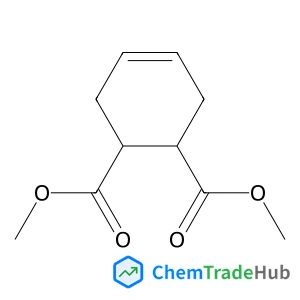
4-Cyclohexene-1,2-dicarboxylic acid, 1,2-dimethyl ester, (1R,2R)-rel-
CAS Number:
17673-68-6
Molecular Formula:
C10H14O4
Yeli Fan, Baoping Lin, Ying Sun, Xiaohui Gong, Hong Yang, Xueqin Zhang
Two novel polymers (PFMA-Ma and PFMA-Mb) were synthesized through an efficient and simple method combining conventional free radical polymerization and a Diels–Alder reaction. Different molar percentage compositions of the functionalized pendants in the polymers and two different steric configurations: endo and exo in the D–A adduct structures are revealed in 1H NMR spectra. In addition, DSC curves demonstrate that the reverse Diels–Alder reactions take place at higher temperatures (between 120 °C and 150 °C). Moreover, both of the fluorescence intensities of the two polymer films (PFMA-Ma (x = 0.700) and PFMA-Mb (x = 0.609)) become weak and even almost disappear with the increase of the annealing temperature, indicating that thermal annealing induces π–π stacking and aggregation of the pendants in the polymers. Concurrently, as the molar ratios of pendant moieties in the polymers are increased, a characteristic peak of face-to-face stacking appears in the fluorescence spectra of PFMA-Ma and a slight red-shift is observed in the fluorescence spectra of PFMA-Mb. These phenomena suggest that high molar percentage of pendants is also beneficial to their π–π stacking and aggregation. This study may provide some insights into the stacking of pendants in polymers and its influencing factors, which will be useful when these polymer materials are applied in optoelectronic devices.
Jing Kong, Zheng Bo, Huachao Yang, Jinyuan Yang, Xiaorui Shuai, Jianhua Yan, Kefa Cen
DOI: 10.1039/C6CP08752C
Fangfang Chen
DOI: 10.1039/C7CP90203D
Zhongxu Wang
DOI: 10.1039/C7CP04299J
M. Virumbrales-del Olmo, A. Delgado-Cabello, A. Andrada-Chacón, J. Sánchez-Benítez, E. Urones-Garrote, V. Blanco-Gutiérrez, M. J. Torralvo, R. Sáez-Puche
DOI: 10.1039/C6CP08743D
Febdian Rusydi
DOI: 10.1039/C7CP02390A
Artur Schneider, Torsten Brezesinski
DOI: 10.1039/C6CP08865A
Ruixuan Meng, Yuan Li, Chong Li, Kun Gao, Sun Yin, Luxia Wang
DOI: 10.1039/C7CP02626A
E. Fadda, M. G. Nixon
DOI: 10.1039/C7CP02485A
F. Moradi, M. Darvish Ganji, Y. Sarrafi
DOI: 10.1039/C6CP08525C
6-(3-Fluorophenyl)picolinic acid is generally considered safe for laboratory use...
(3R)-3-Pyrrolidinol is used in the pharmaceutical industry as a precursor for dr...
When handling (4R,5R)-4,5-Diethoxycarbonyl-2,2-dimethyldioxolane (CAS: 59779-75-...
1-(6-Chloroimidazo[1,2-b]pyridazin-3-yl)ethanone is often synthesized via a mult...
The market for N-Ethyl-3,4-dimethylbenzylamine (CAS: 39180-83-1) remains steady,...
Tert-butyl 3-(pyrrolidin-1-yl)azetidine-1-carboxylate is a chemical compound wit...
1-Bromo-3-chloro-2,4-dimethoxybenzene (CAS: 1228956-93-1) falls under the classi...
The safety of 8-Bromo-2-methyl-3,4-dihydroisoquinolin-1(2H)-one (CAS: 1368622-07...
Benzyl [(3S)-2,6-dioxo-3-piperidinyl]carbamate is generally safe when handled wi...
1-{[4-(4,4,5,5-Tetramethyl-1,3,2-dioxaborolan-2-yl)phenyl]sulfonyl}pyrrolidine s...

Polymer Chemistry welcomes submissions in all areas of polymer science that have a strong focus on macromolecular chemistry. Manuscripts may cover a broad range of fields, yet no direct application focus is required.