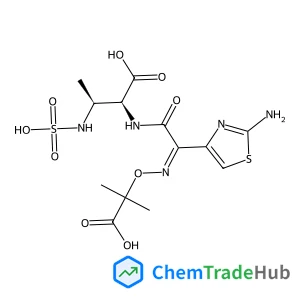
Aztreonam USP Related Compound A (Open-ring Aztreonam)
CAS Number:
87500-74-1
Molecular Formula:
C13H19N5O9S2
Wim Van Camp, Filip Du Prez, Laurent Rubatat, Laurent Billon, Maud Save
In the present work, we show that Cu(0)-mediated controlled radical polymerization is a suitable method to synthesize high molar mass polystyrene-b-poly(ethoxy ethyl acrylate) PS-b-PEEA diblock copolymers. This method, applied at room temperature, is mandatory for complete preservation of ethoxy ethyl protecting groups during the course of polymerization. The synthesized PS-b-PEEA diblock copolymers were subsequently used for the elaboration of pH sensitive hierarchically structured honeycomb (HC) films through the Breath Figure (BF) process. The PS-b-PEEA hydrophobic honeycomb films were characterized by optical microscopy and atomic force microscopy (AFM) to reveal the hexagonal array of pores at the micrometer length scale, together with the phase segregation of the diblock copolymer. Similar to highly structured natural materials, the biomimetic honeycomb polymer films displayed intense iridescence. Moreover, the increase of surface roughness by peeling off the top layer of the PS-b-PEEA HC films produced superhydrophobic surfaces exhibiting a water contact angle of 155°. Subsequent deprotection of PEEA into pH-responsive poly(acrylic acid) (PAA) was performed in situ from the PS-b-PEEA honeycomb film by a simple thermolysis step carried out at 90 °C. The resulting PS-b-PAA honeycomb films showed a clear pH-responsive behavior with a water contact angle gap of 65° between a pH of 3 and 10.
Anna Battisti, Gabriele Ciasca, Alessandro Grottesi, Alexander Tenenbaum
DOI: 10.1039/C6CP07683A
Sarah D. Hann, Daeyeon Lee, Kathleen J. Stebe
DOI: 10.1039/C7CP02809A
Laura Muñoz-Senovilla, Gregory Tricot, Francisco Muñoz
DOI: 10.1039/C7CP04171C
C. T. Liu, J. F. Chu, C. K. Lin, C. W. Hong
DOI: 10.1039/C7CP00541E
DOI: 10.1039/C7CP04759B
Ronghua Ma, Xiaotong Chen, Xvsheng Qiao, Xianping Fan, Jincheng Du, Xianghua Zhang
DOI: 10.1039/C7CP02531A
Jan Meisner, Max N. Markmeyer, Matthias U. Bohner, Johannes Kästner
DOI: 10.1039/C7CP03722H
M. Virumbrales-del Olmo, A. Delgado-Cabello, A. Andrada-Chacón, J. Sánchez-Benítez, E. Urones-Garrote, V. Blanco-Gutiérrez, M. J. Torralvo, R. Sáez-Puche
DOI: 10.1039/C6CP08743D
Dian Wang, Kah H. Chan, Naveen Kumar Elumalai, Md. Arafat Mahmud, Mushfika B. Upama, Ashraf Uddin, Supriya Pillai
DOI: 10.1039/C7CP04053A
6-(3-Fluorophenyl)picolinic acid is generally considered safe for laboratory use...
(3R)-3-Pyrrolidinol is used in the pharmaceutical industry as a precursor for dr...
When handling (4R,5R)-4,5-Diethoxycarbonyl-2,2-dimethyldioxolane (CAS: 59779-75-...
1-(6-Chloroimidazo[1,2-b]pyridazin-3-yl)ethanone is often synthesized via a mult...
The market for N-Ethyl-3,4-dimethylbenzylamine (CAS: 39180-83-1) remains steady,...
Tert-butyl 3-(pyrrolidin-1-yl)azetidine-1-carboxylate is a chemical compound wit...
1-Bromo-3-chloro-2,4-dimethoxybenzene (CAS: 1228956-93-1) falls under the classi...
The safety of 8-Bromo-2-methyl-3,4-dihydroisoquinolin-1(2H)-one (CAS: 1368622-07...
Benzyl [(3S)-2,6-dioxo-3-piperidinyl]carbamate is generally safe when handled wi...
1-{[4-(4,4,5,5-Tetramethyl-1,3,2-dioxaborolan-2-yl)phenyl]sulfonyl}pyrrolidine s...

Polymer Chemistry welcomes submissions in all areas of polymer science that have a strong focus on macromolecular chemistry. Manuscripts may cover a broad range of fields, yet no direct application focus is required.