












Effect of structural defects and chemical functionalisation on the intrinsic mechanical properties of graphene
Literature Information
Publication Date
2012-11-08
DOI
10.1039/C2CP43033A
Impact Factor
3.676
Authors
Songül Güryel, Balázs Hajgató, Yves Dauphin, Jean-Marie Blairon, Hans Edouard Miltner, Frank De Proft, Paul Geerlings, Gregory Van Lier
View Original
Abstract
Due to its unique mechanical properties, graphene can be applied for reinforcement in nanocomposites. We analyse the Young’s modulus of graphene at the semi-empirical PM6 level of theory. The internal forces are calculated and the Young’s modulus is predicted for a finite graphene sheet when external strain is applied on the system. These results are in a good agreement with theoretical and experimental results from the literature giving values of about 1 TPa for the Young’s modulus. Stress–strain curves are computed for elongation up to 20%. In addition, the influence of the presence of a single vacancy, as well as for oxygenation of a vacancy, on the mechanical properties of graphene has been analysed. Our results indicate that when applying the deformation locally onto the system, higher local stress can be induced, as confirmed by Finite Element Analysis. Also, the presence of structural defects in the system will stiffen the system upon low strain, but reduces the elastic limit from more than 20% strain for pristine graphene to less than 10% strain when defects are present.
Related Literature
RAFT polymerization of dimethyl(methacryloyloxy)methyl phosphonate and its phosphonic acid derivative: a new opportunity for phosphorus-based materials
Benjamin Canniccioni, Sophie Monge, Ghislain David, Jean-Jacques Robin
2013-04-19
Paper
DOI: 10.1039/C3PY00426K
Amphiphilic supramolecular A(B)2A quasi-triblock copolymers
2013-03-13
Communication
DOI: 10.1039/C3PY00216K
PEGylation of fluoridated hydroxyapatite (FAp):Ln3+nanorods for cell imaging
Xiaoyong Zhang, Junfeng Hui, Bin Yang, Yong Yang, Daidi Fan, Meiying Liu, Lei Tao, Yen Wei
2013-05-07
Paper
DOI: 10.1039/C3PY00489A
Synthesis and photovoltaic properties of copolymers based on benzo[1,2-b:4,5-b′]dithiophene and thiazole with different conjugated side groups
Xunshan Liu, Yuanshuai Huang, Zhencai Cao, Chao Weng, Huajie Chen, Songting Tan
2013-06-20
Paper
DOI: 10.1039/C3PY00614J
Poly(acrylic acid)-graft-poly(N-vinylcaprolactam): a novel pH and thermo dual-stimuli responsive system
Xiuyu Jiang, Guolin Lu, Chun Feng, Yongjun Li, Xiaoyu Huang
2013-04-23
Paper
DOI: 10.1039/C3PY00415E
A new method to make polymers with flexible main chains and photoelectric pendants for organic semiconductors
Yeli Fan, Baoping Lin, Ying Sun, Xiaohui Gong, Hong Yang, Xueqin Zhang
2013-05-22
Paper
DOI: 10.1039/C3PY00454F
Photochemical thiol–yne functionalization of polypeptide scaffolds
Kai-Steffen Krannig, Jin Huang, Andreas Heise, Helmut Schlaad
2013-05-01
Paper
DOI: 10.1039/C3PY00428G
Hybrid organic–inorganic nanomaterial sensors for selective detection of Au3+ using rhodamine-based modified polyacrylic acid (PAA)-coated FeNPs
Noi Niamsa, Chatthai Kaewtong, Weerapol Srinonmuang, Banchob Wanno, Buncha Pulpoka, Thawatchai Tuntulani
2013-03-04
Paper
DOI: 10.1039/C3PY00229B
Hydrogen bonding assisted reversible-deactivation radical copolymerization of 4-vinylpyridine and styrene: a facile approach for adjusting polymerization behavior, polymer composition, etc.
Xiaoji Zhou, Wenxiang Wang, Huali Yu, Junfei Zhao, Zhengbiao Zhang, Xiulin Zhu
2013-04-08
Paper
DOI: 10.1039/C3PY00255A
Solution-processable blue-to-transmissive electrochromic benzotriazole-containing conjugated polymers
Wei Teng Neo, Lee May Loo, Jing Song, Xiaobai Wang, Ching Mui Cho, Hardy Sze On Chan, Yun Zong
2013-06-20
Paper
DOI: 10.1039/C3PY00677H
You might also like
Compound Q&A
Is 6-(3-Fluorophenyl)picolinic acid (CAS: 887982-40-3) safe?
6-(3-Fluorophenyl)picolinic acid is generally considered safe for laboratory use...
887982-40-36-(3-Fluorophenyl)pi...
Compound Q&A
What industries use (3R)-3-Pyrrolidinol (CAS: 2799-21-5)?
(3R)-3-Pyrrolidinol is used in the pharmaceutical industry as a precursor for dr...
2799-21-5(3R)-3-Pyrrolidinol
Compound Q&A
What precautions should be taken when handling (4R,5R)-4,5-Diethoxycarbonyl-2,2-dimethyldioxolane (CAS: 59779-75-8)?
When handling (4R,5R)-4,5-Diethoxycarbonyl-2,2-dimethyldioxolane (CAS: 59779-75-...
59779-75-8(4R,5R)-4,5-Diethoxy...
Compound Q&A
How is 1-(6-Chloroimidazo[1,2-b]pyridazin-3-yl)ethanone (CAS: 90734-71-7) typically synthesized?
1-(6-Chloroimidazo[1,2-b]pyridazin-3-yl)ethanone is often synthesized via a mult...
90734-71-71-(6-Chloroimidazo[1...
Compound Q&A
What is the market or research trend for N-Ethyl-3,4-dimethylbenzylamine (CAS: 39180-83-1)?
The market for N-Ethyl-3,4-dimethylbenzylamine (CAS: 39180-83-1) remains steady,...
39180-83-1N-Ethyl-3,4-dimethyl...
Compound Q&A
What is Tert-butyl 3-(pyrrolidin-1-yl)azetidine-1-carboxylate (CAS: 1019008-21-9)?
Tert-butyl 3-(pyrrolidin-1-yl)azetidine-1-carboxylate is a chemical compound wit...
1019008-21-9Tert-butyl 3-(pyrrol...
Compound Q&A
What regulatory guidelines apply to 1-Bromo-3-chloro-2,4-dimethoxybenzene (CAS: 1228956-93-1)?
1-Bromo-3-chloro-2,4-dimethoxybenzene (CAS: 1228956-93-1) falls under the classi...
1228956-93-11-Bromo-3-chloro-2,4...
Compound Q&A
Is 8-Bromo-2-methyl-3,4-dihydroisoquinolin-1(2H)-one (CAS: 1368622-07-4) safe?
The safety of 8-Bromo-2-methyl-3,4-dihydroisoquinolin-1(2H)-one (CAS: 1368622-07...
1368622-07-48-Bromo-2-methyl-3,4...
Compound Q&A
Is Benzyl [(3S)-2,6-dioxo-3-piperidinyl]carbamate (CAS: 22785-43-9) safe?
Benzyl [(3S)-2,6-dioxo-3-piperidinyl]carbamate is generally safe when handled wi...
22785-43-9Benzyl [(3S)-2,6-dio...
Compound Q&A
How should 1-{[4-(4,4,5,5-Tetramethyl-1,3,2-dioxaborolan-2-yl)phenyl]sulfonyl}pyrrolidine (CAS: 928657-21-0) be stored?
1-{[4-(4,4,5,5-Tetramethyl-1,3,2-dioxaborolan-2-yl)phenyl]sulfonyl}pyrrolidine s...
928657-21-01-{[4-(4,4,5,5-Tetra...
Source Journal
Physical Chemistry Chemical Physics

CiteScore:
5.5
Self-citation Rate:
10.3%
Articles per Year:
3036
Physical Chemistry Chemical Physics (PCCP) is an international journal co-owned by 19 physical chemistry and physics societies from around the world. This journal publishes original, cutting-edge research in physical chemistry, chemical physics and biophysical chemistry. To be suitable for publication in PCCP, articles must include significant innovation and/or insight into physical chemistry; this is the most important criterion that reviewers and Editors will judge against when evaluating submissions. The journal has a broad scope and welcomes contributions spanning experiment, theory, computation and data science. Topical coverage includes spectroscopy, dynamics, kinetics, statistical mechanics, thermodynamics, electrochemistry, catalysis, surface science, quantum mechanics, quantum computing and machine learning. Interdisciplinary research areas such as polymers and soft matter, materials, nanoscience, energy, surfaces/interfaces, and biophysical chemistry are welcomed if they demonstrate significant innovation and/or insight into physical chemistry. Joined experimental/theoretical studies are particularly appreciated when complementary and based on up-to-date approaches.
Recommended Compounds
![Benzyl spiro[indole-3,4'-piperidine]-1(2H)-carboxylate hydrochloride (1:1) structure](https://static.chemtradehub.com/structs/159/159635-46-8-8de0.webp "Benzyl spiro[indole-3,4'-piperidine]-1(2H)-carboxylate hydrochloride (1:1) structure")
Benzyl spiro[indole-3,4'-piperidine]-1(2H)-carboxylate hydrochloride (1:1)
CAS Number:
159635-46-8
Molecular Formula:
C20H23ClN2O2

![(2E)-4-[(1R,2S,8R,19S,21R)-14-Hydroxy-11-isopropenyl-8,23,23-trimethyl-5-(3-methyl-2-buten-1-yl)-16,20-dioxo-3,7,22-trioxaheptacyclo[17.4.1.1~8,12~.0~2,17~.0~2,21~.0~4,15~.0~6,13~]pentacosa-4(15),5,13
,17-tetraen-21-yl]-2-methyl-2-butenoic acid structure](https://static.chemtradehub.com/structs/173/173867-04-4-d2d3.webp "(2E)-4-[(1R,2S,8R,19S,21R)-14-Hydroxy-11-isopropenyl-8,23,23-trimethyl-5-(3-methyl-2-buten-1-yl)-16,20-dioxo-3,7,22-trioxaheptacyclo[17.4.1.1~8,12~.0~2,17~.0~2,21~.0~4,15~.0~6,13~]pentacosa-4(15),5,13
,17-tetraen-21-yl]-2-methyl-2-butenoic acid structure")
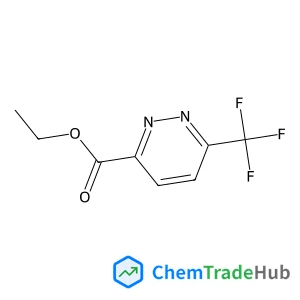
Ethyl 6-(trifluoromethyl)pyridazine-3-carboxylate
CAS Number:
1192155-06-8
Molecular Formula:
C8H7F3N2O2
Recommended Suppliers





Disclaimer
This page provides academic journal information for reference and research purposes only. We are not affiliated with any journal publishers and do not handle publication submissions. For publication-related inquiries, please contact the respective journal publishers directly.
If you notice any inaccuracies in the information displayed, please contact us at support@chemtradehub.com. We will promptly review and address your concerns.