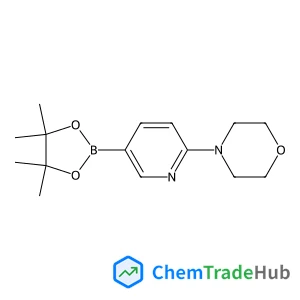
4-(5-(4,4,5,5-tetramethyl-1,3,2-dioxaborolan-2-yl)pyridin-2-yl)morpholine
CAS Number:
485799-04-0
Molecular Formula:
C15H23BN2O3
Darren J. Simpson, Alagu Thilagam, Giuseppe P. Cavallaro, Klara Kaplun, Andrea R. Gerson
We report the in-flight CVD coating with smooth 1–2 nm thick SiO2 of pure and doped rutile particles via the oxidation of SiCl4 vapour introduced in the high temperature zone of a purpose built thermal reactor. The effectiveness of the coatings was determined by a combination of electron microscopy, surface analysis and photocatalytic measurements. No excess Cl was detected on the coated pigment particles indicating the complete oxidation of the SiCl4 precursor. In conjunction with the experimental outcomes of this optimised deposition process, we use first-principles density functional and semi-empirical quantum chemical calculations to examine the underlying electronic processes which determined the morphology and photocatalytic properties of the coated titania. We highlight the presence of low lying valence electronic states which reduce photocatalytic activity, and as a consequence decrease the population of photo-excited titania electrons which transfer to the surrounding matrix. Born–Oppenheimer molecular dynamics (MD) simulations indicate that the coating process is completed within the order of 10 ps.

Herald of the Russian Academy of Sciences

NDT & E International

Acta Metallurgica Sinica-English Letters

Critical Reviews in Solid State and Materials Sciences

Bioorganic & Medicinal Chemistry

Bioorganic & Medicinal Chemistry Letters

Polycyclic Aromatic Compounds

Journal of the Indian Institute of Science

Journal of Chemical Sciences

Main Group Chemistry
Xie-Huang Sheng, Cheng-Cheng Cui, Chao Shan, Yu-Zhen Li, Duo-Hong Sheng, Bin Sun, De-Zhan Chen
DOI: 10.1039/C8OB00546J
Wenzheng Zhang, Guangyang Xu, Lin Qiu, Jiangtao Sun
DOI: 10.1039/C8OB00826D
Anton S. Makarov, Alexander A. Fadeev, Maxim G. Uchuskin
DOI: 10.1039/D1QO01281A
Chunyu Han, Xianhai Tian, Lina Song, Yaowen Liu
DOI: 10.1039/D1QO01401C
Xiao-Lan Liu, Luo-Bin Jiang, Mu-Peng Luo, Zhi Ren, Shou-Guo Wang
DOI: 10.1039/D1QO01223A
Debashruti Bandyopadhyay, Annaram Thirupathi, Nagsen Munjaji Dhage, Nirmala Mohanta, S. Peruncheralathan
DOI: 10.1039/C8OB01712C
Weilian Qiu, Weiyi Wang, Yin Liu, Renhua Fan
DOI: 10.1039/D1QO01257F
Li-Wen Sun, Zi-Lun Yu, Xin-Long Luo, Mengtao Ma, Zhi-Liang Shen, Xue-Qiang Chu
DOI: 10.1039/D1QO01439K
Olga Bakulina, Dmitry Dar'in, Mikhail Krasavin
DOI: 10.1039/C8OB00768C
Xiaolong Zhu, Xuan Li, Enjie Zhu, Qirong Deng, Xiuyan Song, Jian Lv
DOI: 10.1039/D1QO01570B
(1R,3S)-1,3-Cyclopentanediol finds applications in various industries. In the ph...
When handling N'-[4-(Dimethylamino)phenyl]-N,N-dimethyl-1,4-benzenediamine, it i...
There are several alternatives to 5-(2,4-Difluorophenyl)-2-methoxypyrimidine in ...
1-(3-Methoxyphenoxy)propan-2-ol (CAS: 382141-68-6) must comply with the Globally...
Tetrodotoxin Citrate is extremely dangerous and should be handled with extreme c...
2-Methyl-2-propanyl [(1R,3S)-3-hydroxycyclopentyl]carbamate (CAS: 225641-84-9) i...
Waste containing 4-(2-Hydroxyhexafluoroisopropyl)Benzoic Acid (CAS: 16261-80-6) ...
2-Methyl-2-proanyl {(2S)-1-[(benzyloxy)amino]-3-hydroxy-3-methyl-1-oxo-2-butanyl...
Benzeneethanamine, α-ethyl-, hydrochloride (1:1) is an organic compound with the...
In the synthesis of compounds similar to 3-{(E)-[4-(Dimethylamino)phenyl]diazeny...

Physical Chemistry Chemical Physics (PCCP) is an international journal co-owned by 19 physical chemistry and physics societies from around the world. This journal publishes original, cutting-edge research in physical chemistry, chemical physics and biophysical chemistry. To be suitable for publication in PCCP, articles must include significant innovation and/or insight into physical chemistry; this is the most important criterion that reviewers and Editors will judge against when evaluating submissions. The journal has a broad scope and welcomes contributions spanning experiment, theory, computation and data science. Topical coverage includes spectroscopy, dynamics, kinetics, statistical mechanics, thermodynamics, electrochemistry, catalysis, surface science, quantum mechanics, quantum computing and machine learning. Interdisciplinary research areas such as polymers and soft matter, materials, nanoscience, energy, surfaces/interfaces, and biophysical chemistry are welcomed if they demonstrate significant innovation and/or insight into physical chemistry. Joined experimental/theoretical studies are particularly appreciated when complementary and based on up-to-date approaches.