


Mixed carboxylic–sulfonic anhydride in reaction with imines: a straightforward route to water-soluble β-lactams via a Staudinger-type reaction
Literature Information
Publication Date
2018-05-08
DOI
10.1039/C8OB00768C
Impact Factor
3.876
Authors
Olga Bakulina, Dmitry Dar'in, Mikhail Krasavin
View Original
Abstract
The first example of employing a mixed carboxylic–sulfonic anhydride in reaction with imines is reported. Unlike its well-studied isostere homophthalic anhydride, benzo[c][1,2]oxathiin-3(4H)-one 1,1-dioxide gave no product of a formal [4 + 2] cycloaddition and only followed an alternative reaction pathway toward β-lactams, presumably, via a formal [2 + 2] cycloaddition (a Staudinger-type reaction). Optimized reaction conditions involve the use of triethylamine as a base promoter, which also allows isolating the product β-lactam benzene sulfonic acids as respective triethylammonium salts by conventional column chromatography. The reaction shows some preference to trans-isomer formation; pure diastereomers can be isolated in some cases.
Recommended Journals

Bioorganic & Medicinal Chemistry

Critical Reviews in Solid State and Materials Sciences

Polycyclic Aromatic Compounds

Journal of Asian Natural Products Research

Acta Metallurgica Sinica-English Letters

Cellulose

Journal of Chemical Sciences

Main Group Chemistry

Biocatalysis and Biotransformation

Journal of the Indian Institute of Science
Related Literature
The protecting group enabled para-selective C–H benzylation of anilides via iron(ii) catalysis: a convenient approach for the synthesis of triarylmethanes
Yi Han, Guobao Li, Lingling Liu, Chenyang Dai, Da-Qing Shi, Yingsheng Zhao
2020-06-10
Research Article
DOI: 10.1039/D0QO00402B
Straight access to highly fluorescent angular indolocarbazoles via merging Au- and Mo-catalysis
Fernando Martínez-Lara, Anisley Suárez, Samuel Suárez-Pantiga, M. José Tapia, Roberto Sanz
2020-06-10
Research Article
DOI: 10.1039/D0QO00405G
Synthesis of a non-natural glucose-2-phosphate ester able to dupe the acc system of Agrobacterium fabrum
Si-Zhe Li, Armelle Vigouroux, Mohammed Ahmar, Abbas El Sahili, Laurent Soulère, Laïla Sago, David Cornu, Solange Moréra, Yves Queneau
2019-01-04
Paper
DOI: 10.1039/C8OB03086C
Facile synthesis of the daphnane and tigliane framework by semi-flow tube-based-bubbling photooxidation and diastereoselective conjugate addition
Zhengwei Ding, Zhi Liu, Guanghu Tong, Linlin Hu, Yangqing He, Yueyun Bao, Zhouhang Lei, Hailong Zhang
2020-06-09
Research Article
DOI: 10.1039/D0QO00424C
A semipinacol rearrangement of vinylogous α-ketol cocatalyzed by a cinchona-based primary amine and N-Boc-phenylglycines: mechanisms, roles of catalysts and the origin of enantioselectivity
Chao-Xian Yan, Fang-Ling Yang, Ka Lu, Xing Yang, Pan-Pan Zhou, Xiangfeng Shao
2020-06-05
Research Article
DOI: 10.1039/D0QO00506A
Oxidative N-heterocyclic carbene-catalyzed [3 + 3] annulation reaction of enals with benzofuran-3-ones: efficient access to benzofuran-fused δ-lactones
Zhan-Yong Wang, Ting Yang, Kai-Kai Wang, Rongxiang Chen, Menghan Liu
2020-03-17
Research Article
DOI: 10.1039/D0QO00161A
Direct organocatalytic asymmetric Michael reaction of fluorine hemiaminal-type nucleophile to 4-nitro-5-styrylisoxazoles
Luyao Li, Bo Zhu, Huihui Fan, Zhiyong Jiang, Junbiao Chang
2020-04-17
Research Article
DOI: 10.1039/D0QO00348D
Hydroaminoalkylation of sterically hindered alkenes with N,N-dimethyl anilines using a scandium catalyst
Jianhong Su, Yiqun Zhou, Xin Xu
2018-12-10
Paper
DOI: 10.1039/C8OB02657B
Biosynthesis of bioactive natural products from Basidiomycota
Yit-Heng Chooi
2018-12-14
Review Article
DOI: 10.1039/C8OB02774A
You might also like
Compound Q&A
What industries use (1R,3S)-1,3-Cyclopentanediol (CAS: 16326-97-9)?
(1R,3S)-1,3-Cyclopentanediol finds applications in various industries. In the ph...
16326-97-9(1R,3S)-1,3-Cyclopen...
Compound Q&A
What precautions should be taken when handling N'-[4-(Dimethylamino)phenyl]-N,N-dimethyl-1,4-benzenediamine (CAS: 637-31-0)?
When handling N'-[4-(Dimethylamino)phenyl]-N,N-dimethyl-1,4-benzenediamine, it i...
637-31-0N'-[4-(Dimethylamino...
Compound Q&A
Are there alternatives to 5-(2,4-Difluorophenyl)-2-methoxypyrimidine (CAS: 1352318-16-1) in synthesis?
There are several alternatives to 5-(2,4-Difluorophenyl)-2-methoxypyrimidine in ...
1352318-16-15-(2,4-Difluoropheny...
Compound Q&A
What regulatory guidelines apply to 1-(3-Methoxyphenoxy)propan-2-ol (CAS: 382141-68-6)?
1-(3-Methoxyphenoxy)propan-2-ol (CAS: 382141-68-6) must comply with the Globally...
382141-68-61-(3-Methoxyphenoxy)...
Compound Q&A
Is Tetrodotoxin Citrate (CAS: 18660-81-6) safe?
Tetrodotoxin Citrate is extremely dangerous and should be handled with extreme c...
18660-81-6Tetrodotoxin Citrate
Compound Q&A
What are the main uses of 2-Methyl-2-propanyl [(1R,3S)-3-hydroxycyclopentyl]carbamate (CAS: 225641-84-9)?
2-Methyl-2-propanyl [(1R,3S)-3-hydroxycyclopentyl]carbamate (CAS: 225641-84-9) i...
225641-84-92-Methyl-2-propanyl ...
Compound Q&A
How should waste containing 4-(2-Hydroxyhexafluoroisopropyl)Benzoic Acid (CAS: 16261-80-6) be handled?
Waste containing 4-(2-Hydroxyhexafluoroisopropyl)Benzoic Acid (CAS: 16261-80-6) ...
16261-80-64-(2-Hydroxyhexafluo...
Compound Q&A
How is 2-Methyl-2-proanyl {(2S)-1-[(benzyloxy)amino]-3-hydroxy-3-methyl-1-oxo-2-butanyl}carbamate (CAS: 102507-19-7) typically synthesized?
2-Methyl-2-proanyl {(2S)-1-[(benzyloxy)amino]-3-hydroxy-3-methyl-1-oxo-2-butanyl...
102507-19-72-Methyl-2-propanyl ...
Compound Q&A
What is Benzeneethanamine, α-ethyl-, hydrochloride (1:1) (CAS: 20735-15-3)?
Benzeneethanamine, α-ethyl-, hydrochloride (1:1) is an organic compound with the...
20735-15-3Benzeneethanamine, α...
Compound Q&A
Are there alternatives to 3-{(E)-[4-(Dimethylamino)phenyl]diazenyl}benzoic acid (CAS: 20691-84-3) in synthesis?
In the synthesis of compounds similar to 3-{(E)-[4-(Dimethylamino)phenyl]diazeny...
20691-84-33-{(E)-[4-(Dimethyla...
Source Journal
Organic & Biomolecular Chemistry

CiteScore:
3.4
Self-citation Rate:
10.3%
Articles per Year:
1041
Organic & Biomolecular Chemistry (OBC) publishes original and high impact research and reviews in organic chemistry. We welcome research that shows new or significantly improved protocols or methodologies in total synthesis, synthetic methodology or physical and theoretical organic chemistry as well as research that shows a significant advance in the organic chemistry or molecular design aspects of chemical biology, catalysis, supramolecular and macromolecular chemistry, theoretical chemistry, mechanism-oriented physical organic chemistry, medicinal chemistry or natural products. Articles published in the journal should report new work which makes a highly-significant impact in the field. Routine and incremental work is generally not suitable for publication in the journal. More details about key areas of our scope are below. In all cases authors should include in their article clear rationale for why their research has been carried out.
Recommended Compounds
![N,N'-1,2-Ethanediylbis[2-(vinylsulfonyl)acetamide] structure](https://static.chemtradehub.com/structs/667/66710-66-5-b556.webp "N,N'-1,2-Ethanediylbis[2-(vinylsulfonyl)acetamide] structure")
N,N'-1,2-Ethanediylbis[2-(vinylsulfonyl)acetamide]
CAS Number:
66710-66-5
Molecular Formula:
C10H16N2O6S2
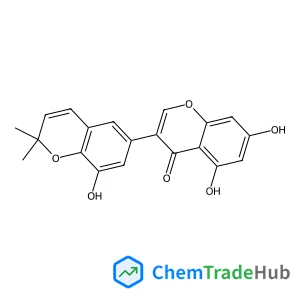
5,7,8'-Trihydroxy-2',2'-dimethyl-2'H,4H-3,6'-bichromen-4-one
CAS Number:
129280-33-7
Molecular Formula:
C20H16O6
Recommended Suppliers





Disclaimer
This page provides academic journal information for reference and research purposes only. We are not affiliated with any journal publishers and do not handle publication submissions. For publication-related inquiries, please contact the respective journal publishers directly.
If you notice any inaccuracies in the information displayed, please contact us at support@chemtradehub.com. We will promptly review and address your concerns.