


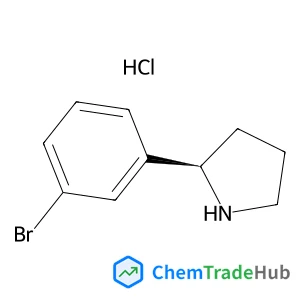
(2R)-2-(3-Bromophenyl)pyrrolidine hydrochloride (1:1)
CAS Number:
1391550-13-2
Molecular Formula:
C10H13BrClN
Wei-Sheng Huang, Ying-Hsien Wu, Hong-Cheu Lin, Jiann T. Lin
A series of novel electroluminescent main-chain copolymers containing fluorene-1,4-bis(9-octyl-9H-carbarzol-3yl)-2,5-dioctyloxy-benzene (BCB) segments and phosphorescent benzimidazole-based iridium (Ir) complexes in the backbones were synthesized by Suzuki coupling reaction. The relative intensity of phosphorescence and fluorescence were affected by the energy transfer and back transfer efficiencies between the polymer backbones and the iridium units as evidenced by solid state PL and EL spectra. PLED devices with a configuration of ITO/PEDOT: PSS (70 nm)/Ir-copolymers (P3–P10) or Ir-doped copolymers (P1–P2 doped with Ir-complex 4) (60–80 nm)/TPBI (40 nm)/LiF (1 nm)/Al (120 nm) were fabricated, where electroluminescence (EL) efficiencies depended on the chemical constituents and the triplet energies of the copolymers. PLED devices based on Ir-containing copolymerP8 or copolymerP2 doped with 5 mol% Ir-complex 4 exhibited white-light emissions with EL properties of ηext,max = 0.93%, ηc,max = 1.88 cd A−1, and Lmax = 1960 cd m−2 from the former (P8), and ηext,max = 4.09%, ηc,max = 10.94 cd A−1, and Lmax = 4870 cd m−2 from the latter (P2 doped with Ir-complex 4), respectively. The CIE coordinates, color-rendering index (CRI) and correlated color temperature (CCT) of the two PLED devices were (0.33, 0.30) at 13 V, 74 and 5966 K for the former, and (0.35, 0.32) at 15 V, 82 and 6147 K for the latter, respectively.

Journal of Physics and Chemistry of Solids

Proceedings of the National Academy of Sciences of the United States of America

Organic Preparations and Procedures International

Fibre Chemistry

Pure and Applied Chemistry

Journal of Organometallic Chemistry

Molecular Pharmacology

Nature

Journal of Medicinal Chemistry

Kinetics and Catalysis
Leslie J. Oates, Richard F. W. Jackson, Michael H. Block
DOI: 10.1039/B208632H
Biao Wang, Yifeng Wang, Yidong Jiang, Mingming Chu, Suosuo Qi, Wanzhen Ju, Danqian Xu
DOI: 10.1039/C8OB01943F
Kuo-Hsin Chen, Yi-Jung Chiang, Jia-Liang Zhu
DOI: 10.1039/C8OB01489B
Mingsheng Wu, Xianghu Zhao, Yisen Liu, Song Cao
DOI: 10.1039/C8OB02117A
Samuel D. Griggs, Nathan Thompson, Daniel T. Tape, Marie Fabre, Paul A. Clarke
DOI: 10.1039/C8OB90117A
Jiaxi Zhang, Eike G. Hübner, Jan C. Namyslo, Martin Nieger, Andreas Schmidt
DOI: 10.1039/C8OB01916A
Jennifer Frommer, Beatrice Karg, Klaus Weisz, Sabine Müller
DOI: 10.1039/C8OB02246A
Martin G. Banwell, Alison J. Edwards, Jason A. Smith, Ernest Hamel, Pascal Verdier-Pinard
DOI: 10.1039/B209992F
Michael Harding, Robert Hodgson, Tahir Majid, Kenneth J. McDowall
DOI: 10.1039/B208781B
Xianwei Li, Tianzhang Wang, Yu-Jing Lu, Shaomin Ji, Yanping Huo, Bifu Liu
DOI: 10.1039/C8OB01532E
N-(4-Methoxybenzyl)-2-pyridinamine (CAS: 52818-63-0) is increasingly being used ...
When handling Ethyl 4-(2-chlorophenyl)-1,3-thiazole-2-carboxylate, appropriate p...
Diethyldiselane (CAS: 628-39-7) is classified under the Globally Harmonized Syst...
The market for oxocopper (CAS: 12053-18-8) is primarily driven by its use in cat...
The market for 5-{[(2-Methyl-2-propanyl)oxy]carbonyl}-5-azaspiro[2.4]heptane-7-c...
2-(1-Pyrrolidinyl)-4-pyridinamine is a chemical compound with the CAS number 359...
2-(3-Pyridinyl)-1-azabicyclo[2.2.2]octane (CAS: 91556-75-1) is a crystalline sol...
(S)-Alpha-allyl-proline hydrochloride is usually synthesized via a Wittig reacti...
3-Methyl-1,2-oxazole-5-carboxylic acid (CAS: 4857-42-5) is an organic compound w...
Lys-SMCC-DM1 is synthesized via a multi-step process involving the coupling of S...

Polymer Chemistry welcomes submissions in all areas of polymer science that have a strong focus on macromolecular chemistry. Manuscripts may cover a broad range of fields, yet no direct application focus is required.
![1-(1-Benzyl-1,2,3,6-tetrahydropyridin-4-yl)-1H-benzo[d]imidazol-2(3H)-one structure](https://static.chemtradehub.com/structs/603/60373-71-9-7dfb.webp "1-(1-Benzyl-1,2,3,6-tetrahydropyridin-4-yl)-1H-benzo[d]imidazol-2(3H)-one structure")




