













DFT studies of the degradation mechanism of methyl mercury activated by a sulfur-rich ligand
Literature Information
Publication Date
2010-01-28
DOI
10.1039/B918402C
Impact Factor
3.676
Authors
Xichen Li, Rong-Zhen Liao, Wenchang Zhou, Guangju Chen
View Original
Abstract
We describe theoretical insights into the mechanism of Hg–C bond protonolysis in methyl mercury coordinated by the tris(2-mercapto-1-tert-butylimidazolyl)hydroborato ligand, the structural and functional analogue of the organomercurial lyase MerB. Different cleavage pathways including both frontside and backside attack transition states were systematically studied by the hybrid density functional method B3LYP. Dependence of Hg–C bond activation on the primary sulfur coordination number of mercury was elaborated, and conceptual DFT indexes were suggested to be more appropriate than gross charge of atom sites in interpreting the dependence. Furthermore, absence of configurational inversion in MerB-catalyzed reactions was accounted for by examinations of the backside protonolysis pathways in the present system. Lastly, a rationalization was provided about the choice between different characteristics of transition states including both four-center and six-center ones.
Related Literature
Fluorescent covalent organic frameworks for environmental pollutant detection sensors and enrichment sorbents: a mini-review
Qiuyi Liu, Yulian Yang, Yuemeng Zou, Luchun Wang, Zhu Li, Mingyue Wang, Lingling Li, Meng Tian, Dandan Wang, Die Gao
2023-10-18
Minireview
DOI: 10.1039/D3AY01166F
Method development for forensic oil identification by direct analysis in real time time-of-flight mass spectrometry
Krishnaja Tikkisetty, Taylor Filewood, Jeffrey Yan, Honoria Kwok, Pamela Brunswick, Robert Cody, Dayue Shang
2023-11-02
Paper
DOI: 10.1039/D3AY01282D
Molecular beacon decorated silver nanowires for quantitative miRNA detection by a SERS approach
Martina Banchelli, Sara Tombelli, Marella de Angelis, Cristiano D'Andrea, Cosimo Trono, Francesco Baldini, Ambra Giannetti, Paolo Matteini
2023-10-27
Paper
DOI: 10.1039/D3AY01661G
A tuning fork-shaped bisbenzothiazole derivative as a pH-responsive digital fluorescent probe and its ex vivo evaluation
Priya Ranjan Sahoo, Nikhil Kumar, Keloth Sairam, L. K. Gulati, G. K. Gulati, Anupama Datta, Satish Kumar
2023-11-20
Paper
DOI: 10.1039/D3AY01702H
Recent advances in small-molecule fluorescent probes with the function of targeting cancer receptors
Xinke Li, Caiyun Liu, Hanchuang Zhu, Kun Wang, Xiaohua Ren, Lixue Ma, Xiaohui Zhang, Mengyuan Liu, Baocun Zhu
2023-11-01
Critical Review
DOI: 10.1039/D3AY01387A
Preparation and characterization of iron(iii) nitrilotriacetate complex in aqueous solutions for quantitative protein binding experiments
Valentina Borko, Tomislav Friganović, Tin Weitner
2023-11-09
Technical Note
DOI: 10.1039/D3AY01261A
A homogeneous label-free electrochemical aptasensor based on an omega-like DNA nanostructure for progesterone detection
Zaofen Wang, Weiping Shi, Yunzhu Tan, Bingqian Liu
2023-11-13
Paper
DOI: 10.1039/D3AY01255G
Optimization of heteronuclear ultrafast 2D NMR for the study of complex mixtures hyperpolarized by dynamic nuclear polarization
Clément Praud, Victor Ribay, Arnab Dey, Benoît Charrier, Joris Mandral, Jonathan Farjon, Jean-Nicolas Dumez, Patrick Giraudeau
2023-11-01
Paper
DOI: 10.1039/D3AY01681A
Simultaneous determination of 27 pesticides in corn and cow matrices by ultra-performance liquid chromatography-tandem mass spectrometry
Fengjiao Hao, Yuanyuan Luo, Fengshou Dong, Xinglu Pan, Xiaohu Wu, Yongquan Zheng, Jun Xu
2023-11-08
Paper
DOI: 10.1039/D3AY01473H
A novel copper-based nanozyme: fabrication and application for colorimetric detection of resveratrol
Wanxin Li, Jiaxin Sun, Yao Xin, Yu Han, Yanyang Sun, Aijun Li, Zhi Wang
2023-11-13
Paper
DOI: 10.1039/D3AY01666H
You might also like
Compound Q&A
What regulatory guidelines apply to 6-Bromo-2-methylimidazo[1,2-a]pyrimidine (CAS: 1111638-05-1)?
6-Bromo-2-methylimidazo[1,2-a]pyrimidine (CAS: 1111638-05-1) falls under various...
1111638-05-16-Bromo-2-methylimid...
Compound Q&A
Are there alternatives to 1-Pyrrolidineethanol, β-methyl-α-phenyl-, (αS,βR) (CAS: 123620-80-4) in synthesis?
While there are no direct alternatives, similar compounds like 1-Pyrrolidineetha...
123620-80-41-Pyrrolidineethanol...
Compound Q&A
Is 4-Methyl-2,6-bis(2-methyl-2-propanyl)phenyl methylcarbamate (CAS: 1918-11-2) safe?
4-Methyl-2,6-bis(2-methyl-2-propanyl)phenyl methylcarbamate (CAS: 1918-11-2) is ...
1918-11-24-Methyl-2,6-bis(2-m...
Compound Q&A
How should 2-(3-Bromo-4-fluorophenyl)-1,3-dioxolane (CAS: 77771-04-1) be stored?
2-(3-Bromo-4-fluorophenyl)-1,3-dioxolane (CAS: 77771-04-1) should be stored in a...
77771-04-12-(3-Bromo-4-fluorop...
Compound Q&A
What are the physical and chemical properties of 4,5,6,7-Tetrahydro-1H-indazole hydrochloride (CAS: 18161-11-0)?
4,5,6,7-Tetrahydro-1H-indazole hydrochloride is a white crystalline solid with a...
18161-11-04,5,6,7-Tetrahydro-1...
Compound Q&A
What is (2R)-1-Methoxy-3-phenyl-2-propanamine (CAS: 59919-07-2)?
(2R)-1-Methoxy-3-phenyl-2-propanamine is a chiral organic compound with the CAS ...
59919-07-2(2R)-1-Methoxy-3-phe...
Compound Q&A
What industries use Ethyl 1-(1-phenylethyl)-1H-imidazole-5-carboxylate (CAS: 56649-47-9)?
Ethyl 1-(1-phenylethyl)-1H-imidazole-5-carboxylate is used in various industries...
56649-47-9Ethyl 1-(1-phenyleth...
Compound Q&A
What regulatory guidelines apply to 4-[(1E,3S)-1-(4-Hydroxyphenyl)-1,4-pentadien-3-yl]phenol (CAS: 17676-24-3)?
4-[(1E,3S)-1-(4-Hydroxyphenyl)-1,4-pentadien-3-yl]phenol (CAS: 17676-24-3) falls...
17676-24-34-[(1E,3S)-1-(4-Hydr...
Compound Q&A
What industries use (S)-3-Amino-5-phenylpentanoic acid hydrochloride (CAS: 331846-97-0)?
(S)-3-Amino-5-phenylpentanoic acid hydrochloride is primarily used in the pharma...
331846-97-0(S)-3-Amino-5-phenyl...
Compound Q&A
How is 7-methoxy-1-benzothiophene-2-carboxylic acid (CAS: 88791-07-5) typically synthesized?
7-Methoxy-1-benzothiophene-2-carboxylic acid is typically synthesized by reactin...
88791-07-57-methoxy-1-benzothi...
Source Journal
Physical Chemistry Chemical Physics

CiteScore:
5.5
Self-citation Rate:
10.3%
Articles per Year:
3036
Physical Chemistry Chemical Physics (PCCP) is an international journal co-owned by 19 physical chemistry and physics societies from around the world. This journal publishes original, cutting-edge research in physical chemistry, chemical physics and biophysical chemistry. To be suitable for publication in PCCP, articles must include significant innovation and/or insight into physical chemistry; this is the most important criterion that reviewers and Editors will judge against when evaluating submissions. The journal has a broad scope and welcomes contributions spanning experiment, theory, computation and data science. Topical coverage includes spectroscopy, dynamics, kinetics, statistical mechanics, thermodynamics, electrochemistry, catalysis, surface science, quantum mechanics, quantum computing and machine learning. Interdisciplinary research areas such as polymers and soft matter, materials, nanoscience, energy, surfaces/interfaces, and biophysical chemistry are welcomed if they demonstrate significant innovation and/or insight into physical chemistry. Joined experimental/theoretical studies are particularly appreciated when complementary and based on up-to-date approaches.
Recommended Compounds
![2-Methyl-2-propanyl 4-{2-fluoro-5-[(4-oxo-3,4-dihydro-1-phthalazinyl)methyl]benzoyl}-1-piperazinecarboxylate structure](https://static.chemtradehub.com/structs/763/763114-04-1-65a9.webp "2-Methyl-2-propanyl 4-{2-fluoro-5-[(4-oxo-3,4-dihydro-1-phthalazinyl)methyl]benzoyl}-1-piperazinecarboxylate structure")
2-Methyl-2-propanyl 4-{2-fluoro-5-[(4-oxo-3,4-dihydro-1-phthalazinyl)methyl]benzoyl}-1-piperazinecarboxylate
CAS Number:
763114-04-1
Molecular Formula:
C25H27FN4O4
![Benzeneacetic acid, 2-[(2,6-dichlorophenyl)amino]-, compd. with 1-pyrrolidineethanol (1:1) structure](https://static.chemtradehub.com/structs/119/119623-66-4-5301.webp "Benzeneacetic acid, 2-[(2,6-dichlorophenyl)amino]-, compd. with 1-pyrrolidineethanol (1:1) structure")
Benzeneacetic acid, 2-[(2,6-dichlorophenyl)amino]-, compd. with 1-pyrrolidineethanol (1:1)
CAS Number:
119623-66-4
Molecular Formula:
C20H24Cl2N2O3

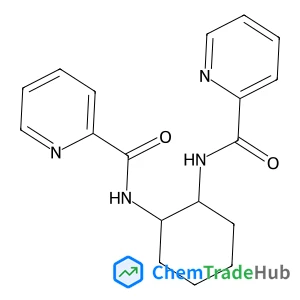
N,N'-(1R,2R)-1,2-Cyclohexanediyldi(2-pyridinecarboxamide)
CAS Number:
218290-24-5
Molecular Formula:
C18H20N4O2
Recommended Suppliers



Disclaimer
This page provides academic journal information for reference and research purposes only. We are not affiliated with any journal publishers and do not handle publication submissions. For publication-related inquiries, please contact the respective journal publishers directly.
If you notice any inaccuracies in the information displayed, please contact us at support@chemtradehub.com. We will promptly review and address your concerns.