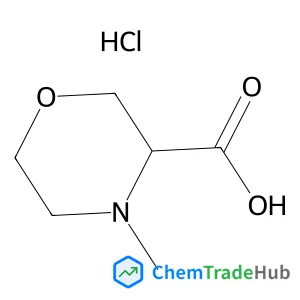
4-Methyl-3-morpholinecarboxylic acid hydrochloride (1:1)
CAS Number:
1240518-90-4
Molecular Formula:
C6H12ClNO3
Priya Ranjan Sahoo, Nikhil Kumar, Keloth Sairam, L. K. Gulati, G. K. Gulati, Anupama Datta, Satish Kumar
A new highly emissive pH-responsive near-IR active digital probe was designed and synthesized. The probe is based on a bisbenzothiazole motif with a highly vulnerable hydrogen unit attached in an intramolecular fashion. The probe produced a large Stokes shift which was observed to be highly pH dependent. The optical pH dependence can be used for sensing pH over a wide range.
Amit R. Sharma, David E. Weeks
DOI: 10.1039/C8CP05550E
Chao Xu, Feng Long Gu
DOI: 10.1039/C8CP04164D
Jutao Jiao, Yusheng Hou, Hui Wang, Dapeng Wu, Tianxing Wang, Zhaoming Fu, Guoliang Xu, Ruqian Wu
DOI: 10.1039/C8CP04272A
Hong Zhang, Haohao Fu, Antonio Monari
DOI: 10.1039/C8CP03836H
Puja Adhikari, Neng Li, Paul Rulis, Wai-Yim Ching
DOI: 10.1039/C8CP05610B
Gaoqi Weng, Ercheng Wang, Fu Chen, Huiyong Sun, Zhe Wang
DOI: 10.1039/C9CP01674K
Saurabh Mishra, Jer-Lai Kuo, G. Naresh Patwari
DOI: 10.1039/C8CP02448K
Carolina Olea Ulloa, Miguel Ponce-Vargas, Alvaro Muñoz-Castro
DOI: 10.1039/C8CP04936J
F. Crasto de Lima, Gerson J. Ferreira, R. H. Miwa
DOI: 10.1039/C8CP03792B
Christoph Scherer, Denis Andrienko
DOI: 10.1039/C8CP00746B
4-Nitrophenyl phosphate disodium salt hexahydrate is primarily used as a substra...
2-(Trifluoromethyl)-1,3-oxazole-4-carboxylic Acid (CAS: 1060816-01-4) is widely ...
2-Fluoro-4-biphenylcarboxylic acid should be stored in a cool, dry place at room...
Prednisolone-21-Carboxylic Acid is primarily used in the pharmaceutical industry...
4-(Hydrazinomethyl)-1,2,3-benzenetriol (CAS: 3614-72-0) should be stored in a co...
4-Amino-1-methyl-1H-pyrazole-5-carboxylic acid hydrochloride (CAS: 92534-70-8) i...
Dehydropachymic acid (CAS: 77012-31-8) is regulated by various agencies. It fall...
The market and research trends for 6-[(2,2-Dimethylpropanoyl)amino]nicotinic aci...
1,10-Phenanthroline-2,9-dicarbaldehyde should be stored in a cool, dry place awa...
5-Carbamoyl-11-oxo-10,11-dihydro-5H-dibenzo[b,f]azepin-10-yl acetate can be synt...
Analytical Methods welcomes early applications of new analytical and bioanalytical methods and technology demonstrating the potential for societal impact. We require that methods and technology reported in the journal are sufficiently innovative, robust, accurate, and compared to other available methods for the intended application. Developments with interdisciplinary approaches are particularly welcome. Systems should be proven with suitably complex and analytically challenging samples. We encourage developments within, but not limited to, the following technologies and applications: global health, point-of-care and molecular diagnostics biosensors and bioengineering drug development and pharmaceutical analysis applied microfluidics and nanotechnology omics studies, such as proteomics, metabolomics or glycomics environmental, agricultural and food science neuroscience biochemical and clinical analysis forensic analysis industrial process and method development