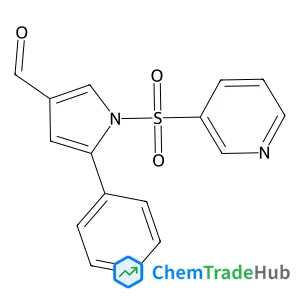
5-Phenyl-1-(pyridin-3-ylsulfonyl)-1H-pyrrole-3-carbaldehyde
CAS Number:
881676-90-0
Molecular Formula:
C16H12N2O3S
Min Li, Sergio L. De Rooy, David K. Bwambok, Bilal El-Zahab, John F. DiTusa, Isiah M. Warner
Novel room temperature magnetic chiral ionic liquids derived from amino acids were synthesized and their magnetic properties as well as chiral discrimination abilities were investigated.
Nobutaka Yoshimura, Atsushi Kobayashi, Wataru Genno, Takashi Okubo, Masaki Yoshida, Masako Kato
DOI: 10.1039/D0SE00151A
Mingyan Chuai, Hongpeng Zhang, Yu Tong, Kewei Zhang, Mingzhe Zhang
DOI: 10.1039/D0SE00366B
Hella Logtenberg, Laurens-Jan C. Jellema, Maria J. Lopez-Martinez, Jetsuda Areephong, Elisabeth Verpoorte, Ben L. Feringa, Wesley R. Browne
DOI: 10.1039/C1AY05475A
Yamin Zhang, Biling Jiang, Chen Guo, Liping Liu, Jian Xu, Yujue Wang, Chen Shen, Jinjin Zhu, Guanxin Shen, Hao Jiang, Jintao Zhu, Juan Tao
DOI: 10.1039/D1BM00373A
Sreerangappa Ramesh, Makhlouf Amoura, Damien P. Debecker
DOI: 10.1039/D0SE00211A
Oindrila Gupta, Sagar Roy, Somenath Mitra
DOI: 10.1039/D0SE00461H
Yu-Tong Mu, Adam Z. Weber, Zhao-Lin Gu, Tobias Schuler, Wen-Quan Tao
DOI: 10.1039/D0SE00560F
Yuying Chang, Cenqi Yan, Qianguang Yang, Zhipeng Kan, Ranbir Singh, Manish Kumar, Gang Li, Shirong Lu, Tainan Duan
DOI: 10.1039/D0SE00335B
(1R,3S)-1,3-Cyclopentanediol finds applications in various industries. In the ph...
When handling N'-[4-(Dimethylamino)phenyl]-N,N-dimethyl-1,4-benzenediamine, it i...
There are several alternatives to 5-(2,4-Difluorophenyl)-2-methoxypyrimidine in ...
1-(3-Methoxyphenoxy)propan-2-ol (CAS: 382141-68-6) must comply with the Globally...
Tetrodotoxin Citrate is extremely dangerous and should be handled with extreme c...
2-Methyl-2-propanyl [(1R,3S)-3-hydroxycyclopentyl]carbamate (CAS: 225641-84-9) i...
Waste containing 4-(2-Hydroxyhexafluoroisopropyl)Benzoic Acid (CAS: 16261-80-6) ...
2-Methyl-2-proanyl {(2S)-1-[(benzyloxy)amino]-3-hydroxy-3-methyl-1-oxo-2-butanyl...
Benzeneethanamine, α-ethyl-, hydrochloride (1:1) is an organic compound with the...
In the synthesis of compounds similar to 3-{(E)-[4-(Dimethylamino)phenyl]diazeny...

ChemComm publishes urgent research which is of outstanding significance and interest to experts in the field, while also appealing to the journal’s broad chemistry readership. Our communication format is ideally suited to short, urgent studies that are of such importance that they require accelerated publication. Our scope covers all topics in chemistry, and research at the interface of chemistry and other disciplines (such as materials science, nanoscience, physics, engineering and biology) where there is a significant novelty in the chemistry aspects. Major topic areas covered include: Analytical Chemistry Catalysis Chemical Biology and medicinal chemistry Computational Chemistry and Machine Learning Energy and sustainable chemistry Environmental Chemistry Green Chemistry Inorganic Chemistry Materials Chemistry Nanoscience Organic Chemistry Physical Chemistry Polymer Chemistry Supramolecular Chemistry