














Photosensitizing ruthenium(ii)–dye multilayers: photoinduced charge separation and back electron transfer suppression
Literature Information
Publication Date
2020-04-23
DOI
10.1039/D0SE00151A
Impact Factor
6.367
Authors
Nobutaka Yoshimura, Atsushi Kobayashi, Wataru Genno, Takashi Okubo, Masaki Yoshida, Masako Kato
View Original
Abstract
Photocatalytic H2 evolution activity of three types of Ru(II)-photosensitizer(PS)-multilayered Pt-cocatalyst loaded TiO2 nanoparticles, RuCP2@Pt–TiO2, RuCP2–Zr–RuP6@Pt–TiO2, and RuCP2–Zr–RuP4–Zr–RuP6@Pt–TiO2 were investigated in the presence of the redox-reversible iodide electron donor aqueous solution. The apparent quantum yield (AQY) significantly improved by about 40 times by increasing the number of Ru(II)–PS layers and decreasing the loading amount of Pt cocatalyst on the surface of TiO2 nanoparticles. The zeta potential measurement suggests that the Zr4+ cations between the PS-layers acted as the iodide capturing sites to promote the electron donation. Photocurrent–voltage characteristics of the Ru(II)–PS-multilayered photoelectrodes RuCP2@TiO2–ITO, RuCP2–Zr–RuP6@TiO2–ITO, and RuCP2–Zr–RuP4–Zr–RuP6@TiO2–ITO in aqueous I−/I3− electrolyte solution revealed that the thicker Ru(II)–PS-layer with the Zr4+ cations contributes not only to suppressing the back electron transfer from Pt–TiO2 surface to the oxidized iodine species but also to enhancing the photoinduced electron injection.
Related Literature
Correction: Synthesis and structural characterization of bio-based bis(cyclic carbonate)s for the preparation of non-isocyanate polyurethanes
Kamila Błażek, Hynek Beneš, Zuzana Walterová, Sabina Abbrent, Arantxa Eceiza, Tamara Calvo-Correas, Janusz Datta
2021-03-31
Correction
DOI: 10.1039/D1PY90040D
Synthesis of thermo-sensitive polymers with super narrow molecular weight distributions: PET-RAFT polymerization of N-isopropyl acrylamide mediated by cross-linked zinc porphyrins with high active site loadings
Fanfan Li, Yi Yu, Hanyu Lv, Guiting Cai, Yanwu Zhang
2021-03-22
Paper
DOI: 10.1039/D0PY01643H
Heterotellurium-containing macrocycles towards degradable tellurium-functionalized polymers
Jieni Hu, Chuanhao Sun, Siqi Li, Yuan Yuan
2021-07-20
Communication
DOI: 10.1039/D1PY00703C
Nucleobase-monofunctionalized supramolecular poly(l-lactide): controlled synthesis, competitive crystallization, and structural organization
Xing Li, Lingling Ni, Chenxuan Sun, Wenqing Xu
2021-05-26
Paper
DOI: 10.1039/D1PY00288K
Polymers and boron neutron capture therapy (BNCT): a potent combination
Anaïs Pitto-Barry
2021-03-23
Review Article
DOI: 10.1039/D0PY01392G
One-shot synthesis of star gradient copolymers with controllable graft density
2021-04-06
Paper
DOI: 10.1039/D1PY00313E
Self-catalyzing photoredox polymerization for recyclable polymer catalysts
Jacob J. Lessard, Georg M. Scheutz, Angie B. Korpusik, Rebecca A. Olson, C. Adrian Figg, Brent S. Sumerlin
2021-04-07
Communication
DOI: 10.1039/D1PY00208B
Hollow microspherical carbazole-based conjugated polymers by photoinduced step-growth polymerization
Tugba Celiker, Ali Suerkan, Sinem Altinisik, Mert Akgun, Sermet Koyuncu
2021-07-21
Paper
DOI: 10.1039/D1PY00822F
You might also like
Compound Q&A
What industries use (1R,3S)-1,3-Cyclopentanediol (CAS: 16326-97-9)?
(1R,3S)-1,3-Cyclopentanediol finds applications in various industries. In the ph...
16326-97-9(1R,3S)-1,3-Cyclopen...
Compound Q&A
What precautions should be taken when handling N'-[4-(Dimethylamino)phenyl]-N,N-dimethyl-1,4-benzenediamine (CAS: 637-31-0)?
When handling N'-[4-(Dimethylamino)phenyl]-N,N-dimethyl-1,4-benzenediamine, it i...
637-31-0N'-[4-(Dimethylamino...
Compound Q&A
Are there alternatives to 5-(2,4-Difluorophenyl)-2-methoxypyrimidine (CAS: 1352318-16-1) in synthesis?
There are several alternatives to 5-(2,4-Difluorophenyl)-2-methoxypyrimidine in ...
1352318-16-15-(2,4-Difluoropheny...
Compound Q&A
What regulatory guidelines apply to 1-(3-Methoxyphenoxy)propan-2-ol (CAS: 382141-68-6)?
1-(3-Methoxyphenoxy)propan-2-ol (CAS: 382141-68-6) must comply with the Globally...
382141-68-61-(3-Methoxyphenoxy)...
Compound Q&A
Is Tetrodotoxin Citrate (CAS: 18660-81-6) safe?
Tetrodotoxin Citrate is extremely dangerous and should be handled with extreme c...
18660-81-6Tetrodotoxin Citrate
Compound Q&A
What are the main uses of 2-Methyl-2-propanyl [(1R,3S)-3-hydroxycyclopentyl]carbamate (CAS: 225641-84-9)?
2-Methyl-2-propanyl [(1R,3S)-3-hydroxycyclopentyl]carbamate (CAS: 225641-84-9) i...
225641-84-92-Methyl-2-propanyl ...
Compound Q&A
How should waste containing 4-(2-Hydroxyhexafluoroisopropyl)Benzoic Acid (CAS: 16261-80-6) be handled?
Waste containing 4-(2-Hydroxyhexafluoroisopropyl)Benzoic Acid (CAS: 16261-80-6) ...
16261-80-64-(2-Hydroxyhexafluo...
Compound Q&A
How is 2-Methyl-2-proanyl {(2S)-1-[(benzyloxy)amino]-3-hydroxy-3-methyl-1-oxo-2-butanyl}carbamate (CAS: 102507-19-7) typically synthesized?
2-Methyl-2-proanyl {(2S)-1-[(benzyloxy)amino]-3-hydroxy-3-methyl-1-oxo-2-butanyl...
102507-19-72-Methyl-2-propanyl ...
Compound Q&A
What is Benzeneethanamine, α-ethyl-, hydrochloride (1:1) (CAS: 20735-15-3)?
Benzeneethanamine, α-ethyl-, hydrochloride (1:1) is an organic compound with the...
20735-15-3Benzeneethanamine, α...
Compound Q&A
Are there alternatives to 3-{(E)-[4-(Dimethylamino)phenyl]diazenyl}benzoic acid (CAS: 20691-84-3) in synthesis?
In the synthesis of compounds similar to 3-{(E)-[4-(Dimethylamino)phenyl]diazeny...
20691-84-33-{(E)-[4-(Dimethyla...
Source Journal
Recommended Compounds

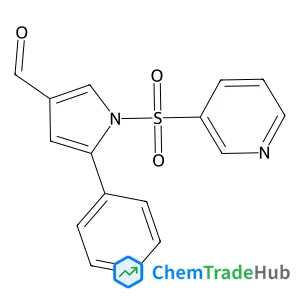
5-Phenyl-1-(pyridin-3-ylsulfonyl)-1H-pyrrole-3-carbaldehyde
CAS Number:
881676-90-0
Molecular Formula:
C16H12N2O3S

(S)-3-((((9H-Fluoren-9-yl)methoxy)carbonyl)amino)-2-phenylpropanoic acid
CAS Number:
1217663-60-9
Molecular Formula:
C24H21NO4
Recommended Suppliers





Disclaimer
This page provides academic journal information for reference and research purposes only. We are not affiliated with any journal publishers and do not handle publication submissions. For publication-related inquiries, please contact the respective journal publishers directly.
If you notice any inaccuracies in the information displayed, please contact us at support@chemtradehub.com. We will promptly review and address your concerns.