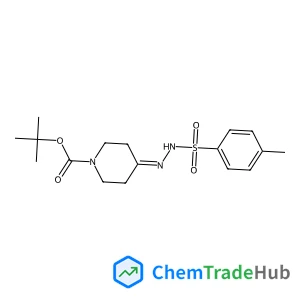
tert-Butyl 4-(2-(p-Tolylsulfonyl)hydrazono)piperidine-1-carboxylate
CAS Number:
1046478-89-0
Molecular Formula:
C17H25N3O4S
Oindrila Gupta, Sagar Roy, Somenath Mitra
Acetone, butanol and ethanol (ABE) mixture separation from dilute aqueous fermentation products is an important process for the biofuel industry. Here, we present a novel approach for ABE recovery using microwave induced membrane distillation (MD). Carbon nanotubes (CNTs) and octadecyl amide (ODA) functionalized CNTs were immobilized on membrane surfaces and were used in sweep gas MD separation of ABE. The ABE flux, separation factor and mass transfer coefficient obtained with CNT and CNT-ODA immobilized membranes were remarkably higher than those of the commercial pristine membrane under various experimental conditions. The ABE flux enhancement reached as high as 105, 100 and 375% for the CNIM and 63, 62 and 175% for CNIM-ODA respectively. The ABE flux obtained was nearly ten times higher than that reported previously for pervaporation. The mass transfer coefficient also increased significantly along with a lower activation energy for the modified membranes. Mechanistically speaking, the immobilization of carbon nanotubes on the active membrane layer led to preferential sorption of ABE leading to enhanced separation. This phenomenon has been validated by the reduction of contact angles for the aqueous ABE mixtures on the CNT and CNT-ODA immobilized membranes indicating enhanced interaction of ABE on the membrane surface.
Xiaoxu Mao, Shoukui Hu, Ke Shang, Guangwei Yang, Jinhao Yan, Chao Ma, Jun Yin
DOI: 10.1039/D1PY00128K
Oksana Suraeva, Beomjin Jeong, Kamal Asadi, Katharina Landfester, Ingo Lieberwirth
DOI: 10.1039/D1PY00117E
Marcel Fickenscher, Tom Reimers, Holger Frey
DOI: 10.1039/D1PY00302J
A. Funes, R. Cuervo-Rodríguez
DOI: 10.1039/D1PY00098E
Shunsuke Ohtani, Natsumi Yamada, Masayuki Gon, Kazuo Tanaka, Yoshiki Chujo
DOI: 10.1039/D1PY00213A
Chai Won Kim, Ji Hye Lee, Seunguk Cho, Hyung Jong Kim, Jinhyo Hwang, Yong Woo Kim, Dae Hyuk Choi, Min Ju Cho, Kwangyeol Lee, Dong Hoon Choi
DOI: 10.1039/D1PY00497B
Peter Černoch, Alessandro Jager, Zulfiya Černochová, Vladimir Sincari, Lindomar J. C. Albuquerque, Rafal Konefal, Ewa Pavlova, Fernando C. Giacomelli, Eliezer Jager
DOI: 10.1039/D1PY00141H
(1R,3S)-1,3-Cyclopentanediol finds applications in various industries. In the ph...
When handling N'-[4-(Dimethylamino)phenyl]-N,N-dimethyl-1,4-benzenediamine, it i...
There are several alternatives to 5-(2,4-Difluorophenyl)-2-methoxypyrimidine in ...
1-(3-Methoxyphenoxy)propan-2-ol (CAS: 382141-68-6) must comply with the Globally...
Tetrodotoxin Citrate is extremely dangerous and should be handled with extreme c...
2-Methyl-2-propanyl [(1R,3S)-3-hydroxycyclopentyl]carbamate (CAS: 225641-84-9) i...
Waste containing 4-(2-Hydroxyhexafluoroisopropyl)Benzoic Acid (CAS: 16261-80-6) ...
2-Methyl-2-proanyl {(2S)-1-[(benzyloxy)amino]-3-hydroxy-3-methyl-1-oxo-2-butanyl...
Benzeneethanamine, α-ethyl-, hydrochloride (1:1) is an organic compound with the...
In the synthesis of compounds similar to 3-{(E)-[4-(Dimethylamino)phenyl]diazeny...
![6-Bromo-2,3-dihydro-1H-pyrido[2,3-b][1,4]oxazine structure](https://static.chemtradehub.com/structs/120/1203499-17-5-b4d1.webp "6-Bromo-2,3-dihydro-1H-pyrido[2,3-b][1,4]oxazine structure")