













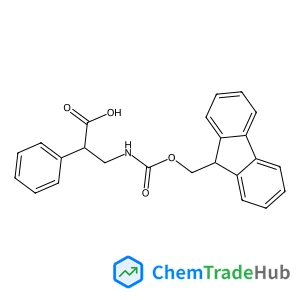
(S)-3-((((9H-Fluoren-9-yl)methoxy)carbonyl)amino)-2-phenylpropanoic acid
CAS Number:
1217663-60-9
Molecular Formula:
C24H21NO4
Yuying Chang, Cenqi Yan, Qianguang Yang, Zhipeng Kan, Ranbir Singh, Manish Kumar, Gang Li, Shirong Lu, Tainan Duan
Thiophene is widely used in organic photovoltaics due to its excellent charge transport properties, simple synthesis, and high stability. In this paper, two simple oligothiophenes, namely, DC5T and 2FDC5T with rhodanine-flanked structures were synthesized and used as donors in nonfullerene small-molecule organic solar cells (NSM-OSCs). Compared to DC5T, 2FDC5T with fluorine atoms substituted on the conjugated backbone exhibited a downshifted highest occupied molecular orbital (HOMO) energy level and blue-shifted light absorption. With IDIC-4F as a small-molecule acceptor, the 2FDC5T-based device exhibited much higher short-circuit current density and open-circuit voltage than the DC5T-based device. As a result, a promising power conversion efficiency (PCE) of 9.02% was achieved for the 2FDC5T/IDIC-4F device, which was 28% higher than that of the DC5T/IDIC-4F device (PCE = 7.03%). Further research indicated that fluorination on the oligothiophene donor assisted the optimization of the active layer morphology and the reduction in the trap-assisted recombination in the device, which could deeply explain the improvement in efficiency.
Xing Li, Lingling Ni, Chenxuan Sun, Wenqing Xu
DOI: 10.1039/D1PY00288K
Brian J. Ree, Yusuke Satoh, Takuya Isono, Toshifumi Satoh
DOI: 10.1039/D1PY00421B
Yongjun Men, Tobias G. Brevé, Antonia G. Denkova, Rienk Eelkema
DOI: 10.1039/D1PY00514F
Kamila Błażek, Hynek Beneš, Zuzana Walterová, Sabina Abbrent, Arantxa Eceiza, Tamara Calvo-Correas, Janusz Datta
DOI: 10.1039/D1PY90040D
Neha Mulchandani, Kazunari Masutani, Sachin Kumar, Hideki Yamane, Yoshiharu Kimura, Vimal Katiyar
DOI: 10.1039/D1PY00429H
Tae Woong Kang, Atsushi Tamura, Yoshinori Arisaka, Nobuhiko Yui
DOI: 10.1039/D1PY00569C
Xiaoxu Mao, Shoukui Hu, Ke Shang, Guangwei Yang, Jinhao Yan, Chao Ma, Jun Yin
DOI: 10.1039/D1PY00128K
(1R,3S)-1,3-Cyclopentanediol finds applications in various industries. In the ph...
When handling N'-[4-(Dimethylamino)phenyl]-N,N-dimethyl-1,4-benzenediamine, it i...
There are several alternatives to 5-(2,4-Difluorophenyl)-2-methoxypyrimidine in ...
1-(3-Methoxyphenoxy)propan-2-ol (CAS: 382141-68-6) must comply with the Globally...
Tetrodotoxin Citrate is extremely dangerous and should be handled with extreme c...
2-Methyl-2-propanyl [(1R,3S)-3-hydroxycyclopentyl]carbamate (CAS: 225641-84-9) i...
Waste containing 4-(2-Hydroxyhexafluoroisopropyl)Benzoic Acid (CAS: 16261-80-6) ...
2-Methyl-2-proanyl {(2S)-1-[(benzyloxy)amino]-3-hydroxy-3-methyl-1-oxo-2-butanyl...
Benzeneethanamine, α-ethyl-, hydrochloride (1:1) is an organic compound with the...
In the synthesis of compounds similar to 3-{(E)-[4-(Dimethylamino)phenyl]diazeny...

![[4-(Isobutyrylamino)phenyl]boronic acid structure](https://static.chemtradehub.com/structs/874/874219-50-8-6ab5.webp "[4-(Isobutyrylamino)phenyl]boronic acid structure")




