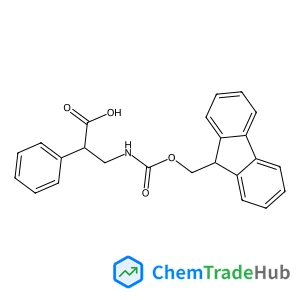
(S)-3-((((9H-Fluoren-9-yl)methoxy)carbonyl)amino)-2-phenylpropanoic acid
CAS Number:
1217663-60-9
Molecular Formula:
C24H21NO4
Hella Logtenberg, Laurens-Jan C. Jellema, Maria J. Lopez-Martinez, Jetsuda Areephong, Elisabeth Verpoorte, Ben L. Feringa, Wesley R. Browne
We report the application of multi-wavelength resonance Raman (rR) spectroscopy for the characterisation of vinyl-bridged polysexithiophene films formed by electropolymerisation on gold electrodes. Resonance Raman spectroscopy of the neutral, polaronic and bipolaronic states of the polymer were determined by in situ μRaman spectroelectrochemistry. In particular the differences in the UV/Vis-NIR absorption spectra of the neutral, monopolaronic and bipolaronic states of the polymer allow for characterising the redox state of the polymer films in PDMS based microfluidic channels. The information obtained in this way allows for determination of the optimum film thickness required for achieving full electrochemical switching between neutral and charged states, which is important in their use in switching surface properties. The approach taken allows for direct analysis of polymer films formed within microchannels.
Yunkai Dai, Zhitao Hu, Xiaoying Wang, Xingliang Liu, Yuanchao Li, Yi Shi, Yongming Chen
DOI: 10.1039/D1PY00106J
Xianheng Shi, Min Liu, Lishan Li, Jiandong Zhang, Haiyan Li, Zhihao Huang, Wei Zhang, Zhengbiao Zhang, Nianchen Zhou, Xiulin Zhu
DOI: 10.1039/D1PY00165E
Tianwen Zhu, Qiaoxi Yu, Weiwen Zheng, Runxin Bei, Wenhui Wang, Minming Wu, Siwei Liu, Zhenguo Chi, Yi Zhang, Jiarui Xu
DOI: 10.1039/D1PY00084E
Fanfan Li, Yi Yu, Hanyu Lv, Guiting Cai, Yanwu Zhang
DOI: 10.1039/D0PY01643H
Chen-Lu He, Zeyu Feng, Yan Li, Manman Zhou, Liyang Zhao, Sizhen Shan, Mengqiao Wang, Xin Chen, Xi-Sheng Wang, Gang Zou
DOI: 10.1039/D1PY00082A
Marc Schmutz
DOI: 10.1039/D1PY00139F
Jurrie Noordijk, Bert Gebben, Monique H. M. Meeusen-Wierts, Katrien V. Bernaerts
DOI: 10.1039/D1PY00005E
Jacob J. Lessard, Georg M. Scheutz, Angie B. Korpusik, Rebecca A. Olson, C. Adrian Figg, Brent S. Sumerlin
DOI: 10.1039/D1PY00208B
Simone Lazar, Ruiqing Shen, Yufeng Quan, Bethany Palen, Qingsheng Wang, Christopher J. Ellison
DOI: 10.1039/D1PY00111F
(1R,3S)-1,3-Cyclopentanediol finds applications in various industries. In the ph...
When handling N'-[4-(Dimethylamino)phenyl]-N,N-dimethyl-1,4-benzenediamine, it i...
There are several alternatives to 5-(2,4-Difluorophenyl)-2-methoxypyrimidine in ...
1-(3-Methoxyphenoxy)propan-2-ol (CAS: 382141-68-6) must comply with the Globally...
Tetrodotoxin Citrate is extremely dangerous and should be handled with extreme c...
2-Methyl-2-propanyl [(1R,3S)-3-hydroxycyclopentyl]carbamate (CAS: 225641-84-9) i...
Waste containing 4-(2-Hydroxyhexafluoroisopropyl)Benzoic Acid (CAS: 16261-80-6) ...
2-Methyl-2-proanyl {(2S)-1-[(benzyloxy)amino]-3-hydroxy-3-methyl-1-oxo-2-butanyl...
Benzeneethanamine, α-ethyl-, hydrochloride (1:1) is an organic compound with the...
In the synthesis of compounds similar to 3-{(E)-[4-(Dimethylamino)phenyl]diazeny...

Analytical Methods welcomes early applications of new analytical and bioanalytical methods and technology demonstrating the potential for societal impact. We require that methods and technology reported in the journal are sufficiently innovative, robust, accurate, and compared to other available methods for the intended application. Developments with interdisciplinary approaches are particularly welcome. Systems should be proven with suitably complex and analytically challenging samples. We encourage developments within, but not limited to, the following technologies and applications: global health, point-of-care and molecular diagnostics biosensors and bioengineering drug development and pharmaceutical analysis applied microfluidics and nanotechnology omics studies, such as proteomics, metabolomics or glycomics environmental, agricultural and food science neuroscience biochemical and clinical analysis forensic analysis industrial process and method development
![(2S)-2-{[(9H-Fluoren-9-ylmethoxy)carbonyl]amino}-4-(methylselanyl)butanoic acid structure](https://static.chemtradehub.com/structs/121/1217852-49-7-f252.webp "(2S)-2-{[(9H-Fluoren-9-ylmethoxy)carbonyl]amino}-4-(methylselanyl)butanoic acid structure")