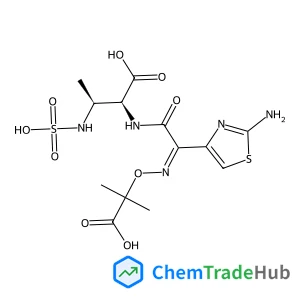
Aztreonam USP Related Compound A (Open-ring Aztreonam)
CAS Number:
87500-74-1
Molecular Formula:
C13H19N5O9S2
F. Flores, J. Ortega, H. Vázquez
A review of our theoretical understanding of the band alignment at organic interfaces is presented with particular emphasis on the metal/organic (MO) case. The unified IDIS (induced density of interface states) and the ICT (integer charge transfer) models are reviewed and shown to describe qualitatively and semiquantitatively the barrier height formation at those interfaces. The IDIS model, governed by the organic CNL (charge neutrality level) and the interface screening includes: (a) charge transfer across the interface; (b) the “pillow” (or Pauli) effect associated with the compression of the metal wavefunction tails; and (c) the molecular dipoles. We argue that the ICT-model can be described as a limiting case of the unified IDIS-model for weak interface screening. For a fully quantitative understanding of the band alignment at organic interfaces, use of DFT (density functional theory) or quantum chemistry methods is highly desirable. In this Perspective review, we concentrate our discussion on DFT and show that conventional LDA or GGA calculations are limited by the “energy gap problem of the organic materials”, because the LDA (or GGA) Kohn–Sham energy levels have to be corrected by the self-interaction energy of the corresponding wavefunction, to provide the appropriate molecule transport energy gap. Image potential and polarization effects at MO interfaces tend to cancel these self-interaction corrections; in particular, we show that for organic molecules lying flat on Cu and Ag, these cancellations are so strong that we can rely on conventional DFT to calculate their interface properties. For Au, however, the cancellations are weaker making it necessary to go beyond conventional DFT. We discuss several alternatives beyond conventional LDA or GGA. The most accurate approach is the well-known GW-technique, but its use is limited by its high demanding computer time. In a very simple approach one can combine conventional DFT with a “scissor” operator which incorporates self-interaction corrections and polarization effects in the organic energy levels. Hybrid potentials combined with conventional DFT represent, probably, the best alternative for having a simple and accurate approach for analyzing organic interfaces. The problem then is to find an appropriate one for both the metal and the organic material in a plane-wave formulation; we show, however, how to overcome this difficulty using a local-orbital basis formulation. As examples of these alternatives, we present some DFT-calculations for several organic interfaces, using either the scissor operator or a hybrid potential, which can be interpreted in terms of the unified IDIS-model.

Environmental Toxicology and Pharmacology

Foundations of Chemistry

CrystEngComm

Mini-Reviews in Medicinal Chemistry

European Journal of Organic Chemistry

Lab on a Chip

Nature Reviews Drug Discovery

Current Pharmaceutical Biotechnology

Coloration Technology

Journal of Enzyme inhibition and Medicinal Chemistry
Kyra Lunstroot, Kris Driesen, Peter Nockemann, Lydie Viau, P. Hubert Mutin, André Vioux, Koen Binnemans
DOI: 10.1039/B920145A
Takashi Yumura, Hiroki Yamashita, Hiroe Torigoe, Hisayoshi Kobayashi, Yasushige Kuroda
DOI: 10.1039/B919032E
Renshun Xu, Xiaochao Shi, Weiping Zhang, Yunpeng Xu, Zhijian Tian, Xiaobing Lu, Xiuwen Han, Xinhe Bao
DOI: 10.1039/B920232N
Ilaria Biondi, Manish Chaubey, Zhaofu Fei, Rosario Scopelliti, Christian G. Hartinger, Yongdan Li, Cinzia Chiappe, Paul J. Dyson
DOI: 10.1039/B920025H
Anna Kaczmarek, Wojciech Bartkowiak
DOI: 10.1039/B819346K
Thomas Fox, Klaus R. Liedl, Christofer S. Tautermann
DOI: 10.1039/C0CP00607F
Jia Jia, Kévin Giffard, Kyle Pellarin, Carly Hewson
DOI: 10.1039/C0CP00586J
Takashi Nakamura, Keiji Yashiro, Kazuhisa Sato, Junichiro Mizusaki
DOI: 10.1039/B823364K
Jung Min Lee, Jelliarko Palgunadi, Jin Hyung Kim, Srun Jung, Young-seop Choi, Minserk Cheong, Hoon Sik Kim
DOI: 10.1039/B915989D
Reshmi Kurian, Michael Filatov
DOI: 10.1039/B918655G
6-(3-Fluorophenyl)picolinic acid is generally considered safe for laboratory use...
(3R)-3-Pyrrolidinol is used in the pharmaceutical industry as a precursor for dr...
When handling (4R,5R)-4,5-Diethoxycarbonyl-2,2-dimethyldioxolane (CAS: 59779-75-...
1-(6-Chloroimidazo[1,2-b]pyridazin-3-yl)ethanone is often synthesized via a mult...
The market for N-Ethyl-3,4-dimethylbenzylamine (CAS: 39180-83-1) remains steady,...
Tert-butyl 3-(pyrrolidin-1-yl)azetidine-1-carboxylate is a chemical compound wit...
1-Bromo-3-chloro-2,4-dimethoxybenzene (CAS: 1228956-93-1) falls under the classi...
The safety of 8-Bromo-2-methyl-3,4-dihydroisoquinolin-1(2H)-one (CAS: 1368622-07...
Benzyl [(3S)-2,6-dioxo-3-piperidinyl]carbamate is generally safe when handled wi...
1-{[4-(4,4,5,5-Tetramethyl-1,3,2-dioxaborolan-2-yl)phenyl]sulfonyl}pyrrolidine s...

Physical Chemistry Chemical Physics (PCCP) is an international journal co-owned by 19 physical chemistry and physics societies from around the world. This journal publishes original, cutting-edge research in physical chemistry, chemical physics and biophysical chemistry. To be suitable for publication in PCCP, articles must include significant innovation and/or insight into physical chemistry; this is the most important criterion that reviewers and Editors will judge against when evaluating submissions. The journal has a broad scope and welcomes contributions spanning experiment, theory, computation and data science. Topical coverage includes spectroscopy, dynamics, kinetics, statistical mechanics, thermodynamics, electrochemistry, catalysis, surface science, quantum mechanics, quantum computing and machine learning. Interdisciplinary research areas such as polymers and soft matter, materials, nanoscience, energy, surfaces/interfaces, and biophysical chemistry are welcomed if they demonstrate significant innovation and/or insight into physical chemistry. Joined experimental/theoretical studies are particularly appreciated when complementary and based on up-to-date approaches.