













Electronic state of oxygen nonstoichiometric La2−xSrxNiO4+δ at high temperatures
Literature Information
Publication Date
2009-03-18
DOI
10.1039/B823364K
Impact Factor
3.676
Authors
Takashi Nakamura, Keiji Yashiro, Kazuhisa Sato, Junichiro Mizusaki
View Original
Abstract
In order to elucidate the electronic state and the conduction mechanism of La2−xSrxNiO4+δ at high temperatures, electrical conductivity, Seebeck coefficient, and nonstoichiometric oxygen content of La2−xSrxNiO4+δ (x = 0, 0.2, 0.4) were measured as a function of Sr content, temperature, and oxygen partial pressure. The hole mobility is estimated from the electrical conductivity and oxygen content. The mobility decreases slightly as temperature increases, like metals at high temperatures. The relationships between Seebeck coefficient and electrical conductivity, and Seebeck coefficient and hole concentration can be explained by the metallic conduction model. Semi-quantitative analyses strongly indicate that electrons (holes) are itinerant in La2−xSrxNiO4+δ and the conduction mechanism of La2−xSrxNiO4+δ is metal-like band conduction at high temperatures. Based on the experimental results and discussions, a schematic of the energy levels and band structure is proposed. At high temperatures, metallic conduction is induced by a free hole in the σx2−y2 band composed of a dx2−y2 orbital.
Related Literature
Low-temperature solution-processed vanadium oxide as hole transport layer for efficient and stable perovskite solar cells
Qiang Guo, Chenyun Wang, Jinyan Li, Yiming Bai, Fuzhi Wang, Lin Liu, Bing Zhang, Ahmed Alsaedi, Zhan’ao Tan
2018-08-01
Paper
DOI: 10.1039/C8CP03223H
Interpreting the Raman OH/OD stretch band of ice from isotopic substitution and phase transition effects
Qingcheng Hu, Haiwen Zhao, Shunli Ouyang
2018-10-26
Paper
DOI: 10.1039/C8CP06281A
Thermoelectric Bi2Te3−xSex alloys for efficient thermal to electrical energy conversion
Omer Meroz, Yaniv Gelbstein
2018-01-02
Paper
DOI: 10.1039/C7CP06176E
Solute clustering in undersaturated solutions – systematic dependence on time, temperature and concentration
K. Renuka Devi, Dikshitkumar Khamar, Donal Mealey, Dominic Cheuk, Jacek Zeglinski
2018-05-21
Paper
DOI: 10.1039/C8CP01509K
The effect of N-methylation on the conformational landscape of alanine: the case of N-methyl-l-alanine
E. M. Neeman, I. León, E. R. Alonso, L. Kolesniková, S. Mata, J. L. Alonso
2018-11-08
Paper
DOI: 10.1039/C8CP06043F
Atomistic insights into the exothermic self-sustained alloying of Al-shell/Ni-core nanoparticle triggered by laser irradiation
Yiming Rong, Pengfei Ji, Mengzhe He, Yuwen Zhang, Yong Tang
2018-07-12
Paper
DOI: 10.1039/C8CP03017K
Effect of hydrogenation on the structure and magnetic properties of an iron oxide cluster
G. L. Gutsev, K. G. Belay, L. G. Gutsev, B. R. Ramachandran, P. Jena
2018-01-22
Paper
DOI: 10.1039/C7CP08224J
The last link of the x-aminobutyric acid series: the five conformers of β-aminobutyric acid
I. León, I. Peña, C. Cabezas, E. R. Alonso, J. L. Alonso
2018-05-11
Paper
DOI: 10.1039/C8CP01734D
High-resolution broadband sum frequency generation vibrational spectroscopy using intrapulse interference
Yang Wang, Xiangyun Ma, Huijie Wang, Da Chen, Keng C. Chou, Qifeng Li
2018-07-31
Communication
DOI: 10.1039/C8CP02519C
You might also like
Compound Q&A
Is 6-(3-Fluorophenyl)picolinic acid (CAS: 887982-40-3) safe?
6-(3-Fluorophenyl)picolinic acid is generally considered safe for laboratory use...
887982-40-36-(3-Fluorophenyl)pi...
Compound Q&A
What industries use (3R)-3-Pyrrolidinol (CAS: 2799-21-5)?
(3R)-3-Pyrrolidinol is used in the pharmaceutical industry as a precursor for dr...
2799-21-5(3R)-3-Pyrrolidinol
Compound Q&A
What precautions should be taken when handling (4R,5R)-4,5-Diethoxycarbonyl-2,2-dimethyldioxolane (CAS: 59779-75-8)?
When handling (4R,5R)-4,5-Diethoxycarbonyl-2,2-dimethyldioxolane (CAS: 59779-75-...
59779-75-8(4R,5R)-4,5-Diethoxy...
Compound Q&A
How is 1-(6-Chloroimidazo[1,2-b]pyridazin-3-yl)ethanone (CAS: 90734-71-7) typically synthesized?
1-(6-Chloroimidazo[1,2-b]pyridazin-3-yl)ethanone is often synthesized via a mult...
90734-71-71-(6-Chloroimidazo[1...
Compound Q&A
What is the market or research trend for N-Ethyl-3,4-dimethylbenzylamine (CAS: 39180-83-1)?
The market for N-Ethyl-3,4-dimethylbenzylamine (CAS: 39180-83-1) remains steady,...
39180-83-1N-Ethyl-3,4-dimethyl...
Compound Q&A
What is Tert-butyl 3-(pyrrolidin-1-yl)azetidine-1-carboxylate (CAS: 1019008-21-9)?
Tert-butyl 3-(pyrrolidin-1-yl)azetidine-1-carboxylate is a chemical compound wit...
1019008-21-9Tert-butyl 3-(pyrrol...
Compound Q&A
What regulatory guidelines apply to 1-Bromo-3-chloro-2,4-dimethoxybenzene (CAS: 1228956-93-1)?
1-Bromo-3-chloro-2,4-dimethoxybenzene (CAS: 1228956-93-1) falls under the classi...
1228956-93-11-Bromo-3-chloro-2,4...
Compound Q&A
Is 8-Bromo-2-methyl-3,4-dihydroisoquinolin-1(2H)-one (CAS: 1368622-07-4) safe?
The safety of 8-Bromo-2-methyl-3,4-dihydroisoquinolin-1(2H)-one (CAS: 1368622-07...
1368622-07-48-Bromo-2-methyl-3,4...
Compound Q&A
Is Benzyl [(3S)-2,6-dioxo-3-piperidinyl]carbamate (CAS: 22785-43-9) safe?
Benzyl [(3S)-2,6-dioxo-3-piperidinyl]carbamate is generally safe when handled wi...
22785-43-9Benzyl [(3S)-2,6-dio...
Compound Q&A
How should 1-{[4-(4,4,5,5-Tetramethyl-1,3,2-dioxaborolan-2-yl)phenyl]sulfonyl}pyrrolidine (CAS: 928657-21-0) be stored?
1-{[4-(4,4,5,5-Tetramethyl-1,3,2-dioxaborolan-2-yl)phenyl]sulfonyl}pyrrolidine s...
928657-21-01-{[4-(4,4,5,5-Tetra...
Source Journal
Physical Chemistry Chemical Physics

CiteScore:
5.5
Self-citation Rate:
10.3%
Articles per Year:
3036
Physical Chemistry Chemical Physics (PCCP) is an international journal co-owned by 19 physical chemistry and physics societies from around the world. This journal publishes original, cutting-edge research in physical chemistry, chemical physics and biophysical chemistry. To be suitable for publication in PCCP, articles must include significant innovation and/or insight into physical chemistry; this is the most important criterion that reviewers and Editors will judge against when evaluating submissions. The journal has a broad scope and welcomes contributions spanning experiment, theory, computation and data science. Topical coverage includes spectroscopy, dynamics, kinetics, statistical mechanics, thermodynamics, electrochemistry, catalysis, surface science, quantum mechanics, quantum computing and machine learning. Interdisciplinary research areas such as polymers and soft matter, materials, nanoscience, energy, surfaces/interfaces, and biophysical chemistry are welcomed if they demonstrate significant innovation and/or insight into physical chemistry. Joined experimental/theoretical studies are particularly appreciated when complementary and based on up-to-date approaches.
Recommended Compounds
![(2E)-4-[(1R,2S,8R,19S,21R)-14-Hydroxy-11-isopropenyl-8,23,23-trimethyl-5-(3-methyl-2-buten-1-yl)-16,20-dioxo-3,7,22-trioxaheptacyclo[17.4.1.1~8,12~.0~2,17~.0~2,21~.0~4,15~.0~6,13~]pentacosa-4(15),5,13
,17-tetraen-21-yl]-2-methyl-2-butenoic acid structure](https://static.chemtradehub.com/structs/173/173867-04-4-d2d3.webp "(2E)-4-[(1R,2S,8R,19S,21R)-14-Hydroxy-11-isopropenyl-8,23,23-trimethyl-5-(3-methyl-2-buten-1-yl)-16,20-dioxo-3,7,22-trioxaheptacyclo[17.4.1.1~8,12~.0~2,17~.0~2,21~.0~4,15~.0~6,13~]pentacosa-4(15),5,13
,17-tetraen-21-yl]-2-methyl-2-butenoic acid structure")
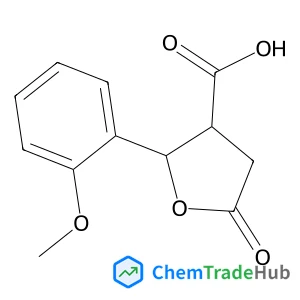
trans-2-(2-Methoxyphenyl)-5-oxotetrahydrofuran-3-carboxylic acid
CAS Number:
99226-02-5
Molecular Formula:
C12H12O5
Recommended Suppliers





Disclaimer
This page provides academic journal information for reference and research purposes only. We are not affiliated with any journal publishers and do not handle publication submissions. For publication-related inquiries, please contact the respective journal publishers directly.
If you notice any inaccuracies in the information displayed, please contact us at support@chemtradehub.com. We will promptly review and address your concerns.