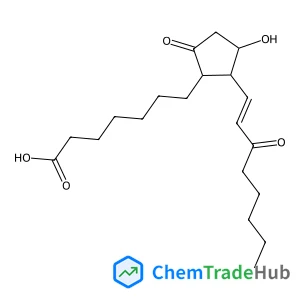
(11alpha,13E)-11-Hydroxy-9,15-dioxoprost-13-en-1-oic acid
CAS Number:
22973-19-9
Molecular Formula:
C20H32O5
Kyra Lunstroot, Kris Driesen, Peter Nockemann, Lydie Viau, P. Hubert Mutin, André Vioux, Koen Binnemans
Flexible luminescent polymer films were obtained by doping europium(III) complexes in blends of poly(methyl methacrylate) (PMMA) and the ionic liquid 1-hexyl-3-methylimidazolium bis(trifluoromethylsulfonyl)imide, [C6mim][Tf2N]. Different europium(III) complexes have been incorporated in the polymer/ionic liquid matrix: [C6mim][Eu(nta)4], [C6mim][Eu(tta)4], [Eu(tta)3(phen)] and [choline]3[Eu(dpa)3], where nta is 2-naphthoyltrifluoroacetonate, tta is 2-thenoyltrifluoroacetonate, phen is 1,10-phenanthroline, dpa is 2,6-pyridinedicarboxylate (dipicolinate) and choline is the 2-hydroxyethyltrimethyl ammonium cation. Bright red photoluminescence was observed for all the films upon irradiation with ultraviolet radiation. The luminescent films have been investigated by high-resolution steady-state luminescence spectroscopy and by time-resolved measurements. The polymer films doped with β-diketonate complexes are characterized by a very intense 5D0 → 7F2 transition (up to 15 times more intense than the 5D0 → 7F1) transition, whereas a marked feature of the PMMA films doped with [choline]3[Eu(dpa)3] is the long lifetime of the 5D0 excited state (1.8 ms).
Chun-Teh Chen, Markus J. Buehler
DOI: 10.1039/C8CP05037F
Alexey Koltsov, Jean-Michel Mataigne
DOI: 10.1039/C8CP02139B
Tim M. Becker, Azahara Luna-Triguero, Jose Manuel Vicent-Luna, Li-Chiang Lin, David Dubbeldam, Sofia Calero, Thijs J. H. Vlugt
DOI: 10.1039/C8CP05750H
Ke-Qiu Chen
DOI: 10.1039/C7CP07795E
D. Banerjee, Santosh K. Gupta, N. Patra, Sk Wasim Raja, N. Pathak, D. Bhattacharyya, P. K. Pujari, S. V. Thakare, S. N. Jha
DOI: 10.1039/C8CP04310H
Ashley L. Kaiser, Itai Y. Stein, Kehang Cui, Brian L. Wardle
DOI: 10.1039/C7CP06869G
E. M. Neeman, I. León, E. R. Alonso, L. Kolesniková, S. Mata, J. L. Alonso
DOI: 10.1039/C8CP06043F
Cristian Celis-Barros, María J. Beltrán-Leiva
DOI: 10.1039/C7CP06585J
Takao Otsuka, Hironori Izawa, Kenji Morihashi
DOI: 10.1039/C7CP07877C
6-(3-Fluorophenyl)picolinic acid is generally considered safe for laboratory use...
(3R)-3-Pyrrolidinol is used in the pharmaceutical industry as a precursor for dr...
When handling (4R,5R)-4,5-Diethoxycarbonyl-2,2-dimethyldioxolane (CAS: 59779-75-...
1-(6-Chloroimidazo[1,2-b]pyridazin-3-yl)ethanone is often synthesized via a mult...
The market for N-Ethyl-3,4-dimethylbenzylamine (CAS: 39180-83-1) remains steady,...
Tert-butyl 3-(pyrrolidin-1-yl)azetidine-1-carboxylate is a chemical compound wit...
1-Bromo-3-chloro-2,4-dimethoxybenzene (CAS: 1228956-93-1) falls under the classi...
The safety of 8-Bromo-2-methyl-3,4-dihydroisoquinolin-1(2H)-one (CAS: 1368622-07...
Benzyl [(3S)-2,6-dioxo-3-piperidinyl]carbamate is generally safe when handled wi...
1-{[4-(4,4,5,5-Tetramethyl-1,3,2-dioxaborolan-2-yl)phenyl]sulfonyl}pyrrolidine s...

Physical Chemistry Chemical Physics (PCCP) is an international journal co-owned by 19 physical chemistry and physics societies from around the world. This journal publishes original, cutting-edge research in physical chemistry, chemical physics and biophysical chemistry. To be suitable for publication in PCCP, articles must include significant innovation and/or insight into physical chemistry; this is the most important criterion that reviewers and Editors will judge against when evaluating submissions. The journal has a broad scope and welcomes contributions spanning experiment, theory, computation and data science. Topical coverage includes spectroscopy, dynamics, kinetics, statistical mechanics, thermodynamics, electrochemistry, catalysis, surface science, quantum mechanics, quantum computing and machine learning. Interdisciplinary research areas such as polymers and soft matter, materials, nanoscience, energy, surfaces/interfaces, and biophysical chemistry are welcomed if they demonstrate significant innovation and/or insight into physical chemistry. Joined experimental/theoretical studies are particularly appreciated when complementary and based on up-to-date approaches.

![2-[({[(2-Methyl-2-propanyl)oxy]carbonyl}amino)methyl]isonicotinic acid structure](https://static.chemtradehub.com/structs/473/473924-63-9-973b.webp "2-[({[(2-Methyl-2-propanyl)oxy]carbonyl}amino)methyl]isonicotinic acid structure")