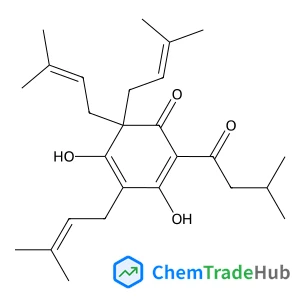
3,5-Dihydroxy-4-(3-methylbutanoyl)-2,6,6-tris(3-methyl-2-buten-1-yl)-2,4-cyclohexadien-1-one
CAS Number:
468-28-0
Molecular Formula:
C26H38O4
Tibor Pasinszki, Balázs Havasi, Nicholas P. C. Westwood
The [3 + 2] and [3 + 3] cyclodimerisation processes of small nitrile oxides, XCNO (X = F, Cl, Br, CN, CH3) are investigated by ab initio coupled cluster theory at the CCSD, CCSD(T) and MR-AQCC levels for the first time. The favoured dimerisation process is a multi-step reaction to furoxans (1,2,5-oxadiazole-2-oxides) involving dinitrosoalkene-like intermediates with diradical character. The rate determining step for all but the F-species is the first, corresponding to the C–C bond formation. The kinetic energy barrier depends on the nature of the substituent X, generally increasing with decreasing electronegativity and increasing π-donor ability of the substituent: F (ΔG298 = 0 kJ mol−1) < Cl (72) < Br (90) < CH3 (104) < CN (114) (MR-AQCC(2,2)//UB3LYP/cc-pVTZ). Following initial C–C bond formation, three possible dinitrosoethylene diradical pathways are explored. Two of them are new, and one of them is a low-energy three-step path with implications for cycloreversion, tautomerism and detection of dinitrosoethylene intermediates. Alternative one-step, concerted [3 + 2] and [3 + 3] cyclodimerisation processes leading to 1,2,4-oxadiazole-4-oxides and 1,4,2,5-dioxadiazines have kinetic energy barriers around 100–240 kJ mol−1 (CCSD//B3LYP), some 1.6 to 2.5 times higher than those leading to furoxans, supporting the experimental observations of furoxan formation as nitrile oxide loss channels during storage, trapping/re-vaporisation and reactions of nitrile oxides. Potential polymerisation initiation processes for NCCNO, involving the 1,2-dipolar NC substituent are also explored.
Yan Gao, Linlin Zhang, Xin Ding
DOI: 10.1039/C3CP55204G
James N. Bull, Jason W. L. Lee, Claire Vallance
DOI: 10.1039/C4CP00490F
Andrea Grafmüller, Volker Knecht
DOI: 10.1039/C3CP54685C
Branka Kovač, Ivan Ljubić, Antti Kivimäki, Marcello Coreno, Igor Novak
DOI: 10.1039/C4CP00867G
I. Izquierdo-Lorenzo, S. Sanchez-Cortes
DOI: 10.1039/C4CP00424H
Xiang Ji, Yan Wang, Zhiping Yu
DOI: 10.1039/C4CP00960F
Heike Fliegl, Dage Sundholm
DOI: 10.1039/C3CP54421D
Seyed Hadi Zandavi, Charles A. Ward
DOI: 10.1039/C4CP00843J
Daniele Vigolo, Talal T. Al-Housseiny, Yi Shen, Fiyinfoluwa O. Akinlawon, Saif T. Al-Housseiny, Ronald K. Hobson, Amaresh Sahu, Katherine I. Bedkowski, Thomas J. DiChristina, Howard A. Stone
DOI: 10.1039/C4CP01086H
Kiminori Sato, Kazuomi Numata, Weili Dai, Michael Hunger
DOI: 10.1039/C4CP00990H
When handling 2-Chloro-1,2-bis(4-methylphenyl)ethanone (CAS: 71193-32-3), it is ...
4-Ethoxy-3-(5-methyl-4-oxo-7-propyl-1,4-dihydroimidazo[5,1-f][1,2,4]triazin-2-yl...
Methyl 3-Oxo-4-Androsten-17-Carboxylate (CAS: 2681-55-2) should be stored in a c...
(R)-3-Amino-4-(3-hexylphenylamino)-4-oxobutylphosphonic acid is primarily used i...
2-Methyl-2-propanyl 3-amino-3-carbamoyl-1-azetidinecarboxylate (CAS: 1254120-14-...
There are alternative reagents that can be used in synthesis instead of (E)-4-(t...
[2-(3-Chlorophenyl)-1,3-thiazol-4-yl]methanol (CAS: 121202-20-8) is a crystallin...
The market and research trends for Methyl (2S)-[(4S)-2,2-dimethyl-1,3-dioxolan-4...
The market for 1-Bromo-2-isocyanatoethane (CAS: 42865-19-0) is driven by its use...
4-Nitro-D-phenylalanine hydrochloride (CAS: 147065-06-3) is primarily used in re...

Physical Chemistry Chemical Physics (PCCP) is an international journal co-owned by 19 physical chemistry and physics societies from around the world. This journal publishes original, cutting-edge research in physical chemistry, chemical physics and biophysical chemistry. To be suitable for publication in PCCP, articles must include significant innovation and/or insight into physical chemistry; this is the most important criterion that reviewers and Editors will judge against when evaluating submissions. The journal has a broad scope and welcomes contributions spanning experiment, theory, computation and data science. Topical coverage includes spectroscopy, dynamics, kinetics, statistical mechanics, thermodynamics, electrochemistry, catalysis, surface science, quantum mechanics, quantum computing and machine learning. Interdisciplinary research areas such as polymers and soft matter, materials, nanoscience, energy, surfaces/interfaces, and biophysical chemistry are welcomed if they demonstrate significant innovation and/or insight into physical chemistry. Joined experimental/theoretical studies are particularly appreciated when complementary and based on up-to-date approaches.