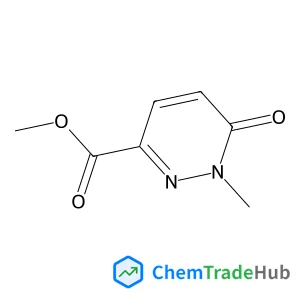
Methyl 1-methyl-6-oxo-1,6-dihydro-3-pyridazinecarboxylate
CAS Number:
74173-58-3
Molecular Formula:
C7H8N2O3
Virginie Lhiaubet-Vallet, Bauer Oliveira Bernardes, Aurelio Baird Buarque Ferreira, Miguel Ángel Miranda
α-Lapachone is a natural 1,4-naphthoquinone with promising biological activity. The fused dihydropyran ring present in its structure, acting as formal 2-alkoxy and 3-alkyl substituents to the quinone moiety, endows this compound with milder redox properties and lower toxicity, when compared with other bioactive 1,4-quinones. Its photochemistry, here reported, seems to originate from the triplet state, which shows ππ* character. Triplet quenching in acetonitrile solution with added hydrogen-atom donors such as 1,4-cyclohexadiene or 2-propanol is inefficient, independent of solvent polarity, and leads to formation of the semiquinone radical. With phenol and indole, quenching rate constants are two orders of magnitude higher, but smaller than the value for triethylamine. In the first two cases the semiquinone radical can be detected by laser flash photolysis and in the last case, the anion radical derived from α-lapachone is readily detected. The semiquinone radical can also be observed in the quenching of triplet α-lapachone by 2′-deoxyguanosine and by the methyl esters of L-tryptophan and L-tyrosine, whereas for L-cysteine methyl ester the quenching rate constant is very slow. Triplet α-lapachone is not quenched by thymine, thymidine, 2′-deoxycytosine or 2′-deoxyadenosine; this is probably due to its ππ* character and low energy, which prevents oxetane formation and triplet–triplet energy transfer, respectively. Steady-state photolysis of aerated solutions of these compounds in the presence of α-lapachone does not show evidence of decomposition, whereas similar experiments with 2′-deoxyguanosine result in efficient consumption of the nucleoside. Singlet oxygen is formed from triplet α-lapachone, and a quantum yield of 0.68 is measured.
Jiayu Dai
DOI: 10.1039/C8CP07298A
DOI: 10.1039/C8CP05027A
Ángel José Pérez-Jiménez, Juan-Carlos Sancho-García
DOI: 10.1039/C8CP06727A
Mareike Wallrabe
DOI: 10.1039/C8CP06041J
Raul Morales-Salvador, Ángel Morales-García, Francesc Viñes, Francesc Illas
DOI: 10.1039/C8CP91852J
B. Moses Abraham, B. Adivaiah
DOI: 10.1039/C8CP04827D
Song Li, Jyh-Pin Chou, Jie Wei, Huaizhong Xing, Alice Hu
DOI: 10.1039/C8CP03508C
Marcelo Lopes Pereira Junior, Rafael Timóteo de Sousa Júnior, Geraldo Magela e Silva
DOI: 10.1039/C8CP06915H
Ingmar Persson, Olle Björneholm, Delphine Kawecki, Clara-Magdalena Saak, Marie-Madeleine Walz, Victor Ekholm, Isaak Unger, Corina Valtl, Gunnar Öhrwall
DOI: 10.1039/C8CP01898G
3-(2-Bromoimidazo[2,1-b]thiazol-6-yl)propanoic acid hydrochloride is typically s...
2-Isopropyl-1,3-dioxane-5-carboxylic acid is typically synthesized by the carbox...
Alisporivir (CAS: 254435-95-5) is an antiviral medication used in the treatment ...
[1,2,4]triazolo[3,4-a]phthalazine (CAS: 234-80-0) is a crystalline compound with...
Regulatory guidelines for (2S)-5-Hydroxy-2-(4-hydroxyphenyl)-4-oxo-3,4-dihydro-2...
2,2-Difluorocyclohexanamine hydrochloride is generally safe when handled under p...
3-Nitro-2-phenylthiophene is primarily used in the synthesis of other organic co...
1-(Trifluoroacetyl)-4-piperidinecarbonitrile (CAS: 77940-79-5) is a colorless to...
Research and market trends for 1,3,6,8-Tetranitro-9H-carbazole (CAS: 4543-33-3) ...
Waste containing Dibenzo[b,d]thiophen-1-ylboronic acid (CAS: 1245943-60-5) shoul...

Physical Chemistry Chemical Physics (PCCP) is an international journal co-owned by 19 physical chemistry and physics societies from around the world. This journal publishes original, cutting-edge research in physical chemistry, chemical physics and biophysical chemistry. To be suitable for publication in PCCP, articles must include significant innovation and/or insight into physical chemistry; this is the most important criterion that reviewers and Editors will judge against when evaluating submissions. The journal has a broad scope and welcomes contributions spanning experiment, theory, computation and data science. Topical coverage includes spectroscopy, dynamics, kinetics, statistical mechanics, thermodynamics, electrochemistry, catalysis, surface science, quantum mechanics, quantum computing and machine learning. Interdisciplinary research areas such as polymers and soft matter, materials, nanoscience, energy, surfaces/interfaces, and biophysical chemistry are welcomed if they demonstrate significant innovation and/or insight into physical chemistry. Joined experimental/theoretical studies are particularly appreciated when complementary and based on up-to-date approaches.
![Potassium trifluoro[(2-methoxyethoxy)methyl]borate(1-) structure](https://static.chemtradehub.com/structs/910/910251-13-7-2d3a.webp "Potassium trifluoro[(2-methoxyethoxy)methyl]borate(1-) structure")