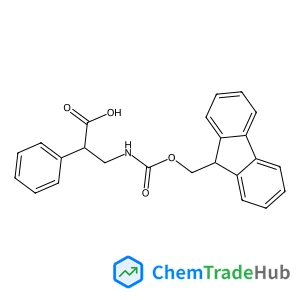
(S)-3-((((9H-Fluoren-9-yl)methoxy)carbonyl)amino)-2-phenylpropanoic acid
CAS Number:
1217663-60-9
Molecular Formula:
C24H21NO4
Song Li, Jyh-Pin Chou, Jie Wei, Huaizhong Xing, Alice Hu
Recently, van der Waals (vdW) two-dimensional heterostructures have attracted great attention. The combination structures demonstrate unique properties that individual layers do not possess, which foretell promising future applications. Here, we investigate the structural and electronic properties of SiC/graphene, SiC/MoS2, and graphene/SiC/MoS2 vdW heterostructures using first-principles calculations. The SiC/graphene interface forms a p-type Schottky contact, which can be turned into an n-type Schottky contact by applying an external electric field. Moreover, a transition from a Schottky to an Ohmic contact at the interface can be triggered by varying the interlayer distance or applying an external electric field. The SiC/MoS2 interface forms a type-II heterostructure, in which the recombination of photoexcited charges will be greatly suppressed. The transition from type-II to type-III band alignment can be realized in the SiC/MoS2 heterostructure by applying a biaxial strain. This heterostructure also shows excellent optical absorption abilities in the visible and far-infrared range, which merits its application as a photocatalyst. The trilayer heterostructure exhibits a tunable Schottky barrier with different stacking patterns and the assembled graphene could act as a protective encapsulating layer on SiC/MoS2. The results show that graphene and MoS2 can tune and improve the electronic performance of SiC and demonstrate the promising application of SiC-based heterostructures for nanoelectronics and nanophotonics.

Current Opinion in Solid State & Materials Science

Crystallography Reports

Organic Process Research & Development

Journal of Natural Medicines

Current Opinion in Colloid & Interface Science

Chemistry Education Research and Practice

Russian Journal of Coordination Chemistry

Russian Journal of General Chemistry

New Journal of Chemistry

Saudi Pharmaceutical Journal
Vladimir A. Seleznev, Nadezhda A. Nebogatikova, Artem I. Ivanov, Bogdan V. Voloshin, Irina I. Kurkina
DOI: 10.1039/D3CP03761D
Tomasz J. Wasowicz, Iwona Dąbkowska, Antti Kivimäki, Robert Richter
DOI: 10.1039/D3CP03760F
Jia-Ben Song, Yun-Hao Zhang, Yu-Feng Li, Jia-Cheng Zhang, Xu Liang, Zhen-Dong Sha
DOI: 10.1039/D3CP04280D
Liying Yang, Tingyu Liu, Jinsong Jiang, Wenqi Song
DOI: 10.1039/D3CP04600A
DOI: 10.1039/A800776D
Kanhu Charan Behera, Mangalampalli Ravikanth
DOI: 10.1039/D3CP04234K
When considering alternatives to 1-(4-Chlorophenyl)-N-hydroxymethanimine (CAS: 3...
This compound should be stored in a cool, dry place away from direct sunlight. I...
3-(4-Bromophenyl)-5-(2-fluorophenyl)-1,2,4-oxadiazole is synthesized through a m...
5-Chloro-2-(4-chlorophenyl)-4-methyl-6-[3-(1-piperidinyl)propoxy]pyrimidine (CAS...
2-Chloro-4-(difluoromethoxy)pyridine is used in the pharmaceutical industry for ...
3-Chloro-6-methylpyridazine (CAS: 1121-79-5) is classified under the Globally Ha...
Several alternatives can be used in the synthesis of Methyl 4,5-dimethyl-2-nitro...
Alternatives to (2E,2'E)-3,3'-(1,4-Phenylene)bisacrylaldehyde include other acry...
3-Amino-5-chloropyridin-2-ol hydrochloride is an organic compound with the CAS n...
When handling 6,7-Difluoro-2,3-dihydro-4H-chromen-4-one, it is essential to wear...

Physical Chemistry Chemical Physics (PCCP) is an international journal co-owned by 19 physical chemistry and physics societies from around the world. This journal publishes original, cutting-edge research in physical chemistry, chemical physics and biophysical chemistry. To be suitable for publication in PCCP, articles must include significant innovation and/or insight into physical chemistry; this is the most important criterion that reviewers and Editors will judge against when evaluating submissions. The journal has a broad scope and welcomes contributions spanning experiment, theory, computation and data science. Topical coverage includes spectroscopy, dynamics, kinetics, statistical mechanics, thermodynamics, electrochemistry, catalysis, surface science, quantum mechanics, quantum computing and machine learning. Interdisciplinary research areas such as polymers and soft matter, materials, nanoscience, energy, surfaces/interfaces, and biophysical chemistry are welcomed if they demonstrate significant innovation and/or insight into physical chemistry. Joined experimental/theoretical studies are particularly appreciated when complementary and based on up-to-date approaches.
![[4-(Isobutyrylamino)phenyl]boronic acid structure](https://static.chemtradehub.com/structs/874/874219-50-8-6ab5.webp "[4-(Isobutyrylamino)phenyl]boronic acid structure")