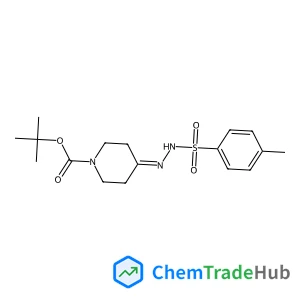
tert-Butyl 4-(2-(p-Tolylsulfonyl)hydrazono)piperidine-1-carboxylate
CAS Number:
1046478-89-0
Molecular Formula:
C17H25N3O4S
Ángel José Pérez-Jiménez, Juan-Carlos Sancho-García
The effect of donor–acceptor (D–A) moieties on magnitudes such as reorganization energies and electronic couplings in cycloparaphenylene (CPP) carbon based nanohoops (i.e. conjugated organic molecules with cyclic topology) is highlighted via model computations and analysis of the available crystalline structure of N,N-dimethylaza[8]CPP. For the sake of comparison, intra-molecular and inter-molecular charge transport parameters are concomitantly modelled for the recently determined herringbone polymorph of [6]CPP, along with [8]CPP and [12]CPP. The peculiar contribution of low frequency vibrations to intramolecular reorganization energies is also disclosed by computing the Huang–Rhys factors for the investigated [n]CPPs and the N,N-dimethylaza derivative. In contrast with most planar organic semiconductors where the layer in which molecules are herringbone arranged identifies the high-mobility plane, nanohoops disclose inter-layer electronic couplings larger than the intra-layer counterparts. Charge transfer rate constants modelled with three different approaches (Marcus, Marcus–Levich–Jortner and spectral overlap) suggest that D–A nanohoops, owing to orbital localization, may be more efficient for charge transport than [n]CPPs for suitable solid phase arrangements.
Youliang Wang, Mingzhu Xia, Kebin Li, Xinlin Shen, Tahir Muhmood, Fengyun Wang
DOI: 10.1039/C6CP90250B
Xiaofeng Li, Hanyu Liu, Feng Peng
DOI: 10.1039/C6CP05702K
Asmita Gupta, Manju Bansal
DOI: 10.1039/C6CP04617G
Yi-Jung Tu, Matthew J. Allen, G. Andrés Cisneros
DOI: 10.1039/C6CP90231F
Andrew G. Stack, Jose M. Borreguero, Timothy R. Prisk, Eugene Mamontov, Hsiu-Wen Wang, Lukas Vlcek, David J. Wesolowski
DOI: 10.1039/C6CP05836A
Taotao Lu, Chengzhe Wang, Levi Lystrom, Chengkui Pei, Svetlana Kilina, Wenfang Sun
DOI: 10.1039/C6CP02628A
Alberto Baggioli, Carlo A. Cavallotti, Antonino Famulari
DOI: 10.1039/C6CP03323G
Felcia Lai, Jonathan J. Du, Linda Váradi, Daniel Baker, Paul W. Groundwater, Jacob Overgaard, James A. Platts, David E. Hibbs
DOI: 10.1039/C6CP02690G
David R. Bell, Rui Qi, Zhifeng Jing, Jin Yu Xiang, Christopher Mejias, Michael J. Schnieders, Jay W. Ponder, Pengyu Ren
DOI: 10.1039/C6CP02509A
Michel-Andreas Geiger, Marcella Orwick-Rydmark, Katharina Märker, W. Trent Franks, Dmitry Akhmetzyanov, Daniel Stöppler, Maximilian Zinke, Edgar Specker, Marc Nazaré, Anne Diehl, Barth-Jan van Rossum, Fabien Aussenac, Thomas Prisner, Ümit Akbey, Hartmut Oschkinat
DOI: 10.1039/C6CP06154K
When considering alternatives to 1-(4-Chlorophenyl)-N-hydroxymethanimine (CAS: 3...
This compound should be stored in a cool, dry place away from direct sunlight. I...
3-(4-Bromophenyl)-5-(2-fluorophenyl)-1,2,4-oxadiazole is synthesized through a m...
5-Chloro-2-(4-chlorophenyl)-4-methyl-6-[3-(1-piperidinyl)propoxy]pyrimidine (CAS...
2-Chloro-4-(difluoromethoxy)pyridine is used in the pharmaceutical industry for ...
3-Chloro-6-methylpyridazine (CAS: 1121-79-5) is classified under the Globally Ha...
Several alternatives can be used in the synthesis of Methyl 4,5-dimethyl-2-nitro...
Alternatives to (2E,2'E)-3,3'-(1,4-Phenylene)bisacrylaldehyde include other acry...
3-Amino-5-chloropyridin-2-ol hydrochloride is an organic compound with the CAS n...
When handling 6,7-Difluoro-2,3-dihydro-4H-chromen-4-one, it is essential to wear...

Physical Chemistry Chemical Physics (PCCP) is an international journal co-owned by 19 physical chemistry and physics societies from around the world. This journal publishes original, cutting-edge research in physical chemistry, chemical physics and biophysical chemistry. To be suitable for publication in PCCP, articles must include significant innovation and/or insight into physical chemistry; this is the most important criterion that reviewers and Editors will judge against when evaluating submissions. The journal has a broad scope and welcomes contributions spanning experiment, theory, computation and data science. Topical coverage includes spectroscopy, dynamics, kinetics, statistical mechanics, thermodynamics, electrochemistry, catalysis, surface science, quantum mechanics, quantum computing and machine learning. Interdisciplinary research areas such as polymers and soft matter, materials, nanoscience, energy, surfaces/interfaces, and biophysical chemistry are welcomed if they demonstrate significant innovation and/or insight into physical chemistry. Joined experimental/theoretical studies are particularly appreciated when complementary and based on up-to-date approaches.