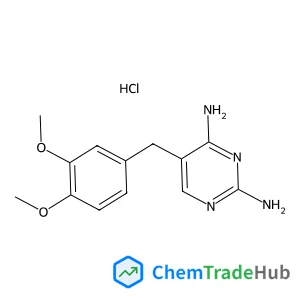
5-(3,4-Dimethoxybenzyl)-2,4-pyrimidinediamine hydrochloride (1:1)
CAS Number:
2507-23-5
Molecular Formula:
C13H17ClN4O2
Jiayu Dai
Type-II van der Waals (vdW) heterostructures are considered as a class of competitive candidates of high-efficiency photovoltaic materials, due to their spontaneous electron–hole separation. However, most of the vdW heterostructures possess an indirect gap and a large band offset, which would lead to low photon-to-electron conversion efficiency. Taking an SbI3/BiI3 vdW heterostructure as an illustrative example, we propose interlayer compression and vertical electric field application as two effective strategies to modulate the electronic and photovoltaic properties of type-II vdW heterostructures. Our results reveal that a lattice-matched SbI3/BiI3 vdW heterostructure has an indirect band gap of 1.34 eV with the conduction band minimum (CBM) at the Γ point and the valence band maximum (VBM) between the Γ and M points. The power conversion efficiency (PCE) of an SbI3/BiI3-based excitonic solar cell (XSC) is predicted to be about 14.42%. When compressing the heterostructure along the vdW gap direction, the highest valence band state at the Γ point is lifted significantly and the VBM gradually approaches the Γ point, implying an indirect–direct gap transition. This interesting evolution can be attributed to the increasing k-dependent electronic hybridization of the pz orbitals of interlayer adjacent I atoms with a reduced interlayer distance. Moreover, the interlayer compression also enhances the PCE of the system monotonically. When applying a vertical electric field, the band alignment of the heterostructure undergoes a transition from type-II to type-I and then returns to type-II between 0.1 and 0.6 V Å−1. Meanwhile, the PCE of the SbI3/BiI3 XSC could be enhanced up to 21.63%. This work provides guidance for improving the electronic and photovoltaic properties of type-II vdW heterostructures.

Journal of Peptide Science

Saudi Pharmaceutical Journal

Russian Journal of Applied Chemistry

Chemical Communications

Current Opinion in Solid State & Materials Science

Nature Medicine

Russian Chemical Bulletin

Russian Journal of General Chemistry

Chemistry Education Research and Practice

Journal of Saudi Chemical Society
Sabine N. Neal, Dario Stacchiola, Samuel A. Tenney
DOI: 10.1039/D3CP03958G
Ping Zhou, Guohao Li, Mengtao Sun
DOI: 10.1039/D3CP04725C
Ruiqin Li
DOI: 10.1039/D3CP04415G
Chaoqun Zhang, Phelan Yu, Chandler J. Conn, Nicholas R. Hutzler, Lan Cheng
DOI: 10.1039/D3CP04040B
DOI: 10.1039/D3CP04879A
When considering alternatives to 1-(4-Chlorophenyl)-N-hydroxymethanimine (CAS: 3...
This compound should be stored in a cool, dry place away from direct sunlight. I...
3-(4-Bromophenyl)-5-(2-fluorophenyl)-1,2,4-oxadiazole is synthesized through a m...
5-Chloro-2-(4-chlorophenyl)-4-methyl-6-[3-(1-piperidinyl)propoxy]pyrimidine (CAS...
2-Chloro-4-(difluoromethoxy)pyridine is used in the pharmaceutical industry for ...
3-Chloro-6-methylpyridazine (CAS: 1121-79-5) is classified under the Globally Ha...
Several alternatives can be used in the synthesis of Methyl 4,5-dimethyl-2-nitro...
Alternatives to (2E,2'E)-3,3'-(1,4-Phenylene)bisacrylaldehyde include other acry...
3-Amino-5-chloropyridin-2-ol hydrochloride is an organic compound with the CAS n...
When handling 6,7-Difluoro-2,3-dihydro-4H-chromen-4-one, it is essential to wear...

Physical Chemistry Chemical Physics (PCCP) is an international journal co-owned by 19 physical chemistry and physics societies from around the world. This journal publishes original, cutting-edge research in physical chemistry, chemical physics and biophysical chemistry. To be suitable for publication in PCCP, articles must include significant innovation and/or insight into physical chemistry; this is the most important criterion that reviewers and Editors will judge against when evaluating submissions. The journal has a broad scope and welcomes contributions spanning experiment, theory, computation and data science. Topical coverage includes spectroscopy, dynamics, kinetics, statistical mechanics, thermodynamics, electrochemistry, catalysis, surface science, quantum mechanics, quantum computing and machine learning. Interdisciplinary research areas such as polymers and soft matter, materials, nanoscience, energy, surfaces/interfaces, and biophysical chemistry are welcomed if they demonstrate significant innovation and/or insight into physical chemistry. Joined experimental/theoretical studies are particularly appreciated when complementary and based on up-to-date approaches.