


Electrochemical studies on the oxidation of guanine and adenine at cyclodextrin modified electrodes
Literature Information
Publication Date
2008-09-02
DOI
10.1039/B806920D
Impact Factor
4.616
Authors
Abdolkarim Abbaspour, Abolhassan Noori
View Original
Abstract
An electrochemical sensor for guanine and adenine using cyclodextrin-modified poly(N-acetylaniline) (PNAANI) on a carbon paste electrode has been developed. The oxidation mechanism of guanine and adenine on the surface of the electrode was investigated by cyclic voltammetry. It was found that the electrode processes are irreversible, pH dependent, and involve several reaction products. The electron transfer process occurs in consecutive steps with the formation of a strongly adsorbed intermediate on the electrode surface. Also, a new method for estimating the apparent formation constants of guanine and adenine with the immobilized cyclodextrins, through the change of surface coverage of studied analytes has been reported. Both guanine and adenine showed linear concentrations in the range of 0.1–10 μM by using differential pulse voltammetry, with an experimental limit of detection down to 0.05 μM. Linear concentration ranges of 2–150 μM for guanine and 6–104 μM for adenine have been found when cyclic voltammetry was used for determination of both analytes.
Recommended Journals

Journal of Enzyme inhibition and Medicinal Chemistry

Nature Reviews Drug Discovery

Environmental Toxicology and Pharmacology

Photochemical & Photobiological Sciences

Advanced Engineering Materials

Coloration Technology

Angewandte Chemie International Edition

Foundations of Chemistry

Molecular Diversity

Current Pharmaceutical Biotechnology
Related Literature
Topological analysis of vapor–liquid equilibrium diagrams for distillation process design
Sergei Blagov, Hans Hasse
2002-02-15
Paper
DOI: 10.1039/B109541B
Geometric foundation of thermo-statistics, phase transitions, second law of thermodynamics, but without thermodynamic limit
2002-02-19
Paper
DOI: 10.1039/B108775D
Liquid–liquid coexistence curves of re-entrant phase transitions beyond the asymptotic range: tetrahydrofuran + water and tetrahydrofuran + heavy water
2002-02-15
Paper
DOI: 10.1039/B109349E
Dipole strength effects on the polymorphism in smectic A mesophases
2002-01-23
Paper
DOI: 10.1039/B106788E
Oscillatory clusters in a reaction–diffusion system switching between excitable and unexcitable states
2002-03-13
Paper
DOI: 10.1039/B109391F
Thermodynamic properties and interfacial tension of a model water–carbon dioxide system
Tatyana Kuznetsova, Bjørn Kvamme
2002-02-12
Paper
DOI: 10.1039/B108726F
Electrodeposition at polarisable liquid|liquid interfaces: The role of interfacial tension on nucleation kinetics
Christoffer Johans, Peter Liljeroth, Kyösti Kontturi
2002-02-13
Paper
DOI: 10.1039/B110182J
Fluid phase diagrams of ternary systems with one volatile component and immiscibility in two of the constituent binary mixtures
2002-02-27
Paper
DOI: 10.1039/B109275H
Investigation of collisional quenching of CCl2( 1B1 and ã 3B1) by some inorganic molecules
Yide Gao, Changjin Hu, Qin Ran, Yang Chen, Xingxiao Ma, Congxiang Chen
2002-02-26
Paper
DOI: 10.1039/B105728F
You might also like
Compound Q&A
What regulatory guidelines apply to 6-Bromo-2-methylimidazo[1,2-a]pyrimidine (CAS: 1111638-05-1)?
6-Bromo-2-methylimidazo[1,2-a]pyrimidine (CAS: 1111638-05-1) falls under various...
1111638-05-16-Bromo-2-methylimid...
Compound Q&A
Are there alternatives to 1-Pyrrolidineethanol, β-methyl-α-phenyl-, (αS,βR) (CAS: 123620-80-4) in synthesis?
While there are no direct alternatives, similar compounds like 1-Pyrrolidineetha...
123620-80-41-Pyrrolidineethanol...
Compound Q&A
Is 4-Methyl-2,6-bis(2-methyl-2-propanyl)phenyl methylcarbamate (CAS: 1918-11-2) safe?
4-Methyl-2,6-bis(2-methyl-2-propanyl)phenyl methylcarbamate (CAS: 1918-11-2) is ...
1918-11-24-Methyl-2,6-bis(2-m...
Compound Q&A
How should 2-(3-Bromo-4-fluorophenyl)-1,3-dioxolane (CAS: 77771-04-1) be stored?
2-(3-Bromo-4-fluorophenyl)-1,3-dioxolane (CAS: 77771-04-1) should be stored in a...
77771-04-12-(3-Bromo-4-fluorop...
Compound Q&A
What are the physical and chemical properties of 4,5,6,7-Tetrahydro-1H-indazole hydrochloride (CAS: 18161-11-0)?
4,5,6,7-Tetrahydro-1H-indazole hydrochloride is a white crystalline solid with a...
18161-11-04,5,6,7-Tetrahydro-1...
Compound Q&A
What is (2R)-1-Methoxy-3-phenyl-2-propanamine (CAS: 59919-07-2)?
(2R)-1-Methoxy-3-phenyl-2-propanamine is a chiral organic compound with the CAS ...
59919-07-2(2R)-1-Methoxy-3-phe...
Compound Q&A
What industries use Ethyl 1-(1-phenylethyl)-1H-imidazole-5-carboxylate (CAS: 56649-47-9)?
Ethyl 1-(1-phenylethyl)-1H-imidazole-5-carboxylate is used in various industries...
56649-47-9Ethyl 1-(1-phenyleth...
Compound Q&A
What regulatory guidelines apply to 4-[(1E,3S)-1-(4-Hydroxyphenyl)-1,4-pentadien-3-yl]phenol (CAS: 17676-24-3)?
4-[(1E,3S)-1-(4-Hydroxyphenyl)-1,4-pentadien-3-yl]phenol (CAS: 17676-24-3) falls...
17676-24-34-[(1E,3S)-1-(4-Hydr...
Compound Q&A
What industries use (S)-3-Amino-5-phenylpentanoic acid hydrochloride (CAS: 331846-97-0)?
(S)-3-Amino-5-phenylpentanoic acid hydrochloride is primarily used in the pharma...
331846-97-0(S)-3-Amino-5-phenyl...
Compound Q&A
How is 7-methoxy-1-benzothiophene-2-carboxylic acid (CAS: 88791-07-5) typically synthesized?
7-Methoxy-1-benzothiophene-2-carboxylic acid is typically synthesized by reactin...
88791-07-57-methoxy-1-benzothi...
Source Journal
Analyst

CiteScore:
7.8
Self-citation Rate:
5.6%
Articles per Year:
653
Analyst publishes analytical and bioanalytical research that reports premier fundamental discoveries and inventions, and the applications of those discoveries, unconfined by traditional discipline barriers.
Recommended Compounds
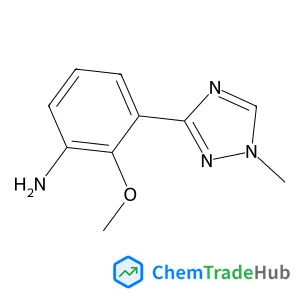
2-Methoxy-3-(1-methyl-1H-1,2,4-triazol-3-yl)aniline
CAS Number:
1609394-10-6
Molecular Formula:
C10H12N4O


Recommended Suppliers




Disclaimer
This page provides academic journal information for reference and research purposes only. We are not affiliated with any journal publishers and do not handle publication submissions. For publication-related inquiries, please contact the respective journal publishers directly.
If you notice any inaccuracies in the information displayed, please contact us at support@chemtradehub.com. We will promptly review and address your concerns.