












Transition metal-catalyzed three-component coupling of allenes and the related allylation reactions
Literature Information
Publication Date
2008-05-15
DOI
10.1039/B800440D
Impact Factor
6.222
Authors
Masilamani Jeganmohan, Chien-Hong Cheng
View Original
Abstract
The feature article surveys the transition metal-catalyzed three-component coupling of allenes and the related allylation reactions. Most of the reactions shown in the article mechanistically proceed via oxidative addition of organic electrophiles to metals, followed by carbometallation of allene and then transmetalation by main group metals or reagents and organometallic reagents. These reactions provide an efficient route for the synthesis of various substituted allyl and vinyl metal reagents and complex organic molecules in highly regio-, stereo- and chemoselective manner in one pot. The metal reagents or π-allyl–metal intermediates obtained from the reaction are utilized for the allylation of aldehydes, ketones and imines, producing various homoallylic alcohols and amines in a highly regio- and stereoselective manner.
Related Literature
Is there any fundamental difference between ionic, covalent, and others types of bond? A canonical perspective on the question
Jay R. Walton, Luis A. Rivera-Rivera, Robert R. Lucchese, John W. Bevan
2017-05-30
Paper
DOI: 10.1039/C7CP02407J
Determination of bending rigidity and tilt modulus of lipid membranes from real-space fluctuation analysis of molecular dynamics simulations
D. Harries
2017-06-12
Paper
DOI: 10.1039/C7CP01921A
The role of the long-range tail of the potential in O2 + N2 collisional inelastic vibrational energy transfers
Ernesto Garcia, Fernando Pirani, Antonio Laganà, Carles Martí
2017-03-29
Paper
DOI: 10.1039/C7CP01340J
Decoupling diffusion from the bimolecular photoinduced electron transfer reaction: a combined ultrafast spectroscopic and kinetic analysis
Puspal Mukherjee, Pratik Sen
2017-03-31
Paper
DOI: 10.1039/C7CP01387F
On the structures, spin states, and optical properties of titanium, platinum, and iron azacalixphyrins: a DFT study
Gabriel Marchand, Olivier Siri
2017-05-22
Paper
DOI: 10.1039/C7CP02600E
The mechanism of the Ser-(cis)Ser-Lys catalytic triad of peptide amidases
N. M. F. S. A. Cerqueira, H. Moorthy, P. A. Fernandes, M. J. Ramos
2017-03-30
Paper
DOI: 10.1039/C7CP00277G
Structure–property relationship of blue solid state emissive phenanthroimidazole derivatives
Agne Ivanauskaite, Ramunas Lygaitis, Steponas Raisys, Karolis Kazlauskas, Gediminas Kreiza, Dmytro Volyniuk, Dalius Gudeika, Saulius Jursenas, Juozas V. Grazulevicius
2017-05-31
Paper
DOI: 10.1039/C7CP02248D
How predictive could alchemical derivatives be?
Macarena Muñoz, Carlos Cárdenas
2017-05-30
Paper
DOI: 10.1039/C7CP02755A
Protocol for disentangling the thermally activated contribution to the tunneling-assisted charge transport. Analytical results and experimental relevance
2017-04-06
Paper
DOI: 10.1039/C7CP01103B
You might also like
Compound Q&A
Are there alternatives to 1-(4-Chlorophenyl)-N-hydroxymethanimine (CAS: 3848-36-0) in synthesis?
When considering alternatives to 1-(4-Chlorophenyl)-N-hydroxymethanimine (CAS: 3...
3848-36-01-(4-Chlorophenyl)-N...
Compound Q&A
How should (1R,9S,10S,12S,14E,16S,19R,20R,21S,22R)-3,9,21-Trihydroxy-5,10,12,14,16,20,22-heptamethyl-23,24-dioxatetracyclo[17.3.1.1~6,9~.0~2,7~]tetracosa-2,5,7,14-tetraen-4-one (CAS: 183202-73-5) be stored?
This compound should be stored in a cool, dry place away from direct sunlight. I...
183202-73-5(1R,9S,10S,12S,14E,1...
Compound Q&A
How is 3-(4-Bromophenyl)-5-(2-fluorophenyl)-1,2,4-oxadiazole (CAS: 419553-16-5) typically synthesized?
3-(4-Bromophenyl)-5-(2-fluorophenyl)-1,2,4-oxadiazole is synthesized through a m...
419553-16-53-(4-Bromophenyl)-5-...
Compound Q&A
How is 5-Chloro-2-(4-chlorophenyl)-4-methyl-6-[3-(1-piperidinyl)propoxy]pyrimidine (CAS: 1639220-19-1) typically synthesized?
5-Chloro-2-(4-chlorophenyl)-4-methyl-6-[3-(1-piperidinyl)propoxy]pyrimidine (CAS...
1639220-19-15-Chloro-2-(4-chloro...
Compound Q&A
What industries use 2-Chloro-4-(difluoromethoxy)pyridine (CAS: 1206978-15-5)?
2-Chloro-4-(difluoromethoxy)pyridine is used in the pharmaceutical industry for ...
1206978-15-52-Chloro-4-(difluoro...
Compound Q&A
What regulatory guidelines apply to 3-Chloro-6-methylpyridazine (CAS: 1121-79-5)?
3-Chloro-6-methylpyridazine (CAS: 1121-79-5) is classified under the Globally Ha...
1121-79-53-Chloro-6-methylpyr...
Compound Q&A
Are there alternatives to Methyl 4,5-dimethyl-2-nitrobenzoate in synthesis?
Several alternatives can be used in the synthesis of Methyl 4,5-dimethyl-2-nitro...
90922-74-0Methyl 4,5-dimethyl-...
Compound Q&A
Are there alternatives to (2E,2'E)-3,3'-(1,4-Phenylene)bisacrylaldehyde in synthesis?
Alternatives to (2E,2'E)-3,3'-(1,4-Phenylene)bisacrylaldehyde include other acry...
63405-68-5(2E,2'E)-3,3'-(1,4-P...
Compound Q&A
What is 3-Amino-5-chloropyridin-2-ol hydrochloride (CAS: 1261906-29-9)?
3-Amino-5-chloropyridin-2-ol hydrochloride is an organic compound with the CAS n...
1261906-29-93-Amino-5-chloropyri...
Compound Q&A
What precautions should be taken when handling 6,7-Difluoro-2,3-dihydro-4H-chromen-4-one (CAS: 1092349-93-3)?
When handling 6,7-Difluoro-2,3-dihydro-4H-chromen-4-one, it is essential to wear...
1092349-93-36,7-Difluoro-2,3-dih...
Source Journal
Chemical Communications

CiteScore:
8.6
Self-citation Rate:
4.7%
Articles per Year:
2458
ChemComm publishes urgent research which is of outstanding significance and interest to experts in the field, while also appealing to the journal’s broad chemistry readership. Our communication format is ideally suited to short, urgent studies that are of such importance that they require accelerated publication. Our scope covers all topics in chemistry, and research at the interface of chemistry and other disciplines (such as materials science, nanoscience, physics, engineering and biology) where there is a significant novelty in the chemistry aspects. Major topic areas covered include: Analytical Chemistry Catalysis Chemical Biology and medicinal chemistry Computational Chemistry and Machine Learning Energy and sustainable chemistry Environmental Chemistry Green Chemistry Inorganic Chemistry Materials Chemistry Nanoscience Organic Chemistry Physical Chemistry Polymer Chemistry Supramolecular Chemistry
Recommended Compounds
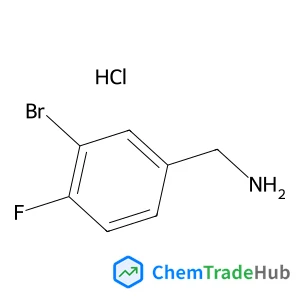
1-(3-Bromo-4-fluorophenyl)methanamine hydrochloride (1:1)
CAS Number:
202865-68-7
Molecular Formula:
C7H8BrClFN
Recommended Suppliers





Disclaimer
This page provides academic journal information for reference and research purposes only. We are not affiliated with any journal publishers and do not handle publication submissions. For publication-related inquiries, please contact the respective journal publishers directly.
If you notice any inaccuracies in the information displayed, please contact us at support@chemtradehub.com. We will promptly review and address your concerns.