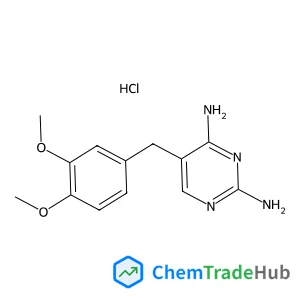
5-(3,4-Dimethoxybenzyl)-2,4-pyrimidinediamine hydrochloride (1:1)
CAS Number:
2507-23-5
Molecular Formula:
C13H17ClN4O2
Gabriel Marchand, Olivier Siri
Azacalixphyrins (ACP) constitute a new class of macrocycles isoelectronic and isostructural to porphyrins. Herein, we report the first theoretical investigation of the properties of the ACP macrocycles metallated at their centre by titanium, platinum, and iron ions. We considered both the original phenyl-type ACP and new pyridyl-type forms. Our results indicate that the metallation greatly impacts the global structure of the macrocycle through pseudo Jahn–Teller effects, giving rise to a possible conformational transition between D2d and S4 structures. Such an effect could not be found in the metal-free ACPs. In addition, we find that, in contrast to the purely singlet platinum ACPs, and the purely triplet iron ACPs, several spin states are energetically close in the titanium ACPs, especially when weak field ligands are bound in axial positions to the metallic centre. According to TD-DFT calculations, metallation also tunes the optical properties. In particular, the absorption band in the near infrared region undergoes a hypsochromic shift of ca. 100–200 nm when going from the D2d to the S4 structures. We quantify how the addition of electroactive ligands in the axial position can increase or tune down these spectral changes. This contribution therefore supports the development of ACP coordination complexes.

Bioorganic & Medicinal Chemistry Letters

Bioorganic & Medicinal Chemistry

Journal of the Indian Institute of Science

Herald of the Russian Academy of Sciences

Electroanalysis

Journal of Asian Natural Products Research

Biocatalysis and Biotransformation

Colloid Journal

Medicinal Chemistry Research

Polycyclic Aromatic Compounds
Sergey M. Borisov, Ingo Klimant
DOI: 10.1039/B805432K
Ryan E. Holcomb, James R. Kraly, Charles S. Henry
DOI: 10.1039/B816289A
Zhenyu Lin, Zhihuang Chen, Yan Liu, Jian Wang, Guonan Chen
DOI: 10.1039/B716281B
Fiona M. Campbell, Andrew Ingram, Paul Monaghan, Jon Cooper, Naveed Sattar, P. David Eckersall, Duncan Graham
DOI: 10.1039/B808087A
Guixin Li, Hongyan Nan, Xingwang Zheng
DOI: 10.1039/B816226C
Yafeng Wu, Songqin Liu
DOI: 10.1039/B812642A
Chun-Feng Duan, Yu-Qi Yu, Hua Cui
DOI: 10.1039/B807163B
Jonas W. Perez, Frederick R. Haselton, David W. Wright
DOI: 10.1039/B904191E
Maarten Scholtes-Timmerman, Alex van Belkum
DOI: 10.1039/B811596F
Takashi Suzuki, Hirohito Ueno, Junichi Nemoto, Yuki Fujii, Mikio Hoshino, Masao Kaneko
DOI: 10.1039/B822512E
When considering alternatives to 1-(4-Chlorophenyl)-N-hydroxymethanimine (CAS: 3...
This compound should be stored in a cool, dry place away from direct sunlight. I...
3-(4-Bromophenyl)-5-(2-fluorophenyl)-1,2,4-oxadiazole is synthesized through a m...
5-Chloro-2-(4-chlorophenyl)-4-methyl-6-[3-(1-piperidinyl)propoxy]pyrimidine (CAS...
2-Chloro-4-(difluoromethoxy)pyridine is used in the pharmaceutical industry for ...
3-Chloro-6-methylpyridazine (CAS: 1121-79-5) is classified under the Globally Ha...
Several alternatives can be used in the synthesis of Methyl 4,5-dimethyl-2-nitro...
Alternatives to (2E,2'E)-3,3'-(1,4-Phenylene)bisacrylaldehyde include other acry...
3-Amino-5-chloropyridin-2-ol hydrochloride is an organic compound with the CAS n...
When handling 6,7-Difluoro-2,3-dihydro-4H-chromen-4-one, it is essential to wear...

Physical Chemistry Chemical Physics (PCCP) is an international journal co-owned by 19 physical chemistry and physics societies from around the world. This journal publishes original, cutting-edge research in physical chemistry, chemical physics and biophysical chemistry. To be suitable for publication in PCCP, articles must include significant innovation and/or insight into physical chemistry; this is the most important criterion that reviewers and Editors will judge against when evaluating submissions. The journal has a broad scope and welcomes contributions spanning experiment, theory, computation and data science. Topical coverage includes spectroscopy, dynamics, kinetics, statistical mechanics, thermodynamics, electrochemistry, catalysis, surface science, quantum mechanics, quantum computing and machine learning. Interdisciplinary research areas such as polymers and soft matter, materials, nanoscience, energy, surfaces/interfaces, and biophysical chemistry are welcomed if they demonstrate significant innovation and/or insight into physical chemistry. Joined experimental/theoretical studies are particularly appreciated when complementary and based on up-to-date approaches.
![4-[(3-Chloro-2-fluorophenyl)amino]-7-methoxy-6-quinazolinyl acetate structure](https://static.chemtradehub.com/structs/740/740081-22-5-f58f.webp "4-[(3-Chloro-2-fluorophenyl)amino]-7-methoxy-6-quinazolinyl acetate structure")