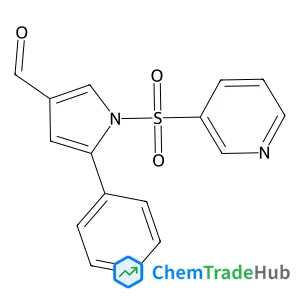
5-Phenyl-1-(pyridin-3-ylsulfonyl)-1H-pyrrole-3-carbaldehyde
CAS Number:
881676-90-0
Molecular Formula:
C16H12N2O3S
Luis R. Domingo, Ramón J. Zaragozá, Manuel Arnó
The N-heterocyclic carbene (NHC) catalyzed addition of enals to enones to yield trans-cyclopentenes has been investigated using DFT methods at B3LYP/6-31G** computational level. This NHC catalyzed reaction comprises several steps. The first one is the formation of a Breslow intermediate, which nucleophilically attacks to the conjugated position of the enone to yield an enol-enolate. This second step is responsible for the trans relationship at the final cyclopentene. An intramolecular aldolic condensation allows for the formation of the alkoxy cyclopentane intermediate, that by intramolecular nucleophilic attack on the carbonyl group yields a bicyclic ether. The extrusion of the NHC catalyst affords a bicyclic lactone, yielding by CO2 elimination, the final trans-cyclopentene.
Katharina Breul, Sebastian Seiffert
DOI: 10.1039/D1PY00121C
Simone Lazar, Ruiqing Shen, Yufeng Quan, Bethany Palen, Qingsheng Wang, Christopher J. Ellison
DOI: 10.1039/D1PY00111F
A. Funes, R. Cuervo-Rodríguez
DOI: 10.1039/D1PY00098E
Vincent Bouad, Marc Guerre, Sami Zeliouche, Bruno Améduri, Cédric Totée, Gilles Silly, Rinaldo Poli, Vincent Ladmiral
DOI: 10.1039/D0PY01753A
Wei Wen
DOI: 10.1039/D1PY00223F
Peter Černoch, Alessandro Jager, Zulfiya Černochová, Vladimir Sincari, Lindomar J. C. Albuquerque, Rafal Konefal, Ewa Pavlova, Fernando C. Giacomelli, Eliezer Jager
DOI: 10.1039/D1PY00141H
Jieni Hu, Chuanhao Sun, Siqi Li, Yuan Yuan
DOI: 10.1039/D1PY00703C
(1R,3S)-1,3-Cyclopentanediol finds applications in various industries. In the ph...
When handling N'-[4-(Dimethylamino)phenyl]-N,N-dimethyl-1,4-benzenediamine, it i...
There are several alternatives to 5-(2,4-Difluorophenyl)-2-methoxypyrimidine in ...
1-(3-Methoxyphenoxy)propan-2-ol (CAS: 382141-68-6) must comply with the Globally...
Tetrodotoxin Citrate is extremely dangerous and should be handled with extreme c...
2-Methyl-2-propanyl [(1R,3S)-3-hydroxycyclopentyl]carbamate (CAS: 225641-84-9) i...
Waste containing 4-(2-Hydroxyhexafluoroisopropyl)Benzoic Acid (CAS: 16261-80-6) ...
2-Methyl-2-proanyl {(2S)-1-[(benzyloxy)amino]-3-hydroxy-3-methyl-1-oxo-2-butanyl...
Benzeneethanamine, α-ethyl-, hydrochloride (1:1) is an organic compound with the...
In the synthesis of compounds similar to 3-{(E)-[4-(Dimethylamino)phenyl]diazeny...

Organic & Biomolecular Chemistry (OBC) publishes original and high impact research and reviews in organic chemistry. We welcome research that shows new or significantly improved protocols or methodologies in total synthesis, synthetic methodology or physical and theoretical organic chemistry as well as research that shows a significant advance in the organic chemistry or molecular design aspects of chemical biology, catalysis, supramolecular and macromolecular chemistry, theoretical chemistry, mechanism-oriented physical organic chemistry, medicinal chemistry or natural products. Articles published in the journal should report new work which makes a highly-significant impact in the field. Routine and incremental work is generally not suitable for publication in the journal. More details about key areas of our scope are below. In all cases authors should include in their article clear rationale for why their research has been carried out.