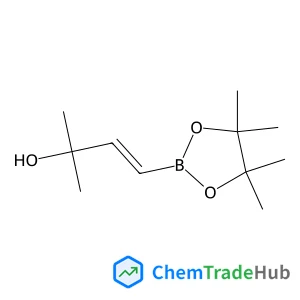
(E)-2-methyl-4-(4,4,5,5-tetramethyl-1,3,2-dioxaborolan-2-yl)but-3-en-2-ol
CAS Number:
581802-26-8
Molecular Formula:
C11H21BO3
Burki Rajendar, Arivazhagan Rajendran, Zhiqiang Ye, Eriko Kanai, Yusuke Sato, Marek Sikorski
Using the DNA duplex containing an AP site (5′-TCC AGX GCA AC-3′/3′-AGG TCN CGT TG-5′, X = AP site, N = A, T, C, or G), we have found that 2-amino-4-hydroxypteridine (pterin) selectively binds to guanine (G), and that the enhanced binding affinity for G is obtained by its methylated derivative 2-amino-6,7-dimethyl-4-hydroxypteridine (diMe pteridine). Similarly, among the cytosine (C)-selective ligands, i.e. derivatives of 2-amino-1,8-naphthyridine, a trimethyl-substituted derivative (2-amino-5,6,7-trimethyl-1,8-naphthyridine) selectively binds to C with a strong binding affinity of 1.9 × 10⁷ M−1. In the case of lumazine derivatives, pteridine-2,4(1H,3H)-dione (lumazine) binds to adenine (A), and its methylated derivative, 6,7-dimethylpteridine-2,4(1H,3H)-dione (diMe lumazine) strongly binds to A with enhanced binding affinity, keeping the same base-selectivity. On the other hand, the benzo-annelated (with phenyl ring, 2.4 Å) derivative of lumazine, benzo[g]pteridine-2,4(1H,3H)-dione (alloxazine), can bind to A selectively, whereas its methylated ligand, 7,8-dimethylbenzo[g]pteridine-2,4(1H,3H)-dione (lumichrome) selectively binds to thymine (T) over A, C and G. Methyl-substituted lumichrome derivatives show moderate binding affinities for target nucleobases. The changes in the base-selectivity and binding affinities are discussed in detail with respect to the substituents of these ligands, considering hydrogen-bonding patterns, size of AP site and stacking interactions.
Chandrasekaran Nithya, Gowtham Thiyagaraj
DOI: 10.1039/D0SE00469C
Hassan Sereshti, Vahid Khojeh, Maryam Karimi, Soheila Samadi
DOI: 10.1039/C1AY05354J
Guibin Shen, Hongye Dong, Qingbin Cai, Xiaoning Wen, Xiangning Xu, Cheng Mu
DOI: 10.1039/D0SE00200C
Malik Muhammad Umair, Yuang Zhang, Shufen Zhang, Xin Jin
DOI: 10.1039/D0SE00368A
Manikandan Palanisamy, Vilas G. Pol, Kia Jackson, Charl J. Jafta, Craig A. Bridges, Sheng Dai, Alan M. Levine, Richard J. Lee
DOI: 10.1039/D0SE00408A
Kuang Feng, Zhiwang Cai, Dingwang Huang, Lintao Li, Kang Wang, Yan Li, Chenyang Wang, Jie Song, Wei Wei, Feng Jiang
DOI: 10.1039/D0SE00152J
(1R,3S)-1,3-Cyclopentanediol finds applications in various industries. In the ph...
When handling N'-[4-(Dimethylamino)phenyl]-N,N-dimethyl-1,4-benzenediamine, it i...
There are several alternatives to 5-(2,4-Difluorophenyl)-2-methoxypyrimidine in ...
1-(3-Methoxyphenoxy)propan-2-ol (CAS: 382141-68-6) must comply with the Globally...
Tetrodotoxin Citrate is extremely dangerous and should be handled with extreme c...
2-Methyl-2-propanyl [(1R,3S)-3-hydroxycyclopentyl]carbamate (CAS: 225641-84-9) i...
Waste containing 4-(2-Hydroxyhexafluoroisopropyl)Benzoic Acid (CAS: 16261-80-6) ...
2-Methyl-2-proanyl {(2S)-1-[(benzyloxy)amino]-3-hydroxy-3-methyl-1-oxo-2-butanyl...
Benzeneethanamine, α-ethyl-, hydrochloride (1:1) is an organic compound with the...
In the synthesis of compounds similar to 3-{(E)-[4-(Dimethylamino)phenyl]diazeny...

Organic & Biomolecular Chemistry (OBC) publishes original and high impact research and reviews in organic chemistry. We welcome research that shows new or significantly improved protocols or methodologies in total synthesis, synthetic methodology or physical and theoretical organic chemistry as well as research that shows a significant advance in the organic chemistry or molecular design aspects of chemical biology, catalysis, supramolecular and macromolecular chemistry, theoretical chemistry, mechanism-oriented physical organic chemistry, medicinal chemistry or natural products. Articles published in the journal should report new work which makes a highly-significant impact in the field. Routine and incremental work is generally not suitable for publication in the journal. More details about key areas of our scope are below. In all cases authors should include in their article clear rationale for why their research has been carried out.