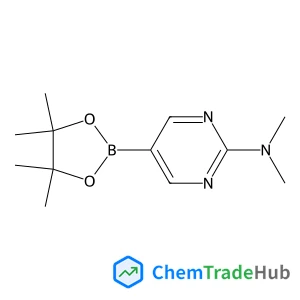
N,N-Dimethyl-5-(4,4,5,5-tetramethyl-1,3,2-dioxaborolan-2-yl)-2-pyrimidinamine
CAS Number:
1032759-30-0
Molecular Formula:
C12H20BN3O2
Cai-Feng Wang, Dong-Ping Li, Xin Chen, Xiao-Ming Li, Yi-Zhi Li, Jing-Lin Zuo, Xiao-Zeng You
The assembly of chirality into magnetic nanowires enables the formation of two new cyano-bridged heterobimetallic 3,2-chain enantiomeric complexes, representing the first example of multiferroic compounds bearing both slow magnetization relaxation and ferroelectricity.
Hao Liu, Huaizhi Gao, Jun Lin, Tasawar Hayat, Ahmed Alsaedi, Zhan'ao Tan
DOI: 10.1039/D0SE00206B
Hasan Baig, Hiroyuki Kanda, Abdullah M. Asiri, Mohammad Khaja Nazeeruddin, Tapas Mallick
DOI: 10.1039/D0SE90048F
Meng Yang, Lingjun Zhu, Yexin Zhuo, Jiacheng Liang, Shurong Wang
DOI: 10.1039/D0SE00468E
Chendan Liu, Yudi Ma, Song Guo, Bingfang He, Tianyue Jiang
DOI: 10.1039/D0BM01766C
N. Queyriaux, K. Abel, J. Fize, J. Pécaut, M. Orio, L. Hammarström
DOI: 10.1039/D0SE00570C
Hongmei Yu, Wei Song, Zhigang Shao
DOI: 10.1039/D0SE00103A
(1R,3S)-1,3-Cyclopentanediol finds applications in various industries. In the ph...
When handling N'-[4-(Dimethylamino)phenyl]-N,N-dimethyl-1,4-benzenediamine, it i...
There are several alternatives to 5-(2,4-Difluorophenyl)-2-methoxypyrimidine in ...
1-(3-Methoxyphenoxy)propan-2-ol (CAS: 382141-68-6) must comply with the Globally...
Tetrodotoxin Citrate is extremely dangerous and should be handled with extreme c...
2-Methyl-2-propanyl [(1R,3S)-3-hydroxycyclopentyl]carbamate (CAS: 225641-84-9) i...
Waste containing 4-(2-Hydroxyhexafluoroisopropyl)Benzoic Acid (CAS: 16261-80-6) ...
2-Methyl-2-proanyl {(2S)-1-[(benzyloxy)amino]-3-hydroxy-3-methyl-1-oxo-2-butanyl...
Benzeneethanamine, α-ethyl-, hydrochloride (1:1) is an organic compound with the...
In the synthesis of compounds similar to 3-{(E)-[4-(Dimethylamino)phenyl]diazeny...

ChemComm publishes urgent research which is of outstanding significance and interest to experts in the field, while also appealing to the journal’s broad chemistry readership. Our communication format is ideally suited to short, urgent studies that are of such importance that they require accelerated publication. Our scope covers all topics in chemistry, and research at the interface of chemistry and other disciplines (such as materials science, nanoscience, physics, engineering and biology) where there is a significant novelty in the chemistry aspects. Major topic areas covered include: Analytical Chemistry Catalysis Chemical Biology and medicinal chemistry Computational Chemistry and Machine Learning Energy and sustainable chemistry Environmental Chemistry Green Chemistry Inorganic Chemistry Materials Chemistry Nanoscience Organic Chemistry Physical Chemistry Polymer Chemistry Supramolecular Chemistry