


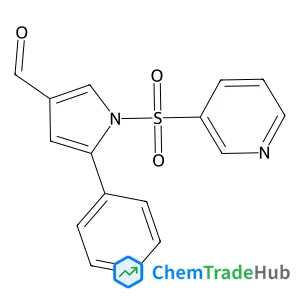
5-Phenyl-1-(pyridin-3-ylsulfonyl)-1H-pyrrole-3-carbaldehyde
CAS Number:
881676-90-0
Molecular Formula:
C16H12N2O3S
Kazuhito Tanabe, Eiji Matsumoto, Takeo Ito, Sei-ichi Nishimoto
Upon X-ray irradiation of hypoxic aqueous solution, modified oligodeoxynucleotides (ODNs) bearing a pair of disulfides at both ends of the strand that forms a stem-and-loop structure with a neighboring arrangement of α,ω-bis-disulfides underwent efficient cyclization via an intramolecular exchange reaction at the disulfide moieties with a multiple turnover process. Mechanistic studies revealed that hydrogen atoms generated in the radiolysis of water are key active species initiating a chain reaction to produce cyclic ODN disulfides, in which addition of hydrogen atom results in dissociation of the original disulfide bond to generate a thiyl radical intermediate as the chain carrier for the succeeding disulfide exchange into cyclization. The properties were also assessed for the resultant cyclic ODN disulfide that has several favorable features for use in the transcriptional decoy strategy. The cyclic ODN disulfides produced by the present radiolytic method showed high thermal stability, resistance to nuclease, and high binding activity to a representative transcriptional factor of nuclear factor κB.

Israel Journal of Chemistry

Journal of Medicinal Chemistry

Pharmacological Reviews

Proceedings of the National Academy of Sciences of the United States of America

Journal of Heterocyclic Chemistry

Nature

Planta Medica

Kinetics and Catalysis

European Journal of Wood and Wood Products

Organic Preparations and Procedures International
Xiao Shang, Jian-Hong Tang, Yujie Sun
DOI: 10.1039/D0SE00466A
Dattaprasad D. Narulkar, Anil Kumar U., Sunder N. Dhuri, Anil Kumar Vardhaman
DOI: 10.1039/D0SE00232A
Philipp Brunner, Florian Brumbauer, Eva-Maria Steyskal, Oliver Renk, Annelie-Martina Weinberg, Hartmuth Schroettner, Roland Würschum
DOI: 10.1039/D1BM00166C
Bojiao Tang, Sijie Zhou, Jianghui Qin, Wujun Geng
DOI: 10.1039/D1BM00063B
Xingxing Zhu, Ruikun Zhao, Kin Liao, Vincent Chan
DOI: 10.1039/D0SE00448K
Yibin Yang, Xun Cui, Di Gao, Huichao He, Yingqing Ou, Ming Zhou, Qingxin Lai, Xijun Wei, Peng Xiao, Yunhuai Zhang
DOI: 10.1039/D0SE00659A
Bo Xiong, Antoine Pallandre, Isabelle le Potier, Pierre Audebert, Elias Fattal, Nicolas Tsapis, Gillian Barratt, Myriam Taverna
DOI: 10.1039/C1AY05598D
Jie Zhang, Conghui Si, Tianyi Kou, Jianfeng Wang, Zhonghua Zhang
DOI: 10.1039/C9SE01312A
Chandrasekaran Nithya, Gowtham Thiyagaraj
DOI: 10.1039/D0SE00469C
De-Zhu Tu, Hai-Long Wu, Yuan-Na Li, Juan Zhang, Yong Li, Chong-Chong Nie, Xiao-Hua Zhang, Ru-Qin Yu
DOI: 10.1039/C1AY05388D
(1R,3S)-1,3-Cyclopentanediol finds applications in various industries. In the ph...
When handling N'-[4-(Dimethylamino)phenyl]-N,N-dimethyl-1,4-benzenediamine, it i...
There are several alternatives to 5-(2,4-Difluorophenyl)-2-methoxypyrimidine in ...
1-(3-Methoxyphenoxy)propan-2-ol (CAS: 382141-68-6) must comply with the Globally...
Tetrodotoxin Citrate is extremely dangerous and should be handled with extreme c...
2-Methyl-2-propanyl [(1R,3S)-3-hydroxycyclopentyl]carbamate (CAS: 225641-84-9) i...
Waste containing 4-(2-Hydroxyhexafluoroisopropyl)Benzoic Acid (CAS: 16261-80-6) ...
2-Methyl-2-proanyl {(2S)-1-[(benzyloxy)amino]-3-hydroxy-3-methyl-1-oxo-2-butanyl...
Benzeneethanamine, α-ethyl-, hydrochloride (1:1) is an organic compound with the...
In the synthesis of compounds similar to 3-{(E)-[4-(Dimethylamino)phenyl]diazeny...

Organic & Biomolecular Chemistry (OBC) publishes original and high impact research and reviews in organic chemistry. We welcome research that shows new or significantly improved protocols or methodologies in total synthesis, synthetic methodology or physical and theoretical organic chemistry as well as research that shows a significant advance in the organic chemistry or molecular design aspects of chemical biology, catalysis, supramolecular and macromolecular chemistry, theoretical chemistry, mechanism-oriented physical organic chemistry, medicinal chemistry or natural products. Articles published in the journal should report new work which makes a highly-significant impact in the field. Routine and incremental work is generally not suitable for publication in the journal. More details about key areas of our scope are below. In all cases authors should include in their article clear rationale for why their research has been carried out.
![(2S)-2-{[(9H-Fluoren-9-ylmethoxy)carbonyl]amino}-4-(methylselanyl)butanoic acid structure](https://static.chemtradehub.com/structs/121/1217852-49-7-f252.webp "(2S)-2-{[(9H-Fluoren-9-ylmethoxy)carbonyl]amino}-4-(methylselanyl)butanoic acid structure")





