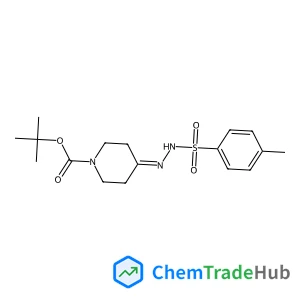
tert-Butyl 4-(2-(p-Tolylsulfonyl)hydrazono)piperidine-1-carboxylate
CAS Number:
1046478-89-0
Molecular Formula:
C17H25N3O4S
Alma R. Morales, Gheorghe Luchita, Ciceron O. Yanez, Mykhailo V. Bondar, Olga V. Przhonska
Linear photophysical characterization and two-photon absorption (2PA) properties of a new water-soluble fluorene derivative, 3-(9-(2-(2-methoxyethoxy)ethyl)-2,7-bis{3-[2-(polyethyleneglycol-550-monomethylether-1-yl)]-4-(benzo[d]thiazol-2-yl)styryl}-9H-fluoren-9-yl)propanoic acid (1), were investigated in several organic solvents and water at room temperature. A comprehensive analysis of the steady-state absorption, emission and excitation anisotropy spectra revealed electronic structures of 1, including mutual orientation of the transition dipoles, relatively weak solvatochromic effects, high fluorescence quantum yield (∼0.5–1.0), and strong aggregation in water. The 2PA spectra of 1 were obtained in the 600–900 nm spectral range by two-photon induced fluorescence (2PF) and open aperture Z-scan methods using femtosecond laser sources. No discrete 2PA bands were apparent and values of the corresponding 2PA cross sections monotonically increased in the short wavelength range up to 3000 GM in organic solvents and ∼6000 GM in aqueous solution, reflecting relatively high two-photon absorptivity. The 2PA efficiency of 1 in water increased 2–3 times relative to aprotic solvents and can be explained by cooperative electronic effects of molecular aggregates of 1 produced in aqueous media. The carboxylic acid fluorenyl probe 1 was conjugated with the cyclic peptide RGDfK. Two-photon fluorescence microscopy (2PFM) imaging of U87MG cells (and MCF-7 as control), incubated with fluorene-RGD peptide conjugate 2, demonstrated high αvβ3 integrin selectivity, making this probe particularly attractive for integrin imaging.
DOI: 10.1039/AN8992400201
Guibin Shen, Hongye Dong, Qingbin Cai, Xiaoning Wen, Xiangning Xu, Cheng Mu
DOI: 10.1039/D0SE00200C
Hella Logtenberg, Laurens-Jan C. Jellema, Maria J. Lopez-Martinez, Jetsuda Areephong, Elisabeth Verpoorte, Ben L. Feringa, Wesley R. Browne
DOI: 10.1039/C1AY05475A
Jieqiong Wang, Shuai Zhao, Man Lin Lai, Tianan Jiang, Fei Yan
DOI: 10.1039/D1BM00251A
Kuang Feng, Zhiwang Cai, Dingwang Huang, Lintao Li, Kang Wang, Yan Li, Chenyang Wang, Jie Song, Wei Wei, Feng Jiang
DOI: 10.1039/D0SE00152J
DOI: 10.1039/AN8992400202
Yilin Chen, Lvting Wang, Mingyue Tan, Yingying Xiao, Bifen Gao, Bizhou Lin
DOI: 10.1039/D0SE00394H
Hassan Sereshti, Vahid Khojeh, Maryam Karimi, Soheila Samadi
DOI: 10.1039/C1AY05354J
DOI: 10.1039/D0SE00509F
(1R,3S)-1,3-Cyclopentanediol finds applications in various industries. In the ph...
When handling N'-[4-(Dimethylamino)phenyl]-N,N-dimethyl-1,4-benzenediamine, it i...
There are several alternatives to 5-(2,4-Difluorophenyl)-2-methoxypyrimidine in ...
1-(3-Methoxyphenoxy)propan-2-ol (CAS: 382141-68-6) must comply with the Globally...
Tetrodotoxin Citrate is extremely dangerous and should be handled with extreme c...
2-Methyl-2-propanyl [(1R,3S)-3-hydroxycyclopentyl]carbamate (CAS: 225641-84-9) i...
Waste containing 4-(2-Hydroxyhexafluoroisopropyl)Benzoic Acid (CAS: 16261-80-6) ...
2-Methyl-2-proanyl {(2S)-1-[(benzyloxy)amino]-3-hydroxy-3-methyl-1-oxo-2-butanyl...
Benzeneethanamine, α-ethyl-, hydrochloride (1:1) is an organic compound with the...
In the synthesis of compounds similar to 3-{(E)-[4-(Dimethylamino)phenyl]diazeny...

Organic & Biomolecular Chemistry (OBC) publishes original and high impact research and reviews in organic chemistry. We welcome research that shows new or significantly improved protocols or methodologies in total synthesis, synthetic methodology or physical and theoretical organic chemistry as well as research that shows a significant advance in the organic chemistry or molecular design aspects of chemical biology, catalysis, supramolecular and macromolecular chemistry, theoretical chemistry, mechanism-oriented physical organic chemistry, medicinal chemistry or natural products. Articles published in the journal should report new work which makes a highly-significant impact in the field. Routine and incremental work is generally not suitable for publication in the journal. More details about key areas of our scope are below. In all cases authors should include in their article clear rationale for why their research has been carried out.
![(2S)-2-{[(9H-Fluoren-9-ylmethoxy)carbonyl]amino}-4-(methylselanyl)butanoic acid structure](https://static.chemtradehub.com/structs/121/1217852-49-7-f252.webp "(2S)-2-{[(9H-Fluoren-9-ylmethoxy)carbonyl]amino}-4-(methylselanyl)butanoic acid structure")