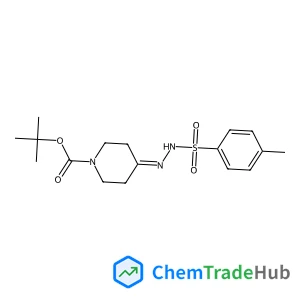
tert-Butyl 4-(2-(p-Tolylsulfonyl)hydrazono)piperidine-1-carboxylate
CAS Number:
1046478-89-0
Molecular Formula:
C17H25N3O4S
Young Jun Seo, Il Joon Lee, Jeong Wu Yi, Byeang Hyean Kim
Pyrene-modified adenosines in the dangling positions of G-rich oligodeoxynucleotides undergo π-stacking in their G-quadruplex formation, but not in their single strands, which can be characterized by fluorescence λmax changes that occur on stacking.
Dage Sundholm
DOI: 10.1039/C7CP00624A
Jie Pan, Vladimir Chorošajev, Mikas Vengris, S. Seckin Senlik, Jian-Ren Shen, Darius Abramavicius, Jennifer P. Ogilvie
DOI: 10.1039/C7CP01673E
S. Güryel, M. Walker, P. Geerlings, F. De Proft, M. R. Wilson
DOI: 10.1039/C7CP01552F
Joao Marcelo Ribeiro, Alexander M. Mebel
DOI: 10.1039/C7CP01873H
Pu Du, Ang Li, Xin Li, Yueheng Zhang, Changwoo Do, Lilin He, Steven W. Rick, Vijay T. John, Revati Kumar, Donghui Zhang
DOI: 10.1039/C7CP01602F
Abhishek Mazumder, Subrata Batabyal, Manas Mondal, Tanumoy Mondol, Susobhan Choudhury, Raka Ghosh, Tanaya Chatterjee, Dhananjay Bhattacharyya, Samir Kumar Pal, Siddhartha Roy
DOI: 10.1039/C7CP01193H
Leonardo Muñoz-Rugeles, Annia Galano, Juan Raúl Alvarez-Idaboy
DOI: 10.1039/C7CP01557G
Julin Joseph, Aji A. Anappara
DOI: 10.1039/C7CP02731A
Liang Liu, Alain Walcarius
DOI: 10.1039/C7CP01775H
When considering alternatives to 1-(4-Chlorophenyl)-N-hydroxymethanimine (CAS: 3...
This compound should be stored in a cool, dry place away from direct sunlight. I...
3-(4-Bromophenyl)-5-(2-fluorophenyl)-1,2,4-oxadiazole is synthesized through a m...
5-Chloro-2-(4-chlorophenyl)-4-methyl-6-[3-(1-piperidinyl)propoxy]pyrimidine (CAS...
2-Chloro-4-(difluoromethoxy)pyridine is used in the pharmaceutical industry for ...
3-Chloro-6-methylpyridazine (CAS: 1121-79-5) is classified under the Globally Ha...
Several alternatives can be used in the synthesis of Methyl 4,5-dimethyl-2-nitro...
Alternatives to (2E,2'E)-3,3'-(1,4-Phenylene)bisacrylaldehyde include other acry...
3-Amino-5-chloropyridin-2-ol hydrochloride is an organic compound with the CAS n...
When handling 6,7-Difluoro-2,3-dihydro-4H-chromen-4-one, it is essential to wear...

ChemComm publishes urgent research which is of outstanding significance and interest to experts in the field, while also appealing to the journal’s broad chemistry readership. Our communication format is ideally suited to short, urgent studies that are of such importance that they require accelerated publication. Our scope covers all topics in chemistry, and research at the interface of chemistry and other disciplines (such as materials science, nanoscience, physics, engineering and biology) where there is a significant novelty in the chemistry aspects. Major topic areas covered include: Analytical Chemistry Catalysis Chemical Biology and medicinal chemistry Computational Chemistry and Machine Learning Energy and sustainable chemistry Environmental Chemistry Green Chemistry Inorganic Chemistry Materials Chemistry Nanoscience Organic Chemistry Physical Chemistry Polymer Chemistry Supramolecular Chemistry