












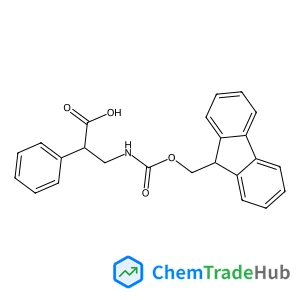
(S)-3-((((9H-Fluoren-9-yl)methoxy)carbonyl)amino)-2-phenylpropanoic acid
CAS Number:
1217663-60-9
Molecular Formula:
C24H21NO4
Leonardo Muñoz-Rugeles, Annia Galano, Juan Raúl Alvarez-Idaboy
The results presented in this work demonstrate the high complexity of chemical reactions involving species with multiple acid–base equilibria. For the case study investigated here, it was necessary to consider two radical species for tryptophan (Trp(−H)˙ and Trp˙+) and three fractions for uric acid (H3Ur, H2Ur− and HUr2−) in order to properly reproduce the experimental results. At pH = 7.4, two main reaction mechanisms were identified: proton–electron sequential transfer (PEST) and sequential proton gain-electron transfer (SPGET). Combined, they account for more than 99% of the overall reaction, despite the fact that they involve minor species, i.e., H3Ur and Trp˙+, respectively. The excellent agreement between the calculated overall rate constant and the experimental value seems to support this proposal. In addition, if only the dominant species at pH = 7.4 (H2Ur− and Trp(−H)˙) were considered, there would be a large discrepancy with the experimental value (about 4 orders of magnitude), which also supports the finding that the key species in this case are not the most abundant ones. The influence of the pH on the kinetics of the investigated reaction was explored. It was found that the maximum repairing ability of uric acid does not occur at physiological pH, but at a more acidic pH (pH = 5.0).
Alexandre Simula, Fernando Ruipérez, Nicholas Ballard, José R. Leiza, José M. Asua
DOI: 10.1039/C8PY00900G
Bingkun Yan, Jiaqian Hou, Chao Wei, Yan Xiao, Meidong Lang, Farong Huang
DOI: 10.1039/D0PY00031K
Andrew B. Ryzhkov, Parisa A. Ariya
DOI: 10.1039/B408414D
Bobing Hu, Yunlong Wang, Zhuoying Zhu, Changrong Xia
DOI: 10.1039/C5TA00510H
Aäron G. Vandeputte, Maarten K. Sabbe, Marie-Françoise Reyniers, Guy B. Marin
DOI: 10.1039/C2CP41114H
Weijun Zhang, Kunxi Zhang, Shifeng Yan, Jie Wu, Jingbo Yin
DOI: 10.1039/C8TB01981A
Zhangping Shi, Yangxia Wang, Huanlei Lin, Hongbin Zhang, Meikun Shen, Songhai Xie, Yahong Zhang, Qingsheng Gao, Yi Tang
DOI: 10.1039/C6TA01900E
Z. Stoeva, C. T. Imrie, M. D. Ingram
DOI: 10.1039/B208552F
Malay Pramanik, Asim Bhaumik
DOI: 10.1039/C3TA12476B
When considering alternatives to 1-(4-Chlorophenyl)-N-hydroxymethanimine (CAS: 3...
This compound should be stored in a cool, dry place away from direct sunlight. I...
3-(4-Bromophenyl)-5-(2-fluorophenyl)-1,2,4-oxadiazole is synthesized through a m...
5-Chloro-2-(4-chlorophenyl)-4-methyl-6-[3-(1-piperidinyl)propoxy]pyrimidine (CAS...
2-Chloro-4-(difluoromethoxy)pyridine is used in the pharmaceutical industry for ...
3-Chloro-6-methylpyridazine (CAS: 1121-79-5) is classified under the Globally Ha...
Several alternatives can be used in the synthesis of Methyl 4,5-dimethyl-2-nitro...
Alternatives to (2E,2'E)-3,3'-(1,4-Phenylene)bisacrylaldehyde include other acry...
3-Amino-5-chloropyridin-2-ol hydrochloride is an organic compound with the CAS n...
When handling 6,7-Difluoro-2,3-dihydro-4H-chromen-4-one, it is essential to wear...

Physical Chemistry Chemical Physics (PCCP) is an international journal co-owned by 19 physical chemistry and physics societies from around the world. This journal publishes original, cutting-edge research in physical chemistry, chemical physics and biophysical chemistry. To be suitable for publication in PCCP, articles must include significant innovation and/or insight into physical chemistry; this is the most important criterion that reviewers and Editors will judge against when evaluating submissions. The journal has a broad scope and welcomes contributions spanning experiment, theory, computation and data science. Topical coverage includes spectroscopy, dynamics, kinetics, statistical mechanics, thermodynamics, electrochemistry, catalysis, surface science, quantum mechanics, quantum computing and machine learning. Interdisciplinary research areas such as polymers and soft matter, materials, nanoscience, energy, surfaces/interfaces, and biophysical chemistry are welcomed if they demonstrate significant innovation and/or insight into physical chemistry. Joined experimental/theoretical studies are particularly appreciated when complementary and based on up-to-date approaches.
![(2S)-2-{[(9H-Fluoren-9-ylmethoxy)carbonyl]amino}-4-(methylselanyl)butanoic acid structure](https://static.chemtradehub.com/structs/121/1217852-49-7-f252.webp "(2S)-2-{[(9H-Fluoren-9-ylmethoxy)carbonyl]amino}-4-(methylselanyl)butanoic acid structure")
![[4-(Isobutyrylamino)phenyl]boronic acid structure](https://static.chemtradehub.com/structs/874/874219-50-8-6ab5.webp "[4-(Isobutyrylamino)phenyl]boronic acid structure")



