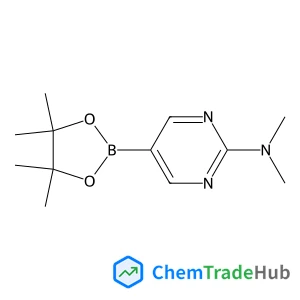
N,N-Dimethyl-5-(4,4,5,5-tetramethyl-1,3,2-dioxaborolan-2-yl)-2-pyrimidinamine
CAS Number:
1032759-30-0
Molecular Formula:
C12H20BN3O2
The first page of this article is displayed as the abstract.
Qing Wang, Xiaohai Yang, Kemin Wang, Weihong Tan, Jun Gou
DOI: 10.1039/B803239D
Soyab A. Patel, Felicity Currie, Nalin Thakker, Royston Goodacre
DOI: 10.1039/B809441A
Joseph R. Lakowicz, Krishanu Ray, Mustafa Chowdhury, Henryk Szmacinski, Yi Fu, Jian Zhang, Kazimierz Nowaczyk
DOI: 10.1039/B802918K
Rosaria Ciriminna, Mario Pagliaro
DOI: 10.1039/B819417C
Atsushi Urakawa, Franz Trachsel, Philipp Rudolf von Rohr, Alfons Baiker
DOI: 10.1039/B808984C
Juris Meija, Laurent Ouerdane, Zoltán Mester
DOI: 10.1039/B814388A
Maarten Scholtes-Timmerman, Alex van Belkum
DOI: 10.1039/B811596F
Takashi Suzuki, Hirohito Ueno, Junichi Nemoto, Yuki Fujii, Mikio Hoshino, Masao Kaneko
DOI: 10.1039/B822512E
Guixin Li, Hongyan Nan, Xingwang Zheng
DOI: 10.1039/B816226C
When considering alternatives to 1-(4-Chlorophenyl)-N-hydroxymethanimine (CAS: 3...
This compound should be stored in a cool, dry place away from direct sunlight. I...
3-(4-Bromophenyl)-5-(2-fluorophenyl)-1,2,4-oxadiazole is synthesized through a m...
5-Chloro-2-(4-chlorophenyl)-4-methyl-6-[3-(1-piperidinyl)propoxy]pyrimidine (CAS...
2-Chloro-4-(difluoromethoxy)pyridine is used in the pharmaceutical industry for ...
3-Chloro-6-methylpyridazine (CAS: 1121-79-5) is classified under the Globally Ha...
Several alternatives can be used in the synthesis of Methyl 4,5-dimethyl-2-nitro...
Alternatives to (2E,2'E)-3,3'-(1,4-Phenylene)bisacrylaldehyde include other acry...
3-Amino-5-chloropyridin-2-ol hydrochloride is an organic compound with the CAS n...
When handling 6,7-Difluoro-2,3-dihydro-4H-chromen-4-one, it is essential to wear...

Physical Chemistry Chemical Physics (PCCP) is an international journal co-owned by 19 physical chemistry and physics societies from around the world. This journal publishes original, cutting-edge research in physical chemistry, chemical physics and biophysical chemistry. To be suitable for publication in PCCP, articles must include significant innovation and/or insight into physical chemistry; this is the most important criterion that reviewers and Editors will judge against when evaluating submissions. The journal has a broad scope and welcomes contributions spanning experiment, theory, computation and data science. Topical coverage includes spectroscopy, dynamics, kinetics, statistical mechanics, thermodynamics, electrochemistry, catalysis, surface science, quantum mechanics, quantum computing and machine learning. Interdisciplinary research areas such as polymers and soft matter, materials, nanoscience, energy, surfaces/interfaces, and biophysical chemistry are welcomed if they demonstrate significant innovation and/or insight into physical chemistry. Joined experimental/theoretical studies are particularly appreciated when complementary and based on up-to-date approaches.